Email: blogagri2@gmail.com

Best Compost for Vegetable Gardens: Choosing and Using Finished Compost
Learn how to choose finished compost, compare homemade and purchased options, check contamination risks, and calculate how much your vegetable beds need.

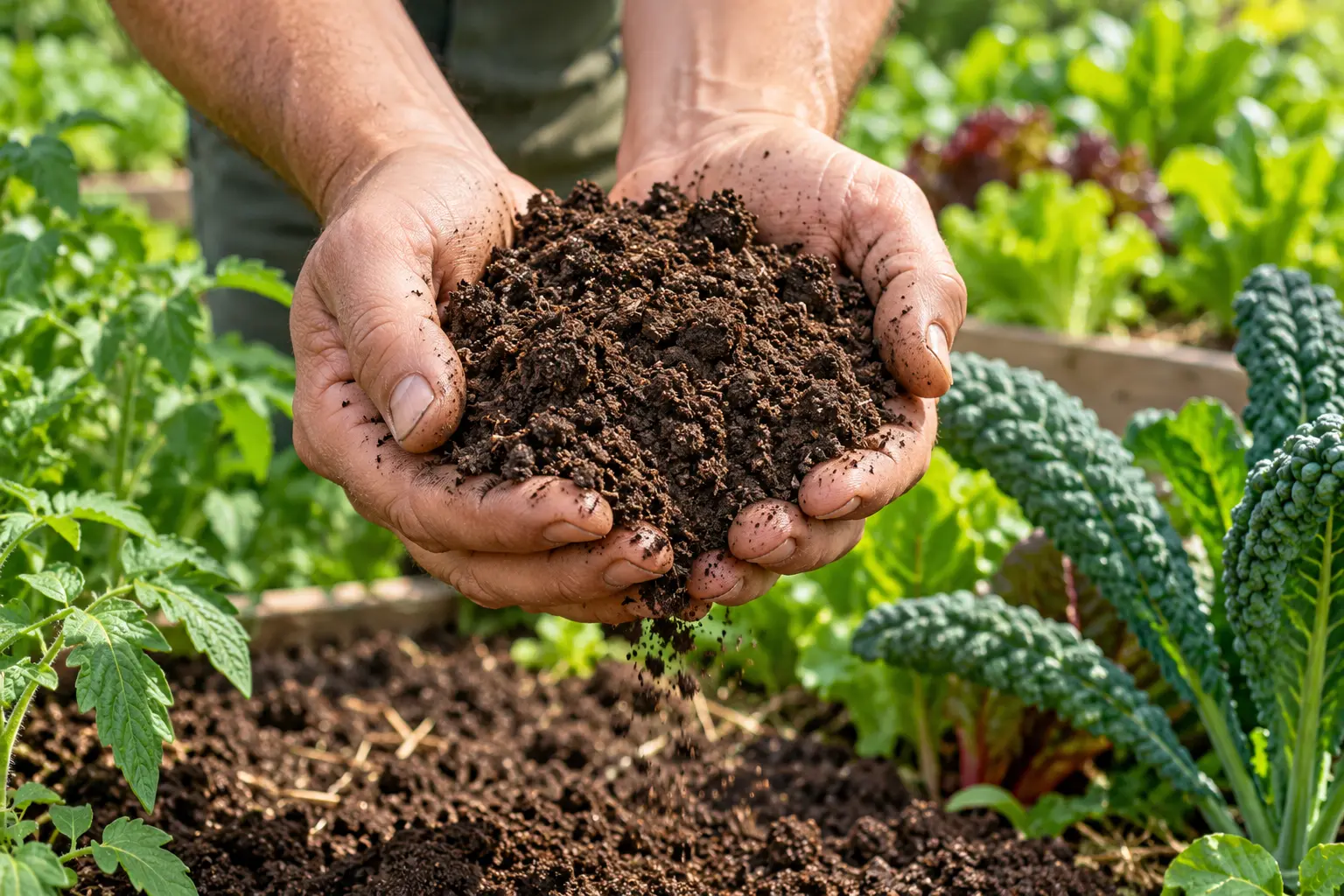
A good compost can make a noticeable difference in a vegetable garden. It can help sandy soil hold moisture, improve the structure of compacted ground, and support the organisms that gradually release nutrients to plant roots.
But choosing compost is not as straightforward as picking up the darkest bag at a garden center.
Two products may both be labeled “organic compost” yet contain very different materials. One might be made primarily from leaves and yard waste. Another could contain poultry manure, food scraps, or a mixture of several ingredients. Both may be useful, but they won’t necessarily behave the same way once you add them to your garden.
For most home vegetable gardens, mature, well-processed plant-based compost from a reliable source is a sensible choice for improving soil organic matter. Properly composted manure can also be valuable when your soil needs additional nutrients, provided the product is safe and its nutrient content suits the garden.
The best compost for vegetable gardens is not necessarily the richest, cheapest, or most expensive option. It is the compost that solves a genuine soil problem without creating another one.
This guide explains how to compare different types of compost, recognize a finished product, interpret compost labels, avoid contamination, and work out how much to apply to your vegetable beds.
What Does Compost Actually Do for Vegetable Garden Soil?
Compost is organic material that has decomposed through the activity of microorganisms and other decomposers. Its ingredients may include leaves, grass clippings, crop residues, food scraps, and properly managed animal manure.
During decomposition, much of the original material breaks down into a darker, more stable substance that can be added to soil.
Its greatest value is not simply that it contains nutrients. Compost also changes the physical conditions in which vegetable roots grow.
In sandy soil, organic matter can improve moisture retention. Instead of water passing rapidly through coarse particles, the soil can hold more moisture for plants to use.
In clay-rich soil, well-managed organic matter can encourage better aggregation. Soil particles become arranged into small clusters, creating spaces for air and water movement. Over time, this can make heavy ground easier to manage.
Compost also supplies food for soil organisms. As these organisms break down organic material, nutrients are released and cycled through the soil.
The University of Minnesota Extension’s soil-health guidance explains why organic matter, reduced compaction, soil cover, and healthy root systems work together.
Compost is not the same as garden soil, mulch, or potting mix
These materials are sometimes confused because they are all sold near one another in garden centers.
| Material | Main purpose | Best use |
|---|---|---|
| Garden soil | Provides a mineral-based rooting environment | In-ground vegetable beds |
| Finished compost | Improves soil organic matter and contributes nutrients | Amending suitable existing soil |
| Raised-bed mix | Provides a complete growing medium | Filling raised beds |
| Potting mix | Provides moisture retention and aeration in containers | Pots, grow bags, and planters |
| Mulch | Protects the soil surface | Conserving moisture and reducing weeds |
Compost is usually an ingredient or amendment, not a complete replacement for soil.
For example, a raised bed filled entirely with compost may settle substantially and develop nutrient or salt problems. A more balanced growing medium contains suitable mineral soil or other structural ingredients alongside finished compost.
If you are constructing a new growing area, BlogAgri’s raised-bed design guide explains soil depth, drainage, and material selection.
Which Type of Compost Is Best for Vegetable Gardens?
The answer depends on what your garden needs.
A newly established bed with poor structure may benefit from a different compost than a garden that has received manure and fertilizer for several years.
Before buying anything, consider whether your main goal is improving soil structure, supplying nutrients, maintaining an established bed, or preparing a new raised-bed mixture.
1. Plant-based compost: A practical choice for improving soil
Plant-based compost is commonly made from fallen leaves, grass clippings, garden trimmings, and other plant materials.
When these ingredients are properly decomposed, the resulting compost can provide organic matter without necessarily delivering large amounts of fertilizer nutrients.
That distinction matters.
Suppose your garden already contains enough phosphorus and potassium, but the soil becomes hard after rain or dries too quickly in summer. Adding nutrient-rich manure compost may increase nutrients you don’t need.
A mature plant-based compost could be more suitable because your main objective is improving soil structure.
University of Maryland Extension specifically distinguishes between compost selected to increase organic matter and compost selected to supply nutrients.
Plant-based compost is worth considering for vegetable beds growing tomatoes, beans, peppers, leafy greens, and root vegetables. However, no ingredient list alone guarantees suitability.
A poorly finished leaf compost can still contain undecomposed material, while yard waste from an unknown source may carry unwanted residues.
Check how the material was made and whether it has finished decomposing.
2. Composted manure: Useful, but often richer in nutrients
Manure-based compost may come from cattle, horses, poultry, sheep, or other suitable livestock sources.
Properly processed manure can provide organic matter together with nitrogen, phosphorus, potassium, and other nutrients.
This can be useful when a soil test identifies nutrient deficiencies. However, nutrient concentrations vary significantly between products.
Poultry-manure compost, for example, may have a different nutrient profile from cattle-manure compost. The manure source, bedding materials, moisture content, and composting process all influence the final product.
There is another consideration: repeated manure applications can gradually increase soil phosphorus and soluble salts.
The University of Minnesota Extension explains problems caused by excessive compost and manure, including nutrient imbalances that can be difficult to correct.
If your garden has already received manure for several seasons, test the soil before adding more.
Agricultural insight: A compost with higher nutrient numbers is not automatically better. If your garden already contains abundant phosphorus, adding a phosphorus-rich amendment may be unnecessary even when the product is marketed as a premium organic fertilizer.
3. Homemade compost: More control over the ingredients
Making compost at home can be an economical way to reuse suitable garden and kitchen materials.
You can combine carbon-rich ingredients such as dried leaves with nitrogen-rich materials such as fresh grass clippings and vegetable scraps.
The advantage is knowing what went into the pile.
However, homemade compost requires more than allowing waste to sit in a container.
Decomposition depends on adequate moisture, oxygen, ingredient balance, and time. A well-managed pile may heat considerably during active composting, but it must also finish decomposing before sensitive plants are exposed to the material.
The University of Maryland Extension’s home-composting guide explains the composting process, turning, moisture management, and curing.
One practical approach is to maintain separate batches.
Keep adding fresh material to an active compost bin while allowing another batch to finish and cure without new additions. This makes it much easier to determine which material is ready for the vegetable garden.
If you’re planning your own compost mixture, BlogAgri’s Compost Carbon-to-Nitrogen Calculator can help estimate the starting ratio of two ingredients by dry weight.
Remember that an estimated starting C ratio does not confirm that the final compost is mature, pathogen-free, or suitable for immediate use.
4. Worm castings and vermicompost: Useful for smaller applications
Vermicompost is produced through the combined action of earthworms and microorganisms.
It is often sold in smaller quantities and can be convenient for seedling production or as one ingredient in a growing mixture.
However, worm castings vary in nutrient concentration and soluble-salt content. They should not automatically replace a balanced potting mix or a complete soil-fertility program.
For a large vegetable garden, buying enough worm castings to improve every bed may be unnecessarily expensive.
A better approach is to compare the actual product analysis, intended use, quantity, and cost with suitable finished compost.
5. Bagged versus bulk compost
Bagged compost is convenient when you have one or two small raised beds.
You can purchase a measured quantity, transport it easily, and avoid storing a large pile of leftover material.
Bulk compost becomes more practical as the growing area increases. A landscape supplier may sell it by the cubic yard and deliver it directly to your property.
Neither option guarantees quality.
A bag with attractive branding may contain inconsistent material, while an established bulk supplier may provide excellent compost with documented testing.
For a substantial order, ask for a representative sample and information about the ingredients, processing, and recent test results.
How to Tell Whether Compost Is Finished and Ready to Use
Compost should be allowed to complete its active decomposition and curing process before it is used in situations where immature material could injure plants.
You don’t need to identify every microorganism in a compost pile, but several observations can help you recognize obvious problems.
Look at the texture
Finished compost generally has a relatively uniform, crumbly appearance.
You should not see large quantities of recognizable food scraps or fresh green material.
A few small woody pieces may remain, particularly in compost made from leaves or woody garden waste. That does not automatically make the entire batch unusable.
However, a product containing numerous large, undecomposed fragments may be unsuitable for preparing fine seedbeds.
Check the smell
Good finished compost normally smells earthy rather than sharp, sour, or rotten.
A strong ammonia smell can indicate that the material is not properly stabilized or that nitrogen-rich material has been poorly managed.
A sour or unpleasant smell may indicate insufficient oxygen or other unfavorable composting conditions.
If a bag releases a strong offensive odor when opened, do not assume it is ready simply because the label says “finished.”
Consider temperature and stability
During active composting, microorganisms release heat as they decompose organic material.
Once the readily decomposable materials have been processed and the compost has cured, the pile should become more stable.
Material that repeatedly becomes hot again after turning may require further decomposition.
However, temperature by itself is not a reliable safety test. A cool pile may also be inactive because it is too dry, too wet, or otherwise unsuitable for microbial activity.
Ask whether the compost was cured
Curing is the period following active composting during which the material continues to stabilize.
This stage matters because compost that appears dark may still contain compounds capable of injuring young plants.
When purchasing commercial compost, ask whether the batch has completed an appropriate curing process.
Oregon State University’s guide to interpreting compost analyses explains the difference between maturity and stability, including how laboratory measurements help evaluate them.
Field tip: If you make compost at home, mark the date when you stop adding fresh materials to a particular batch. Keeping separate batches prevents fresh scraps from becoming mixed with material you are preparing to use.
How to Choose the Best Bagged Compost for a Vegetable Garden
A useful compost label should tell you more than whether the product is organic or natural.
Before placing a bag in your cart, take a moment to examine the ingredients and application instructions.
Check the ingredient list
Identify whether the compost contains plant residues, manure, food waste, wood-based materials, or a mixture.
Different ingredients can produce composts with different nutrient concentrations, textures, and salt levels.
When the label gives no meaningful information, contact the manufacturer or consider a more transparent product.
Look for maturity and quality information
A supplier should be able to explain the composting process and whether the material has been assessed for maturity.
Laboratory information may include organic matter, pH, electrical conductivity, nutrients, carbon-to-nitrogen ratio, and indicators of compost stability.
Penn State’s Compost Testing Service describes several of these measurements.
You do not need to become a laboratory technician to buy a few bags of compost. But these tests are particularly useful when purchasing bulk material for multiple beds.
Understand soluble salts
Soluble salts are especially important when compost will be used near germinating seeds, young transplants, or inside containers.
Some manure-based and spent-mushroom composts contain higher soluble-salt levels.
Salt-sensitive plants may develop poor germination, slowed growth, or leaf injury when exposed to unsuitable concentrations.
A compost can be mature yet still contain excessive salts for a particular application.
This is why maturity and salinity should be evaluated separately.
Compare actual volume and cost
Compost is commonly sold in cubic feet when bagged and cubic yards when delivered in bulk.
A larger-looking bag may contain less material than another product, so compare the stated volume.
For example, if a garden needs 6 cubic feet of compost, you would need three 2-cubic-foot bags or six 1-cubic-foot bags.
Also consider delivery charges and whether a large bulk purchase would leave material unused.
For beginners, purchasing a smaller quantity first may be worthwhile if it allows you to inspect the product before investing in a truckload.
Important Compost Safety Checks Before You Use It
Most gardeners think about nutrients and soil structure when choosing compost. It is equally important to consider where the ingredients came from.
Poor-quality material can introduce problems that are difficult to correct once the compost has been spread throughout a vegetable bed.
Persistent herbicide residues
Some herbicides used on pastures, hay fields, and other vegetation can persist in treated plant material.
Those residues may be carried into compost through grass clippings, hay, straw, or livestock manure.
Certain herbicides are particularly damaging to sensitive broadleaf crops such as tomatoes, beans, peas, and other vegetables.
The risk is not limited to fresh manure. Some compounds may remain active even after conventional composting.
NC State Extension’s herbicide carryover guide explains how contaminated material enters gardens and why the problem is not always obvious before planting.
Ask suppliers about the treatment history of the materials they accept, particularly manure and hay-derived ingredients.
If you suspect contamination, a comparative plant-growth bioassay may help identify possible herbicide injury. Follow a recognized procedure, such as the NC State Extension bioassay method.
A bioassay is a screening method, not a guarantee that compost is free from all chemical contaminants, pathogens, or heavy metals.
Raw manure versus properly composted manure
Raw, aged, and composted manure are not interchangeable.
Raw manure may contain microorganisms that present food-safety risks, especially when it comes into contact with vegetables eaten raw.
Aged manure may have been stored for months without undergoing a controlled composting process.
University of Minnesota Extension explains why successful manure composting depends on managing temperature, oxygen, moisture, and ingredients rather than simply waiting.
For vegetable gardens, choose reliably processed manure compost from a known source whenever possible.
If raw or aged manure is used, the University of New Hampshire Extension recommends at least 120 days between application and harvest for crops growing in or near the soil and at least 90 days for other crops.
These are risk-reduction guidelines, not proof that an unknown manure product is safe or fully composted. Follow applicable local food-safety requirements and guidance.
Physical debris and unknown feedstocks
Inspect compost for pieces of plastic, glass, metal, treated wood, and other unwanted material.
A few naturally woody fragments are different from construction waste or rubbish.
For large purchases, ask the producer how incoming materials are screened and whether the supplied batch has been tested for relevant contaminants.
A dark color and earthy smell do not establish freedom from heavy metals or other invisible contaminants.
Safety note: If the compost source is unknown, particularly where industrial waste or contaminated material might have entered the feedstock, request more information before using it in a food garden.
How Much Compost Should You Add to a Vegetable Garden?
The amount of compost matters just as much as the type.
Adding a generous layer may seem beneficial, especially when preparing a new garden. But repeated heavy applications can cause nutrients and salts to accumulate.
A better starting point is to identify the condition of your existing soil.
For a new garden with poor soil structure
A newly established bed with low organic matter may benefit from incorporating compost into the upper soil layer.
University of Minnesota Extension describes incorporating approximately 1–2 inches of compost into the upper 6–8 inches of soil as an approach for improving compacted soil in flower and vegetable gardens.
Oregon State Extension provides a different, more substantial initial application example for new vegetable beds, followed by lower maintenance amounts for established gardens.
These recommendations illustrate why application depth should depend on the soil, compost quality, and management objective.
Do not treat the highest suggested amount as a universal target.
For an established garden
A bed that has received compost regularly for many years may already contain substantial organic matter and more phosphorus than the plants require.
In that situation, adding another thick layer could be unnecessary.
Test the soil before making major repeat applications. Pay particular attention to nutrient recommendations and any history of manure or high-salt compost use.
For an established bed that needs only modest maintenance, a lighter surface application may be sufficient when supported by local guidance.
And sometimes the right amount is no additional compost at all.
For raised vegetable beds
Compost should normally be one component of a suitable raised-bed growing medium rather than the entire filling material.
A mineral-soil-and-compost blend is often a practical option, provided the components are safe and have appropriate drainage and nutrient characteristics.
For example, Oregon State Extension describes using up to about 25% compost by volume in certain raised-bed filling situations.
This is a context-specific example, not a guarantee that every commercial soil or compost will perform well at that proportion.
Read BlogAgri’s guide to designing and filling raised garden beds for a fuller explanation of bed construction and growing-medium selection.
How to Calculate Compost for Raised Beds and Vegetable Gardens
Once you have decided how deep a layer your soil actually needs, you can calculate the required volume.
For a rectangular garden, use:
Compost volume (cubic feet) = Length (feet) × Width (feet) × Depth (inches) ÷ 12
The division by 12 converts the application depth from inches to feet.
Example: A 4 × 8-foot vegetable bed
A common home-garden bed measures 4 feet wide and 8 feet long.
Its surface area is:
4 × 8 = 32 square feet
The quantity of compost depends on the depth selected.
| Compost layer | Volume required | 2-cubic-foot bags needed |
|---|---|---|
| ½ inch | 1.33 cubic feet | 1 bag |
| 1 inch | 2.67 cubic feet | 2 bags |
| 2 inches | 5.33 cubic feet | 3 bags |
Bag counts are rounded up to whole bags. These figures show quantities, not recommended application rates.
For example, if your soil-test and extension guidance support a 1-inch application, you need approximately 2.67 cubic feet of compost.
If you buy 2-cubic-foot bags, two bags provide 4 cubic feet, leaving some for another suitable application.
How many cubic yards of compost do you need?
Bulk compost is commonly sold by the cubic yard.
One cubic yard contains 27 cubic feet.
Suppose you are covering a 10-by-20-foot garden with a 1-inch layer.
First calculate the cubic feet:
10 × 20 × 1 ÷ 12 = 16.67 cubic feet
Then convert to cubic yards:
16.67 ÷ 27 = approximately 0.62 cubic yards
Confirm how your supplier measures and delivers material, and account for any genuine site variation or handling requirements.
BlogAgri’s Topsoil Calculator can also calculate a rectangular volume from length, width, and depth. Its geometric volume calculation can help with compost ordering when you enter the chosen compost layer depth, although the tool is primarily designed for topsoil.
How to Apply Compost Without Damaging Your Vegetable Beds
Even good compost can be used poorly.
Before spreading it, make sure the garden has a suitable drainage pattern and that you are not attempting to correct a serious physical problem with compost alone.
Step 1: Start with a soil assessment
Check whether your garden suffers from excessive drying, poor drainage, hard clods, or restricted root growth.
Review the latest soil-test recommendations.
If the soil already has excessive phosphorus or soluble salts, seek locally appropriate advice before adding nutrient-rich compost.
The University of Maryland Extension’s soil-testing guide explains what routine soil tests can reveal.
Step 2: Remove weeds and prepare the area
Remove persistent weeds before applying compost.
If the bed is compacted, address the cause rather than repeatedly cultivating it when wet.
Create permanent walking paths where practical to prevent further compaction.
Step 3: Measure and spread evenly
Calculate the appropriate amount, then spread the compost across the intended area.
Avoid placing a large quantity in individual planting holes while leaving the surrounding soil unimproved.
An even application provides more consistent growing conditions.
Step 4: Decide whether to incorporate or surface-apply
When establishing a new bed, some extension recommendations call for incorporating compost into the upper soil layer.
In established beds, especially where roots are already growing, surface application may avoid unnecessary disturbance.
Choose the method according to the garden’s condition and crop stage.
Do not dig through active root systems simply to mix compost into the soil.
Step 5: Keep stems and crowns clear
Do not pile compost tightly around plant stems or crowns.
Leave an appropriate clearance to reduce the chance of prolonged moisture against sensitive plant tissues.
Step 6: Water appropriately and observe
After application, manage soil moisture according to plant needs.
Over the following weeks, watch how the soil handles water and whether plants show any unexpected symptoms.
Record the compost source, amount, date, and any test results.
These notes become valuable when deciding whether another application is necessary next season.
After preparing the soil, use an appropriate surface covering if your garden needs better moisture conservation or weed control. BlogAgri compares several materials in its Best Mulch for Vegetable Gardens guide.
Can Compost Replace Fertilizer?
Compost can supply plant nutrients, but it does not always deliver them in the amounts or at the times vegetables require.
Many nutrients in compost are present in organic forms. Their availability depends partly on decomposition and nutrient cycling.
A garden growing leafy greens may need additional nitrogen even when compost has improved the soil structure.
Conversely, a garden with high phosphorus may not benefit from additional manure compost or a general-purpose fertilizer containing phosphorus.
This is why compost and fertilizer should be considered together rather than treated as separate, unlimited inputs.
The University of Maryland Extension’s vegetable fertilization guidance recommends matching fertilizer choices to soil-test information.
If you are comparing commercial fertilizer products, BlogAgri’s 19-19-19 Fertilizer Guide explains how NPK analysis works and why equal nutrient percentages do not suit every soil.
The practical lesson is straightforward: don’t spread a heavy layer of nutrient-rich compost and then automatically apply a full fertilizer program without considering what both materials contribute.
Common Compost Problems and How to Avoid Them
When vegetables struggle after compost application, compost is not always the cause. Weather, watering, root damage, and disease can produce similar symptoms.
Still, certain patterns are worth investigating.
| Problem | Possible explanation | What to do |
|---|---|---|
| Seeds germinate poorly after compost application | Immature compost, excessive salts, unsuitable planting conditions | Check compost maturity, soil moisture, and salinity where appropriate |
| Plants grow slowly after adding woody material | Possible nitrogen immobilization if high-carbon material was incorporated | Review material type, C information, and soil fertility |
| Leaf edges look burned | Possible excess salts or fertilizer injury | Stop unnecessary additions and request appropriate testing |
| Tomatoes or beans show twisted new growth | Possible herbicide carryover, among other causes | Review amendment history and seek extension diagnosis |
| Soil becomes overly rich in phosphorus | Repeated nutrient-heavy compost or manure applications | Test soil and revise nutrient-management practices |
| Compost smells sour or strongly of ammonia | Material may not be sufficiently stabilized | Do not use near sensitive plants until suitability is established |
Avoid diagnosing a problem from one symptom alone.
For example, distorted tomato leaves can have several causes. An experienced extension adviser may need to distinguish herbicide injury from other environmental or biological problems.
Likewise, yellowing plants may be affected by nutrient availability, waterlogging, root disease, or temperature rather than a simple fertilizer shortage.
Three Practical Compost Decisions for Different Gardens
Example 1: A new backyard garden with heavy clay
Imagine that you are turning part of a lawn into a vegetable garden. The soil is heavy, forms firm clods, and drains slowly after rain.
Your first job is to assess drainage and compaction.
Once the soil is workable, an appropriate application of finished compost may help improve soil structure over time. Avoid cultivating the soil while it is wet, because that can create further compaction.
Plant-based compost may be useful if nutrient additions are not the primary goal.
The important point is that compost can support long-term soil improvement, but it cannot automatically overcome a restrictive subsurface layer or persistently saturated site.
Example 2: A raised bed filled with commercial soil mix
A gardener buys a premixed raised-bed soil product and wants to add several bags of compost before planting tomatoes.
That extra compost may not be necessary.
The purchased mix could already contain a substantial proportion of compost and fertilizer nutrients.
Check its composition and, where appropriate, test the growing medium before adding more.
Adding extra material merely because it is organic can disturb an otherwise suitable blend.
Example 3: An established vegetable bed amended every spring
A garden has produced vegetables for several years and receives manure compost annually.
The plants look reasonably healthy, but the gardener continues adding the same amount every season.
This is a good situation for reviewing soil-test results before another application.
If phosphorus or salts are already elevated, reducing or stopping further compost applications may be more useful than adding another layer.
These examples illustrate why soil condition and previous management matter more than a universal compost recipe.
Frequently Asked Questions
Which compost is ideal for growing peppers and tomatoes?
Tomatoes and peppers can benefit from mature, clean compost that has the right amounts of salt and nutrients. When increasing soil organic matter is the primary objective, plant-based compost is frequently worthwhile. Don’t assume that compost with a lot of manure is superior just because it has more nutrients. The choice should be based on the results of the soil test and the growing media.
Can I use 100% compost to grow vegetables?
Generally speaking, filling a regular vegetable bed with pure compost is not the greatest option. Depending on the product, it can settle, have too much salt or nutrients, or not have the mineral-soil structure required for a stable growing environment. Compost can be used as an amendment or as an appropriate part of a well-balanced growth mix.
Is compost made at home superior to compost purchased from a store?
When the materials are appropriate and the material is thoroughly broken down and cured, homemade compost can be quite good. More convenience and, in certain situations, verified laboratory testing may be provided by purchased compost. Neither choice is inherently better. Where it was made is less important than quality, maturity, ingredient history, and garden compatibility.
How frequently should I fertilize my vegetable garden using compost?
There isn’t a single application schedule that works for every garden. While a long-established bed might only require sporadic little additions or none at all, a fresh bed with inadequate soil structure might benefit from an initial treatment. Before adding additional, review prior treatments, plant performance, soil test findings, and local guidelines.
Are compost and organic fertilizer the same thing?
No, although it also provides nutrients, compost is mainly utilized as an organic soil amendment. In general, organic fertilizers are chosen to supply certain nutrients at desired rates. Although their availability and makeup vary, certain manure-based composts offer significant nutrients. Whether compost, fertilizer, or both are required can be ascertained with the aid of a soil test.
Can I tell if compost is ready by looking at its C ratio?
Not on its own. Although it does not determine maturity or safety on its own, the carbon-to-nitrogen ratio aids in describing the balance of materials and possible nitrogen behavior. Stability, ammonium and nitrate, soluble salts, and plant-response tests may also be taken into account when evaluating finished compost.
Choosing Compost That Actually Benefits Your Garden
A vegetable garden doesn’t need the richest-looking compost on the shelf. It needs soil that can support healthy roots, hold useful moisture, drain excess water, and supply nutrients in appropriate amounts.
Finished plant-based compost is often a good starting point when the goal is improving soil organic matter. Properly composted manure may be useful when additional nutrients are needed. Homemade compost can be equally valuable when its ingredients and processing are carefully managed.
Whatever you choose, take a little time to learn about the material before applying it.
Check your soil, examine the compost, and calculate the amount your garden actually needs.
Those decisions will usually do more for long-term soil health than routinely adding another thick layer each season.
If you’re preparing a raised vegetable bed, explore BlogAgri’s garden bed planning guide and use the Topsoil Calculator to estimate growing-medium quantities before purchasing materials.