Email: blogagri2@gmail.com
MOP vs SOP Fertilizer: Which Potassium Fertilizer Should You Use?

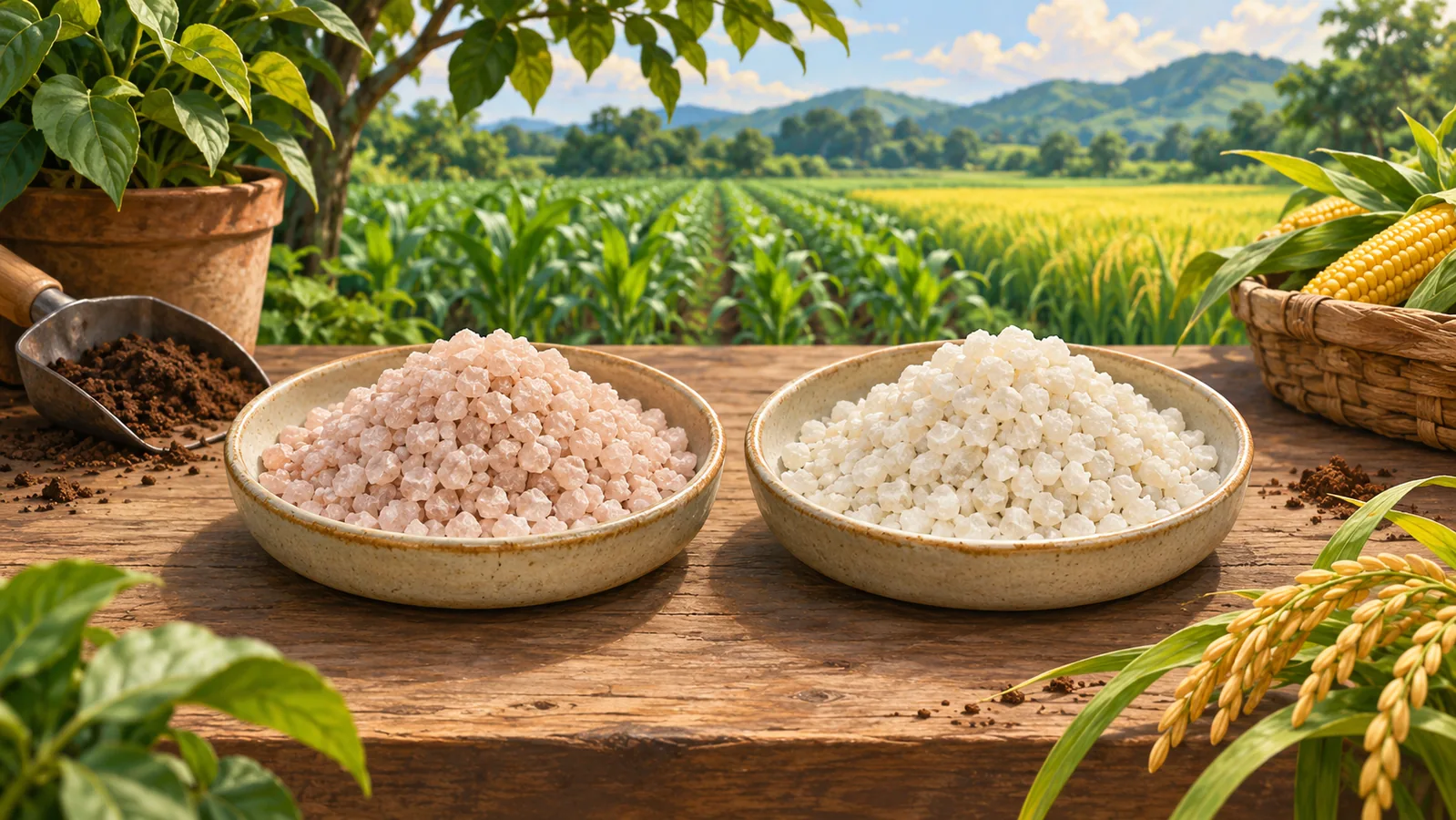
Choosing between MOP and SOP fertilizer starts with two questions: does the crop need potassium, and can the field tolerate the chloride that comes with MOP? MOP is potassium chloride, commonly labeled 0-0-60. SOP is potassium sulfate, commonly around 0-0-50, and also supplies sulfur. Neither is the best choice for every crop.
MOP is often the economical option when potassium is needed and chloride is not a constraint. SOP can justify its higher cost where chloride affects crop quality or where sulfur is also required. Begin with a soil test and a crop-specific recommendation, then compare equivalent amounts of potassium.
MOP vs SOP fertilizer: the practical differences
The final number on an N-P-K label expresses potassium as K₂O equivalent. It is a fertilizer reporting convention, rather than a statement that the bag contains potassium oxide.
| Feature | MOP | SOP |
|---|---|---|
| Chemical form | Potassium chloride (KCl) | Potassium sulfate (K₂SO₄) |
| Typical K₂O analysis | 60–62% | About 50%; some products differ |
| Accompanying nutrient | Chloride | Sulfate sulfur |
| Common reason to choose it | Economical potassium supply | Limit chloride or supply needed sulfur |
| Main check before buying | Crop tolerance and salt loading | Premium cost and actual sulfur need |
University of Minnesota Extension lists these common potassium sources and their approximate analyses. Use the guaranteed analysis on your particular bag for calculations.
When MOP makes sense
For a potassium-deficient field growing a crop that tolerates chloride, MOP is a practical starting option. It supplies more K₂O per pound of product than conventional SOP and is commonly less expensive per unit of potassium. Its red, pink, or white appearance does not establish a meaningful difference in potassium availability.
A lower purchase price is useful only if the product fits the crop and application method. Concentrated fertilizer near seeds can cause injury. The California Department of Food and Agriculture nutrient-management guide cautions against placing high potassium rates close to plant rows.
When SOP deserves consideration
SOP supplies potassium without the large chloride input associated with MOP. That matters for chloride-sensitive production and certain quality objectives. For example, Minnesota Extension notes that potassium chloride can reduce potato specific gravity compared with potassium sulfate. The importance of that response depends on the potato market and production conditions.
SOP can also contribute needed sulfur. Check the sulfur percentage on the label and count it in the full nutrient budget. If sulfur is already adequate, its presence does not automatically create a financial benefit. Neither product supplies a complete fertilizer program.
Do not assume every fruit or vegetable requires SOP. Crop, cultivar, irrigation water, drainage, fertilizer placement, and the total rate affect the decision. A locally supported recommendation is more useful than a universal list of “SOP-only” crops.
Check water quality and salinity separately
Chloride sensitivity and general salt stress are related concerns, but they are not identical. Irrigation water may already contribute chloride and other dissolved salts before fertilizer is applied. Colorado State University Extension explains why irrigation-water chemistry and crop tolerance matter.
Where salt problems are suspected, ask the laboratory or Extension adviser which soil and water tests suit your system. A routine fertility report may not answer all salinity questions. Poor drainage, high evaporation, and saline irrigation water require a broader management plan.
Common Mistake: Switching to SOP does not reclaim saline soil. SOP is still a soluble fertilizer salt. Do not increase its rate simply because it contributes less chloride.
Calculate equal potassium rates before comparing bags
Use the crop recommendation in the same nutrient units as the fertilizer label. Product needed = recommended K₂O ÷ decimal K₂O fraction. These calculations translate an established recommendation; they do not determine the crop’s requirement.
For an illustrative target of 60 lb K₂O per acre, 0-0-60 MOP would require 60 ÷ 0.60 = 100 lb of product per acre. With 0-0-50 SOP, the same target requires 60 ÷ 0.50 = 120 lb per acre. This is an arithmetic example, not a suggested field rate.
The same formula works in metric units: a target of 60 kg K₂O per hectare would require 100 kg/ha of 60% MOP or 120 kg/ha of 50% SOP. Keep pounds with pounds and kilograms with kilograms throughout the calculation.
If the chosen SOP label specifies 18% sulfur, the illustrative 120 lb of product also supplies 21.6 lb sulfur. Include that amount before adding another sulfur source. The fertilizer dosage calculator can help convert an established nutrient target into product quantity.
Compare cost per pound of K₂O
Divide the delivered bag price by bag weight multiplied by the K₂O fraction. For example, a hypothetical 50 lb bag of 0-0-60 contains 30 lb K₂O equivalent. A 50 lb bag of 0-0-50 contains 25 lb. Compare the bag prices against those nutrient quantities, rather than comparing bag prices alone.
Use current local quotes, including delivery and application costs. Then decide whether avoided chloride exposure or needed sulfur justifies the premium. A more expensive product can be worthwhile, but a higher price does not demonstrate a yield advantage.
Application and fertigation checks
Select timing and placement from guidance for your crop, soil, and region. A recommendation for a rain-fed field in Minnesota should not be transferred unchanged to a greenhouse or an irrigated field in an arid state.
For fertigation, check that the specific product is suitable for injection, and confirm its solubility, filtration requirements, and compatibility with the water and other fertilizers. CDFA notes that potassium sulfate is less soluble than potassium chloride. Do not treat every granular product as interchangeable with an injection-grade material.
Store and handle fertilizer according to its label and safety data sheet. Use measured quantities, keep records, and review crop response alongside soil or tissue testing where locally recommended.
A short buying checklist
Before ordering, record the soil-test recommendation, crop and quality objective, irrigation-water limitations, product analysis, calculated product quantity, and delivered nutrient cost. If the soil test indicates sufficient potassium, the appropriate choice may be neither MOP nor SOP.
For a broader nutrient plan, keep potassium calculations separate from the nitrogen and calcium decisions discussed in our fertilizer guides. Use the farm planning tools after establishing the agronomic recommendation, rather than using a calculator to invent one.
Choose the source that fits the field
MOP is a common economical potassium source; SOP offers a lower-chloride alternative and sulfur. Confirm the potassium need first, check crop and water constraints, then price an equivalent nutrient rate. Bring those figures to your local Extension adviser if the choice is uncertain.