Email: blogagri2@gmail.com
Commercial Agriculture: Definition, Characteristics, and Examples

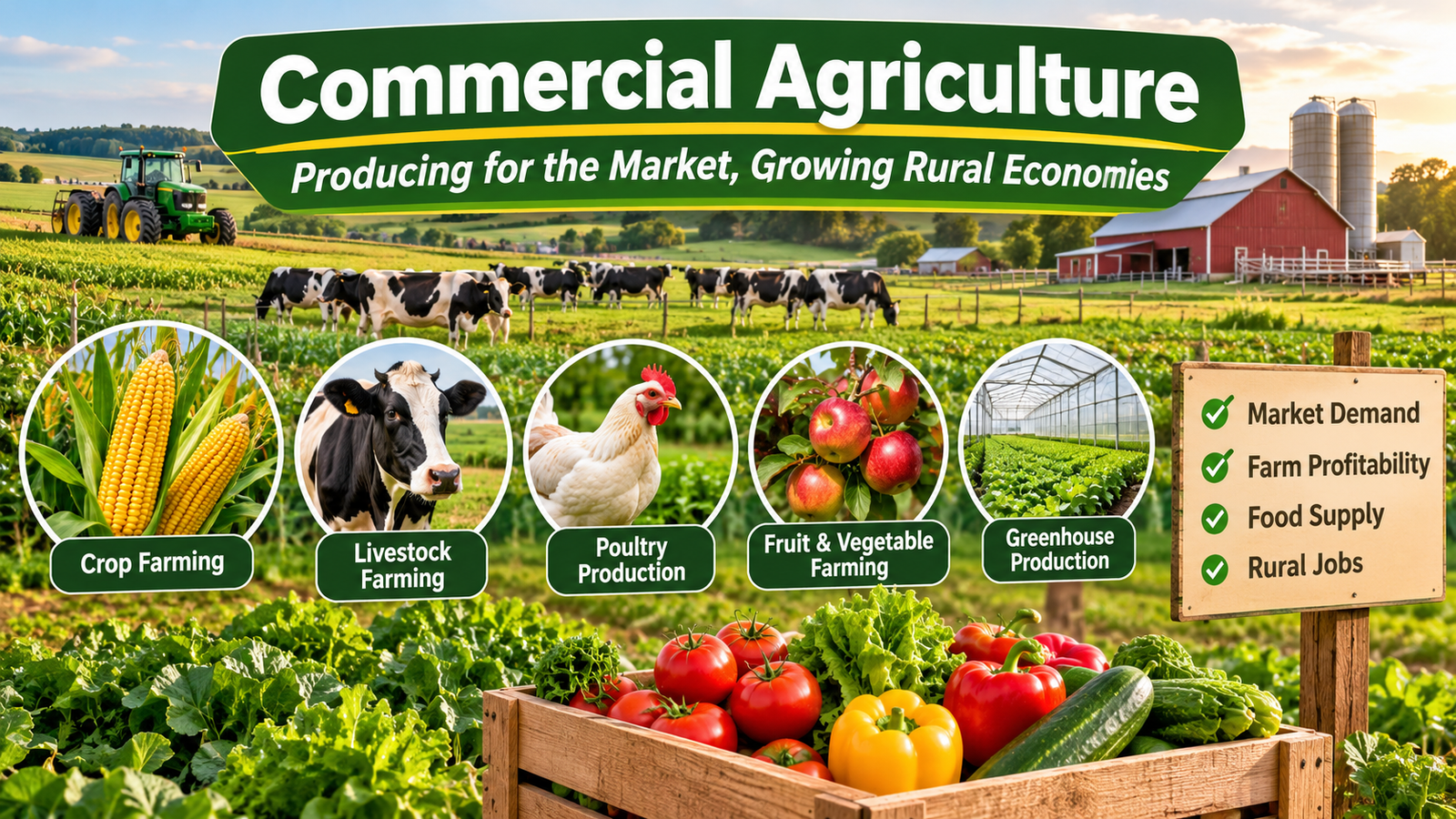
Commercial agriculture is a farming system in which crops, livestock, or other agricultural products are primarily produced for sale in markets. Farmers manage production with buyers, market demand, operating costs, and potential income in mind rather than growing everything mainly for household consumption.
Examples include corn and soybean farms, commercial dairy operations, poultry businesses, fruit orchards, vegetable farms, and greenhouse production. These businesses may operate on large or small farms, depending on their production goals, resources, and markets.
The main purpose of commercial agriculture is to produce agricultural goods for sale and generate farm revenue. However, selling agricultural products does not automatically guarantee a profit. Seed, fertilizer, feed, labor, equipment, transportation, land, and other operating expenses all affect the financial results.
Commercial agriculture plays an important role in the food supply, agricultural trade, and rural economies. Understanding its definition, characteristics, and examples helps students, farmers, and beginners recognize how market-oriented farming works.
What Is Commercial Agriculture?
Commercial agriculture is a type of agricultural production in which farmers primarily grow crops or raise livestock for sale rather than mainly for their own household use.
The U.S. Department of Agriculture’s National Agricultural Library defines commercial farms as farms that produce crops and livestock primarily for sale. This market-oriented purpose is the central feature of commercial agriculture.
Farmers may sell their products to wholesalers, processors, grocery businesses, restaurants, livestock buyers, cooperatives, or directly to consumers. The choice of market depends on the product, location, production capacity, and available distribution channels.
For example, a farmer who grows corn mainly to sell to a grain buyer is participating in commercial agriculture. A dairy producer who sells milk to a processing company is also operating a commercial agricultural business.
Commercial agriculture includes both crop and animal production. It can involve traditional field farming, specialized livestock operations, commercial horticulture, and controlled-environment production.
Main Purpose of Commercial Agriculture
The main purpose is to produce agricultural products for the market and earn revenue from their sale.
Commercial farmers make production decisions by considering factors such as:
- Market demand: Which crops or agricultural products do buyers need?
- Selling prices: What prices are available for the expected products?
- Production costs: How much will seed, fertilizer, feed, labor, machinery, and other inputs cost?
- Expected yield: How much saleable production can the farm reasonably expect?
- Product quality: What standards do buyers require?
- Market access: How will products reach buyers?
- Financial risk: What could happen if prices fall, yields decline, or production costs increase?
These decisions help farmers plan their operations as businesses rather than focusing only on producing enough food for household consumption.
What Are the Main Characteristics of Commercial Agriculture?
Commercial agriculture has several characteristics that distinguish it from farming primarily intended for household consumption. Not every commercial farm uses the same methods, but most market-oriented operations share the following features.
1. Production for the Market
The most important characteristic is that agricultural products are primarily produced for sale.
Farmers choose crops, livestock, and production quantities according to market opportunities and business objectives.
For example, a vegetable grower may produce tomatoes, peppers, and cucumbers to supply local grocery stores. A grain farmer may grow wheat or soybeans for commercial buyers.
The amount produced depends on expected demand, available resources, and the farm’s production capacity.
2. Focus on Revenue and Business Performance
Commercial farmers operate with financial objectives. They need to generate enough revenue to cover production costs and support the farm business.
However, revenue and profit are not the same.
- Revenue: Money received from selling agricultural products and other farm-related income.
- Operating costs: Expenses such as seed, fertilizer, fuel, feed, labor, repairs, and utilities.
- Profit: The financial amount remaining after relevant expenses are deducted from revenue.
For example, a farm may generate substantial revenue from selling corn but still earn a small profit if fertilizer, machinery, land, fuel, and transportation costs are high.
Commercial farmers therefore need to monitor both production and financial performance.
3. Use of Agricultural Inputs
Commercial agriculture may involve different production inputs to improve crop growth, livestock performance, and product quality.
Common inputs include:
- Improved seeds and planting materials
- Fertilizers and soil amendments
- Animal feed and nutritional supplements
- Irrigation water and equipment
- Crop protection products
- Machinery and farm tools
- Veterinary supplies
- Labor and technical services
The type and amount of inputs depend on the farming system. A small commercial vegetable farm may use hand tools and drip irrigation, while a large grain operation may depend on tractors, planters, and harvesting machinery.
4. Farm Mechanization and Technology
Many commercial farms use machinery and technology to complete production activities more efficiently.
Examples include tractors, seed drills, combine harvesters, irrigation systems, milking equipment, automated poultry feeders, and greenhouse monitoring systems.
Technology adoption varies considerably. A commercial farm does not have to use advanced machinery to qualify as commercial. The defining feature is its market-oriented production purpose.
For example, a small vegetable grower selling produce through farmers’ markets can operate commercially without owning a tractor or automated harvesting equipment.
5. Specialized or Diversified Production
Some commercial farms specialize in one main agricultural product, while others produce several crops or livestock products.
A specialized operation may focus on:
- Corn production
- Soybean farming
- Dairy cattle
- Poultry and egg production
- Apple orchards
- Greenhouse vegetables
Other farms diversify their production to serve different markets or spread production risks.
For example, a family farm may grow vegetables, maintain an apple orchard, and raise chickens for egg sales. All three activities can contribute to its commercial income.
6. Labor and Farm Management
Commercial agriculture requires planning and management of the people and resources involved in production.
Depending on the operation, farmers may use family labor, hired employees, seasonal workers, contractors, or a combination of these.
Farm management activities include:
- Planning planting and harvesting schedules
- Purchasing agricultural inputs
- Maintaining machinery and facilities
- Managing livestock health and feeding
- Organizing labor
- Keeping financial records
- Monitoring crop and livestock performance
- Arranging product sales and transportation
Larger operations may employ managers and specialized workers, while small commercial farms may be managed directly by their owners.
7. Market Access and Distribution
Producing agricultural products is only one part of commercial farming. Farmers also need reliable ways to sell and distribute their output.
Possible sales channels include:
- Agricultural cooperatives
- Grain elevators
- Food processors
- Wholesale distributors
- Grocery stores
- Restaurants
- Farmers’ markets
- Community-supported agriculture programs
- Direct-to-consumer sales
Market access influences crop selection, production schedules, harvesting, packaging, storage, and transportation decisions.
What Are the Main Types of Commercial Agriculture?
Commercial agriculture includes different production systems. The following are practical examples of market-oriented farming rather than a single official classification of farm types.
1. Commercial Crop Farming
Commercial crop farming involves growing crops primarily for sale to agricultural buyers, processors, manufacturers, or consumers.
Common crops include:
- Corn
- Soybeans
- Wheat
- Cotton
- Rice
- Sorghum
- Barley
For example, corn farmers in the United States may sell harvested grain to elevators, feed manufacturers, ethanol producers, or other buyers.
Soybean producers may supply processors that produce soybean meal and oil.
The choice of crop depends on climate, soil, growing season, expected yield, production expenses, and market demand.
2. Commercial Livestock Farming
Commercial livestock farming involves raising animals to produce products for sale.
Common livestock enterprises include:
- Beef cattle production
- Dairy farming
- Sheep farming
- Goat farming
- Hog production
Farmers manage animal feeding, breeding, housing, health, and production to meet market requirements.
For example, a beef cattle operation may raise calves for sale to other producers or feedlots, while a dairy farm produces milk for processing and distribution.
3. Commercial Poultry Farming
Commercial poultry farming focuses on producing poultry meat and eggs for sale.
Common activities include:
- Broiler chicken production
- Commercial egg production
- Turkey farming
- Duck production
Commercial poultry operations may use specialized housing, feeding equipment, ventilation, temperature control, and flock-management systems.
The production model varies. Some farmers operate independently, while others work under production contracts with poultry companies.
4. Commercial Dairy Farming
Commercial dairy farming involves raising dairy animals and producing milk for sale.
Dairy operations require regular feeding, breeding management, animal health monitoring, milking facilities, milk cooling, and hygienic handling.
Common dairy animals include:
- Holstein cattle
- Jersey cattle
- Brown Swiss cattle
Milk may be sold to dairy processors, cooperatives, or other buyers under applicable quality and delivery requirements.
The financial performance of a dairy operation depends on milk production, feed expenses, animal health, labor, equipment, and milk prices.
5. Commercial Horticulture
Commercial horticulture involves producing fruits, vegetables, flowers, nursery plants, and ornamental crops for sale.
Examples include:
- Apple orchards
- Strawberry farms
- Commercial tomato production
- Blueberry farms
- Flower-growing businesses
- Tree and shrub nurseries
Horticultural businesses may supply grocery stores, wholesalers, garden centers, florists, restaurants, and direct customers.
Some operations grow crops in open fields, while others use greenhouses, high tunnels, or other protected production systems.
6. Commercial Mixed Farming
Commercial mixed farming combines crop production and livestock activities within a farm business.
For example, a farmer may grow corn and forage crops while raising cattle. Crops can provide livestock feed, while properly managed manure can return nutrients to agricultural land.
The farm may generate revenue from both crop and animal products.
Mixed farming can diversify income and improve resource use, but it also requires additional planning, labor, animal care, and manure management.
Read BlogAgri’s guide to mixed farming in sustainable agriculture for more information.
7. Commercial Greenhouse Farming
Commercial greenhouse farming produces crops in protected structures where growers can manage conditions such as temperature, humidity, irrigation, and ventilation.
Common greenhouse crops include:
- Tomatoes
- Cucumbers
- Peppers
- Lettuce
- Herbs
- Ornamental plants
Some businesses use hydroponic systems, where plants receive nutrients through a water-based growing solution rather than conventional soil.
Greenhouse farming can extend growing seasons and provide greater control over growing conditions. However, infrastructure, energy, maintenance, and technical costs must be considered.
BlogAgri’s guide to controlled environment farming explains these systems and their practical limitations.
What Are Examples of Commercial Agriculture?
Commercial agriculture can be found in many parts of the United States. Different regions specialize in crops and livestock suited to their climate, land resources, infrastructure, and markets.
The following examples illustrate how different agricultural businesses produce goods for sale.
| Example | Agricultural activity | Products sold |
|---|---|---|
| Iowa corn farm | Commercial crop farming | Corn grain |
| Illinois soybean farm | Commercial crop farming | Soybeans |
| California dairy operation | Commercial dairy farming | Milk |
| Georgia poultry farm | Commercial poultry farming | Broiler chickens or eggs |
| Florida citrus orchard | Commercial horticulture | Citrus fruit |
| Washington apple orchard | Commercial fruit production | Apples |
| Texas beef cattle operation | Commercial livestock farming | Cattle |
| Commercial greenhouse | Protected crop production | Tomatoes, cucumbers, or peppers |
These examples represent different production models. The exact crops, products, and selling arrangements vary between individual farms.
Example 1: Corn and Soybean Production
Corn and soybean farming are common examples of commercial crop agriculture in the United States.
Farmers prepare fields, select suitable varieties, plant seeds, manage nutrients and weeds, monitor crop conditions, and harvest the crops.
The harvested grain is sold to buyers or stored for later marketing.
Corn may enter livestock feed, food processing, and industrial uses. Soybeans are processed into products such as soybean meal and soybean oil.
Farmers consider expected yields, input costs, storage expenses, transportation, and market prices when planning production.
Example 2: Commercial Dairy Production
A commercial dairy farm produces milk for sale to processors, cooperatives, or other buyers.
The operation requires a consistent feeding program, suitable housing, breeding management, veterinary care, milking equipment, and milk storage.
Milk quality and hygiene are essential because the product must meet applicable safety and buyer requirements.
Revenue depends on the amount of milk sold and the price received, while expenses include feed, labor, animal health, utilities, equipment, and facilities.
Example 3: Commercial Poultry Production
Commercial poultry farms produce chickens or eggs for the food market.
Broiler operations raise chickens for meat, while layer operations maintain flocks for egg production.
Farmers monitor flock health, feed consumption, water availability, ventilation, temperature, and biosecurity.
Some poultry producers operate independently, while others use contracts that specify production responsibilities and payment arrangements.
Example 4: Commercial Fruit and Vegetable Farming
Fruit and vegetable farms produce crops for grocery stores, restaurants, wholesale markets, food processors, and direct consumers.
For example, a Washington apple grower manages orchard trees, pruning, irrigation, pest monitoring, harvesting, grading, and storage.
A commercial vegetable grower may produce tomatoes, lettuce, peppers, or cucumbers according to seasonal demand and buyer requirements.
These farms must consider harvest timing, product quality, storage conditions, packaging, and transportation because fresh produce can deteriorate quickly.
Example 5: Small Commercial Vegetable Farming
Commercial agriculture is not limited to large farms. A small farmer who grows tomatoes, peppers, leafy greens, or other vegetables primarily for sale can also operate a commercial agricultural business.
The farmer may sell produce through farmers’ markets, local grocery stores, restaurants, or community-supported agriculture programs.
The operation may use raised beds, hand tools, small irrigation systems, and family labor rather than large machinery.
The important factor is that production is intended primarily for the market.
Commercial Agriculture vs. Subsistence Agriculture
Commercial agriculture and subsistence agriculture differ mainly in their production objectives.
Commercial agriculture primarily produces agricultural goods for sale, while subsistence agriculture focuses mainly on meeting the food and basic needs of the farming household.
However, the distinction is not always absolute. A household farm may consume some production and sell the surplus, combining subsistence and commercial activities.
The following table explains the main differences.
| Comparison factor | Commercial agriculture | Subsistence agriculture |
|---|---|---|
| Main purpose | Produce goods primarily for sale | Produce mainly for household consumption |
| Market involvement | Regular participation in markets | Limited or occasional market sales |
| Production planning | Considers demand, prices, costs, and buyers | Focuses mainly on household food needs |
| Crop selection | Often influenced by market opportunities | Often influenced by household food requirements |
| Income | Generates revenue from product sales | May generate limited income from surplus sales |
| Inputs | May use purchased seeds, fertilizer, machinery, and services | May rely more on household labor and locally available resources |
| Production scale | Can range from small to large | Often small-scale, although systems vary |
| Examples | Commercial corn farms, dairy farms, poultry businesses | Household vegetable plots and farms producing mainly for family use |
Can a Farm Combine Commercial and Subsistence Agriculture?
Yes. Many farms produce food for household consumption while also selling agricultural products.
For example, a family may grow vegetables, keep chickens, and raise a small number of livestock for household use. The same farm may sell surplus eggs, vegetables, or animals to local buyers.
This type of operation does not always fit neatly into one category.
The most useful distinction is the primary purpose of production and the role that market sales play in the farm’s activities.
What Are the Advantages of Commercial Agriculture?
Commercial agriculture supports food production, agricultural businesses, and employment. Its potential benefits depend on production efficiency, market conditions, and responsible resource management.
1. Supports Food and Raw Material Supply
Commercial farms supply agricultural products to food processors, retailers, manufacturers, and consumers.
Crops such as corn, wheat, soybeans, and cotton provide raw materials for food, feed, textiles, and other industries.
Livestock operations supply milk, meat, eggs, and other animal products.
2. Creates Employment Opportunities
Commercial agriculture supports jobs in planting, harvesting, livestock management, transportation, food processing, equipment maintenance, storage, and agricultural services.
Employment opportunities vary by farm size, production system, and season.
3. Encourages Agricultural Investment
Market-oriented farming can create reasons to invest in better seeds, irrigation, machinery, storage, transportation, and production technology.
Farmers evaluate these investments based on their expected contribution to productivity, quality, operating costs, and business performance.
4. Supports Agricultural Trade
Commercial farms supply products to local, regional, national, and international markets.
Agricultural exports can connect farmers with buyers outside their immediate communities, although access to these markets depends on quality standards, transportation, trade conditions, and regulations.
5. Supports Specialized Production
Commercial agriculture allows farmers to focus on particular crops, livestock, or production systems.
Specialization can help develop technical knowledge and efficient production processes, although depending too heavily on one commodity may increase exposure to market and production risks.
6. Encourages Improved Farm Management
Commercial operations need to monitor expenses, yields, labor, product quality, and sales.
These records help farmers compare production results and make better decisions about future crops, livestock, equipment, and marketing arrangements.
What Are the Challenges of Commercial Agriculture?
Commercial agriculture also involves financial, production, market, and environmental challenges.
1. High Production Costs
Depending on the farming system, commercial operations may need substantial spending on land, machinery, seeds, fertilizers, feed, labor, irrigation, buildings, and transportation.
Higher production costs can reduce the amount of money remaining after sales.
2. Market Price Fluctuations
Agricultural prices can change because of supply and demand, weather conditions, trade policies, transportation costs, and international market developments.
A farmer may receive a lower price at harvest than expected when planning the crop.
3. Weather and Production Risks
Drought, excessive rainfall, floods, frost, heat, pests, and plant diseases can reduce agricultural production.
Livestock operations also face risks related to animal health, feed availability, and extreme weather.
Farmers may use insurance, diversification, monitoring, and risk-management plans to reduce exposure.
4. Dependence on Agricultural Inputs
Some commercial production systems depend heavily on purchased fertilizer, fuel, feed, electricity, and other inputs.
Unexpected increases in input prices can affect production budgets and farm finances.
5. Environmental Pressure
Poorly managed agricultural activities can contribute to soil erosion, nutrient runoff, water pollution, habitat loss, and excessive water use.
Responsible commercial agriculture requires appropriate soil management, nutrient planning, water conservation, crop protection, and compliance with environmental requirements.
6. Marketing and Distribution Difficulties
Farmers may struggle to access reliable buyers, suitable storage, processing facilities, transportation, or competitive selling prices.
Fresh produce and other perishable goods require careful handling and timely distribution.
7. Financial Risk
High operating expenses, debt payments, uncertain yields, and changing commodity prices can place pressure on farm finances.
A farm can generate high sales revenue while still experiencing weak cash flow or low profitability.
Is Commercial Agriculture the Same as Intensive Farming?
No. Commercial agriculture and intensive farming describe different aspects of agricultural production.
Commercial agriculture describes the primary purpose of production: growing crops or raising animals for sale.
Intensive farming describes a production approach that generally uses relatively high levels of inputs, labor, management, or other resources per unit of land to achieve higher production.
A commercial farm may use intensive production methods, but it does not have to.
For example, a small vegetable farm selling produce at local markets is commercial even if it relies on relatively simple tools and labor.
Similarly, a large grain farm can produce crops for sale using extensive land-based production methods.
Commercial and intensive farming can overlap, but the terms are not interchangeable.
Can Small Farms Practice Commercial Agriculture?
Yes. Small farms can practice commercial agriculture when their primary production purpose is to sell agricultural products.
A small operation may generate revenue through:
- Selling vegetables at farmers’ markets
- Supplying fresh produce to restaurants
- Selling eggs to local customers
- Producing berries for direct sales
- Raising animals for meat markets
- Growing specialty herbs
- Selling seedlings and nursery plants
Small commercial farms often focus on particular products or local markets rather than competing directly with large commodity producers.
For example, a small vegetable farm may grow several varieties of tomatoes, peppers, and leafy greens for restaurants and neighborhood customers.
The farm’s commercial nature comes from its market-oriented production, not the number of acres it operates.
How Does Commercial Agriculture Work as a Business?
Commercial agriculture requires farmers to connect production decisions with financial planning and market opportunities.
A useful starting point is to understand the basic steps involved.
Step 1: Identify a Market Opportunity
Research potential buyers and determine which agricultural products have realistic demand.
Consider:
- Local consumer preferences
- Wholesale buyers
- Grocery stores
- Food processors
- Restaurants
- Seasonal demand
- Quality requirements
Avoid selecting a crop or livestock enterprise based only on its advertised selling price.
Step 2: Choose a Suitable Agricultural Enterprise
Select crops or livestock according to climate, soil, available land, water, labor, experience, and market access.
For example, a farmer with suitable land and access to grain buyers may consider field crops, while another farmer close to urban markets may consider fresh vegetables.
Step 3: Estimate Production Costs
Prepare a production budget before investing.
Include expenses such as:
- Seeds or planting materials
- Fertilizers and soil amendments
- Feed and veterinary care
- Labor
- Machinery and fuel
- Irrigation
- Buildings and equipment
- Packaging and transportation
BlogAgri’s Cash Crops for Small Farms guide explains why farmers should compare market demand, labor, climate, and production costs before selecting a commercial crop.
Step 4: Plan Production
Prepare a realistic production schedule based on crop requirements, livestock needs, weather, and buyer expectations.
Consider planting dates, animal feeding schedules, labor availability, harvesting, and storage.
Step 5: Arrange Buyers and Distribution
Identify potential buyers before production whenever possible.
Consider whether products will be sold directly, through wholesalers, under contracts, or to processing businesses.
Check buyer specifications, delivery arrangements, payment terms, and applicable food-safety requirements.
Step 6: Monitor Financial Performance
Record sales, operating expenses, production quantities, losses, and other relevant business information.
Compare actual results with the original budget to identify areas where production costs or marketing decisions need improvement.
A commercial farm should evaluate both production performance and financial results rather than judging success by total yield alone.
How Does the USDA Classify Commercial Farms?
The term commercial agriculture has a broad market-oriented meaning, but the USDA also uses specific statistical classifications when analyzing U.S. farms.
The USDA Economic Research Service (ERS) uses a farm typology based on factors such as gross cash farm income, the primary occupation of the principal farm operator, and farm ownership.
In its 2026 farm business reporting, ERS describes operations with annual gross cash farm income of $350,000 or more as commercial, while certain smaller operations where farming is the operator’s primary occupation are classified as intermediate.
This $350,000 threshold belongs to a specific USDA statistical classification. It is not a universal definition of commercial agriculture and should not be used to suggest that a smaller farm cannot produce primarily for sale.
For the latest classification details, consult the USDA Economic Research Service guide to farm structure and organization.
Frequently Asked Questions About Commercial Agriculture
What is the definition of commercial agriculture?
Commercial agriculture is a farming system in which crops, livestock, or other agricultural products are primarily produced for sale in markets rather than mainly for household consumption.
What are five examples of commercial agriculture?
Five examples are corn farming, soybean production, commercial dairy farming, poultry production, and commercial fruit orchards. Each produces agricultural goods primarily for sale.
What are the main characteristics of commercial agriculture?
Its main characteristics include market-oriented production, revenue objectives, farm planning, agricultural inputs, labor management, marketing, distribution, and financial recordkeeping. The level of machinery and technology varies between farms.
What is the main purpose of commercial agriculture?
Its main purpose is to produce agricultural products for sale and generate farm revenue. Farmers consider production costs, market demand, product quality, and expected selling prices when making decisions.
What is the difference between commercial and subsistence agriculture?
Commercial agriculture primarily produces goods for sale, while subsistence agriculture focuses mainly on meeting household food needs. Some farms combine both by consuming part of their production and selling the surplus.
Is commercial agriculture the same as intensive farming?
No. Commercial agriculture describes production for sale, while intensive farming describes a production approach involving relatively high inputs or management per unit of land. A farm can be commercial without using intensive methods.
Can small farms practice commercial agriculture?
Yes. Small farms can operate commercially by producing vegetables, fruit, eggs, flowers, or other products primarily for sale. Farm size does not determine whether production is commercial.
Why is commercial agriculture important?
Commercial agriculture supplies food and agricultural raw materials, supports employment, contributes to agricultural trade, and creates business opportunities across farming and related industries.
Does commercial agriculture include livestock farming?
Yes. Commercial agriculture includes livestock and poultry production when animals or their products are primarily raised for sale. Dairy, beef cattle, poultry, and egg production are common examples.
Is commercial agriculture always profitable?
No. Commercial agriculture is intended to generate revenue through product sales, but profitability depends on selling prices, yields, production costs, market access, and financial management.
Final Thoughts
Commercial agriculture is an important part of modern farming because it connects agricultural production with markets, businesses, and consumers.
It includes crop farming, livestock production, poultry, dairy, horticulture, mixed farming, and greenhouse operations. These businesses can operate on different scales and use different production methods, but their central purpose is to produce agricultural products primarily for sale.
Successful commercial farming requires more than producing a large harvest or raising many animals. Farmers must understand market demand, control production expenses, maintain product quality, manage resources, and plan for financial and environmental risks.
Whether operating a large grain farm or a small vegetable business, the foundation of commercial agriculture remains the same: produce goods that meet market needs while managing the resources and costs required to supply them.
