Email: blogagri2@gmail.com
Agricultural Innovation in Pakistan: How Technology is Changing Farming
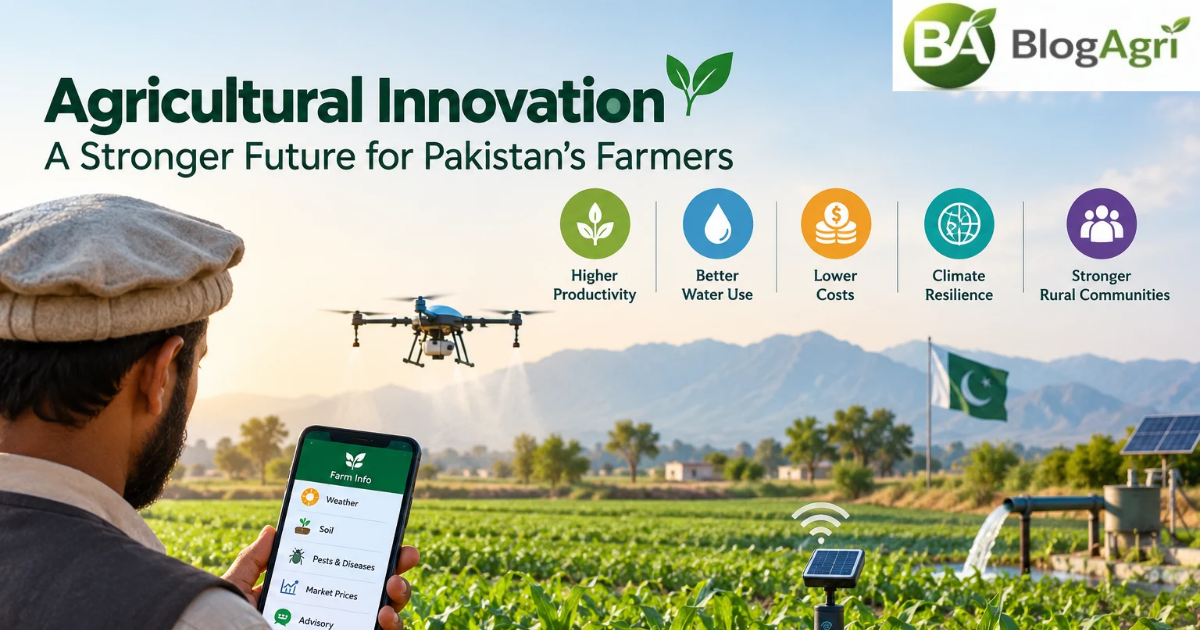
Agricultural innovation can help Pakistan’s farmers overcome challenges like water shortages, rising costs and climate change. Modern technologies such as AI, drones and smart irrigation can improve productivity, reduce expenses and create a more sustainable future for agriculture.

Agriculture is one of the most important parts of Pakistan’s economy. It provides food for the country and supports millions of people. Many families in rural areas depend on farming for their income.
But farming in Pakistan is not easy.
Farmers face many problems every year. Water is becoming harder to manage. The prices of fertilizer, seeds, diesel and pesticides are rising. Weather is also becoming less predictable. Floods, heat waves and droughts can damage crops. In many areas, farmers still use old methods because modern technology is either expensive or not easily available.
This is where agricultural innovation can help.
Agricultural innovation means finding better ways to grow crops, raise animals and manage farms. It does not always mean using expensive machines. Sometimes, a simple mobile app, better seed or improved irrigation method can make a big difference.
Pakistan has a large agricultural sector. According to the Pakistan Economic Survey 2024–25, agriculture contributed 23.54% of Pakistan’s GDP and employed more than 37% of the country’s labor force. The sector grew by only 0.56% in FY2025. Crop production actually declined, while livestock performed better.
These figures show why Pakistan needs new ideas in agriculture.
What Is Agricultural Innovation?
Agricultural innovation is the use of new ideas, methods and technology to improve farming.
It can be something very simple.
For example, a farmer may change the way he waters his field. Instead of flooding the whole field, he may use drip irrigation. This can help save water.
Another farmer may use a mobile phone to check the weather before spraying pesticides.
A livestock farmer may use digital records to keep track of animal health.
A large farm may use drones to check crops from the air.
All of these are examples of agricultural innovation.
The main purpose is to make farming:
- More productive
- Less expensive
- More efficient
- More profitable
- More resistant to climate problems
- Easier to manage
Innovation should solve real problems. It should not be technology just for the sake of technology.
Why Does Pakistan Need Agricultural Innovation?
Pakistan has a large population. People need food every day. At the same time, farmers have limited land and water.
This creates a difficult situation.
The country needs to produce more food without wasting its resources.
Water is a major concern. Farmers use a large amount of water for irrigation. In some areas, traditional irrigation methods waste a significant amount of water.
Climate change is another problem.
Farmers may face extreme heat, unusual rainfall and floods. These conditions can affect wheat, rice, cotton, maize, fruits and vegetables.
The cost of farming is also increasing.
A farmer has to pay for:
- Seeds
- Fertilizer
- Pesticides
- Diesel
- Electricity
- Labor
- Machinery
- Transport
If the crop fails, the farmer can suffer a major financial loss.
Technology cannot solve every problem. But it can help farmers make better decisions.
Traditional Farming and Modern Farming
Traditional farming depends heavily on experience.
This experience is valuable. Pakistani farmers have been farming for generations. They know their land and crops very well.
But modern technology can add another source of information.
It can provide data about weather, soil, water and crops.
| Traditional Farming | Modern Farming |
|---|---|
| Mostly depends on experience | Uses experience and data |
| Manual field checking | Sensors, satellites and drones |
| Fixed irrigation practices | Water based on crop needs |
| Manual records | Digital records |
| Pest problems found later | Early pest warnings |
| Local market information | Digital market information |
| General fertilizer use | More targeted fertilizer use |
| Weather based on observation | Weather forecasts and alerts |
Modern farming does not mean that traditional knowledge should be ignored.
The two approaches can work together.
A farmer can use his experience and also use modern information.
That can lead to better decisions.
Precision Agriculture
One of the most interesting developments in agriculture is precision farming.
The basic idea is simple.
A farmer should not treat every part of a field in exactly the same way if the conditions are different.
One part of a field may have enough water. Another part may be dry.
One area may have healthy plants. Another area may have a pest problem.
Technology can help identify these differences.
Farmers can use:
- GPS
- Satellite images
- Drones
- Soil sensors
- Weather stations
- Mobile apps
For example, a drone can fly over a wheat field and take pictures.
The pictures may show areas where plants are not growing properly.
The farmer can then inspect those areas.
This can save time and reduce unnecessary use of fertilizer and pesticides.
Smart Irrigation
Water is extremely important for Pakistani agriculture.
Many farmers still use traditional flood irrigation. Water is released into the field and spreads across the soil.
This method is simple. But it may use more water than necessary.
Modern irrigation methods include:
- Drip irrigation
- Sprinkler systems
- Soil moisture sensors
- Automated irrigation
- Laser land leveling
Drip irrigation sends water closer to the roots of plants.
This can reduce water loss.
A soil sensor can also tell the farmer when the soil is becoming dry.
The farmer does not have to depend only on guesswork.
The government has also identified water management and technologies such as solar-powered irrigation as areas of agricultural development in its 2025–26 Annual Plan.
Traditional irrigation vs drip irrigation
| Feature | Traditional Irrigation | Drip Irrigation |
|---|---|---|
| Water delivery | Across the field | Near plant roots |
| Water control | Low | High |
| Initial cost | Usually lower | Usually higher |
| Maintenance | Simple | Requires equipment |
| Suitable for | Many traditional crops | Many high-value crops |
| Technology needed | Low | Medium |
The main challenge is cost.
Small farmers may not be able to install expensive systems.
This is why government support, agricultural banks and affordable service companies can be important.
Artificial Intelligence in Agriculture
Artificial intelligence is also entering agriculture.
AI can process large amounts of information. It can then provide useful suggestions.
For example, imagine a farmer sees spots on the leaves of his tomato plants.
He takes a picture with his phone.
An AI application can examine the picture and suggest possible diseases.
The farmer can then seek confirmation from an agricultural expert.
AI can also be used for:
- Weather advice
- Pest warnings
- Disease detection
- Crop monitoring
- Yield estimates
- Irrigation advice
- Fertilizer recommendations
- Market analysis
AI can also support farmers in local languages.
This is important in Pakistan.
Not every farmer is comfortable reading technical information in English.
An agricultural application that supports Urdu, Punjabi, Sindhi, Pashto and other local languages could be much easier to use.
But AI should not replace agricultural experts.
Its advice should be treated as a useful tool. Important decisions may still need to be checked by a qualified expert.
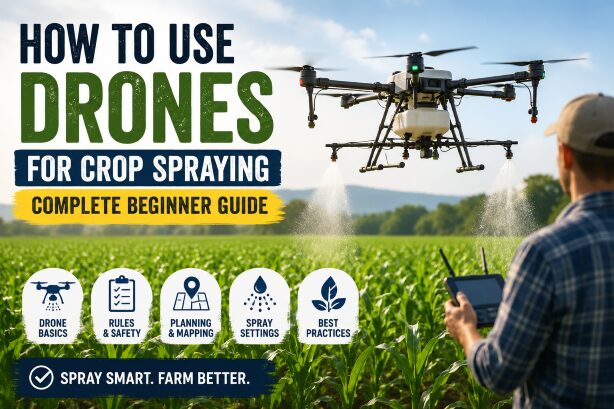
Agricultural Drones
Drones are small flying machines that can carry cameras and other equipment.
They are becoming useful in farming.
A drone can cover a large field in a short time.
Farmers can use drones to:
- Take aerial pictures
- Check crop growth
- Find dry areas
- Identify possible pest problems
- Map fields
- Monitor damage
- Spray some agricultural products
Drones can be expensive.
For this reason, farmers do not always need to own them.
A company could offer drone services to farmers.
For example, a drone operator could charge farmers according to the number of acres checked.
This would make the technology more accessible to small farmers.
Digital Agriculture
Mobile phones have changed many parts of daily life.
They can also change farming.
A farmer with a smartphone can receive information about:
- Weather
- Crop prices
- Pests
- Diseases
- Seeds
- Fertilizer
- Government programs
- Agricultural loans
- Market opportunities
Digital agriculture can also help farmers keep records.
A farmer can record how much fertilizer was purchased.
He can record when a crop was planted.
He can record how much was spent on labor.
At the end of the season, these records can help him understand whether the crop was profitable.
This is much better than relying only on memory.
Pakistan’s Proposed Agri Stack
Pakistan is also working toward greater use of digital agricultural information.
In 2025, the Ministry of IT and Telecommunications discussed the development of a national Agri Stack.
The proposed system is intended to connect different types of agricultural information. This may include farmer identity, land information, agricultural data, advisory services, credit, insurance and subsidies.
If implemented effectively, such a system could make it easier to provide services to farmers.
For example, a farmer could have a digital agricultural profile.
That profile could contain information about:
- Land
- Crops
- Production
- Loans
- Insurance
- Government support
Such information could also help financial institutions understand farmers better.
However, data privacy and security would be important.
Farmers should know how their information is collected and used.
Better Seeds
Seeds are one of the most important parts of farming.
A good seed can make a major difference.
Researchers are developing varieties that can perform better under difficult conditions.
These may include varieties that are:
- Resistant to diseases
- More tolerant to heat
- More tolerant to drought
- More tolerant to salinity
- Faster growing
- Higher yielding
This is especially important because Pakistan has different climates.
The conditions in Punjab are not the same as those in Sindh, Balochistan or Khyber Pakhtunkhwa.
A seed that performs well in one area may not perform equally well somewhere else.
Therefore, local testing is important.
Farmers also need access to good-quality seed.
The government has identified improvements in seed certification and access to quality seed as important areas for agricultural development.
Climate-Smart Agriculture
Climate change is making farming more difficult.
Farmers cannot always depend on old weather patterns.
A season may be hotter than expected.
Rain may come late.
Heavy rain may cause flooding.
A long dry period may damage crops.
Climate-smart agriculture tries to prepare farmers for these changes.
Some examples include:
- Drought-resistant crops
- Water-saving irrigation
- Better soil management
- Crop diversification
- Weather alerts
- Improved livestock housing
- Better drainage
- Conservation agriculture
The goal is not only to produce more.
The goal is also to make farms more able to handle difficult weather.
Innovation in Livestock Farming
Agriculture is not only about crops.
Livestock is also a major part of Pakistan’s agricultural economy.
Cows, buffaloes, goats, sheep and poultry provide meat, milk, eggs and other products.
According to the Pakistan Economic Survey 2024–25, livestock accounted for 14.97% of GDP and grew by 4.72% in FY2025.
Technology can improve livestock management.
Farmers can use digital systems to record:
- Animal age
- Vaccination
- Disease history
- Milk production
- Breeding information
- Feed use
Some modern farms also use sensors to monitor animals.
Early detection of disease can reduce losses.
Better breeding programs can also improve milk and meat production.
The 2025–26 Annual Plan includes digital disease surveillance and livestock traceability among areas for development.
Agricultural Marketplaces
Growing a crop is only one part of farming.
Selling it at a fair price is another major challenge.
Farmers often depend on local markets and middlemen.
Digital marketplaces could give farmers more options.
A farmer could use an online platform to find buyers.
The platform could show:
- Product
- Quantity
- Quality
- Location
- Expected harvest date
- Asking price
A buyer could then contact the farmer.
But this system needs more than a website.
Transport, payment, quality checking and trust are also important.
If these problems are solved, digital marketplaces could become useful tools for farmers.
Agricultural Machinery
Farm machinery can save time and reduce labor requirements.
Common machinery includes:
- Tractors
- Seed drills
- Harvesters
- Planters
- Sprayers
- Laser land levelers
- Mechanical weeders
Modern machines can also improve accuracy.
For example, a seed drill can place seeds at a more controlled depth and distance.
Another example is the Super Seeder.
It can plant wheat into rice fields while dealing with crop residue. It is also linked with efforts to reduce the need for burning rice straw. FAO has identified the Super Seeder as an example of agricultural innovation in Pakistan.
The problem is again cost.
A small farmer may not use a machine often enough to justify buying it.
A better solution can be machinery rental.
One machine can serve many farmers.
Post-Harvest Innovation
Farmers can lose money even after successfully producing a crop.
This happens because of poor storage and transportation.
Fruits and vegetables are especially sensitive.
They can spoil quickly.
Innovation can help reduce these losses.
Examples include:
- Cold storage
- Solar-powered storage
- Better packaging
- Refrigerated transport
- Digital temperature monitoring
- Better grading
- Food processing
Suppose a farmer produces high-quality mangoes.
If the mangoes are damaged during transportation, their value falls.
Good packaging and cold storage can help maintain quality.
This is why agricultural innovation should cover the entire journey from the farm to the consumer.
Agricultural Startups in Pakistan
Agricultural technology is also creating opportunities for new businesses.
A startup can solve a specific agricultural problem.
For example, one company could provide drone services.
Another could develop a farmer mobile app.
Another could connect farmers with buyers.
Another could provide soil testing.
Possible agricultural startup ideas include:
| Startup Idea | Possible Service |
|---|---|
| AgriAI | AI-based agricultural advice |
| Drone service | Crop monitoring |
| Soil-tech | Soil testing |
| Agri marketplace | Connect farmers and buyers |
| Farm software | Farm record keeping |
| Agri-fintech | Loans and digital payments |
| Livestock tech | Animal health records |
| Cold-chain company | Storage and transport |
| Irrigation service | Smart irrigation |
| Machinery rental | Rent tractors and machines |
In June 2025, the government reported that 100 agriculture startups had been launched under a project linked with Ignite, the National Technology Fund.
This shows that agriculture is also becoming an area of interest for technology entrepreneurs.
Problems That Can Slow Agricultural Innovation
Technology has great potential.
But Pakistan has several challenges.
High Cost
Modern machines and sensors can be expensive.
Many small farmers cannot afford them.
Lack of Awareness
A farmer may not know that a particular technology exists.
Training is therefore important.
Digital Literacy
Some farmers may find complicated applications difficult to use.
Apps should be simple.
Local languages can also help.
Poor Connectivity
Some rural areas have weaker internet and mobile services.
Digital farming needs reliable connectivity.
Lack of Cooperation
Universities, government departments, private companies and farmers do not always work closely together.
Research may be produced without reaching farmers.
Lack of Testing
A technology may work in another country but not necessarily in Pakistan.
It should be tested under local conditions.
How Can Pakistan Improve Agricultural Innovation?
There is no single solution.
Several things need to happen together.
1. Make technology affordable
Technology should be available through loans, subsidies, rentals or shared services where appropriate.
2. Train farmers
Farmers need practical training.
A farmer should learn not only what a technology does but also how it can improve his farm.
3. Support local companies
Local companies can develop products for Pakistani conditions.
This can also create jobs.
4. Improve agricultural research
Universities and research institutions should work more closely with farmers.
5. Improve rural internet
Digital agriculture depends on connectivity.
6. Use local languages
Agricultural information should be available in languages farmers understand.
7. Test technology before large-scale use
Field trials can identify problems before a technology is introduced widely.
8. Connect farmers with markets
Technology should help farmers sell their products, not just produce them.
Agriculture in Pakistan: Today and the Future
The future of agriculture may look very different from the past.
Consider a farmer growing wheat.
In the past, he may have depended mainly on his own experience.
In the future, he could use several sources of information.
A mobile application could provide a weather forecast.
Satellite images could show crop conditions.
A soil test could show nutrient levels.
An AI system could identify possible problems.
A drone could inspect the field.
A digital marketplace could help find buyers.
A digital payment system could transfer the money.
None of these tools needs to replace the farmer.
They can support him.
That is the real purpose of agricultural innovation.
A Simple Comparison of Agricultural Innovation
| Area | Old Approach | New Approach |
|---|---|---|
| Weather | Personal observation | Digital forecasts |
| Irrigation | Fixed routine | Soil and weather information |
| Crop inspection | Walking through fields | Drones and satellite images |
| Pest control | Treat after problem appears | Early warning |
| Records | Notebook | Mobile application |
| Selling crops | Local market | Local + digital buyers |
| Livestock records | Manual | Digital |
| Machinery | Buy individually | Rental/service models |
| Agricultural advice | Occasional visits | Mobile and online support |
| Finance | Traditional records | Digital agricultural records |
The new approach is not perfect.
It also requires money, training and infrastructure.
But it gives farmers more information.
The Future of Agricultural Innovation in Pakistan
Pakistan has a large agricultural workforce.
It also has universities, research organizations, technology companies and a growing number of young people interested in entrepreneurship.
This creates an opportunity.
The country does not need to adopt every new technology.
Instead, it should focus on technologies that solve local problems.
For example, water-saving technology may be especially important in areas facing water shortages.
Heat-resistant crops may become more important as temperatures rise.
Digital marketplaces may help farmers reach new buyers.
AI applications can provide information quickly.
Drones can help monitor large farms.
Low-cost sensors can provide information about soil and water.
The most successful technologies will probably be the ones that are affordable and easy to use.
Conclusion
Agricultural innovation can play an important role in the future of Pakistan.
The country has a large agricultural sector. Millions of people depend on it. But farmers face many challenges.
Water shortages, high input costs, climate change, pests, low productivity and market problems all affect agriculture.
Technology can help with many of these issues.
Precision farming can improve field management.
Smart irrigation can help manage water.
AI can provide agricultural information.
Drones can monitor crops.
Better seeds can improve crop performance.
Digital marketplaces can connect farmers with buyers.
Livestock technology can improve animal management.
Cold storage can reduce post-harvest losses.
But technology alone is not enough.
Farmers need training.
They need affordable equipment.
They need reliable electricity and internet.
They also need access to markets and finance.
Most importantly, innovation should be designed around the real needs of farmers.
Pakistan already has many talented farmers, researchers and entrepreneurs.
If their knowledge is combined with useful technology, agriculture can become more productive and more resilient.
The future of farming in Pakistan does not have to mean replacing traditional farmers with machines.
It can mean giving farmers better information, better tools and better opportunities.
That is what agricultural innovation should be about.