Email: blogagri2@gmail.com
How to Use Drones for Crop Spraying: Beginner’s Guide

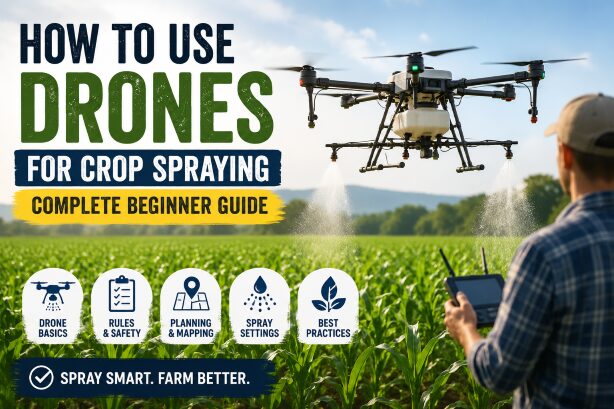
Using drones for crop spraying sounds exciting, especially when you watch one working neatly across a field.
But the first thing I tell beginners is this: a spray drone is not simply a bigger camera drone with a tank attached.
You are flying an aircraft. You are handling agricultural products. You are working around wind, crops, workers, neighboring land, waterways, power lines, pesticide labels, FAA rules, and state regulations.
That sounds like a lot, but once you break the job into steps, it becomes much easier to understand.
This guide explains how to use drones for crop spraying safely, legally, and practically in the USA, especially if you are a farmer, landowner, or new drone operator.
Regulatory Note — Updated August 2026: Drone and pesticide rules can change. Use this guide as a practical introduction, but always confirm the current requirements with the FAA, EPA, your state pesticide agency, the pesticide label, and your drone manufacturer’s operating instructions before spraying.
What Is a Crop Spraying Drone?
A crop spraying drone is an agricultural drone designed to carry and apply liquid products over crops or agricultural land.
It is very different from the small camera drone you may use for field scouting.
A typical agricultural spray drone may include:
- A liquid tank
- Pump
- Spray nozzles or rotary atomizers
- Flow-control system
- GPS/GNSS guidance
- Terrain-following sensors
- Batteries
- Obstacle-detection systems
- Flight-planning software
Think of it as a compact flying sprayer.
Instead of driving a tractor through the field, the drone follows planned passes above the crop while controlling its speed, flow rate, and application path.
Modern systems can automate much of the flying.
They may map field boundaries, follow routes, return for refilling, resume unfinished jobs, and maintain relatively consistent flight paths.
But automation does not remove the operator’s responsibility.
You are still responsible for making sure the application is legal, accurately calibrated, appropriate for the weather, and safe for people, crops, animals, and surrounding areas.
Farmer’s Reality Check: The drone can fly the route for you. It cannot read the pesticide label, judge a changing wind, notice every sensitive crop, or decide whether today is a bad day to spray.
How Does Drone Crop Spraying Work?
The basic idea is simple.
You map the area, select your application settings, fill the tank, launch the drone, and let it follow a planned spray route.
The real job involves more preparation.
Before spraying, you should:
- Confirm that the operation is legally permitted.
- Read the full product label.
- Check state pesticide requirements.
- Inspect the field.
- Identify people, animals, obstacles, water, and neighboring crops.
- Check weather conditions.
- Map the application area.
- Calibrate the spray system.
- Test the drone with clean water.
- Mix and load the product according to its label.
- Monitor the application.
- Clean the system and save required records.
| Step | What You Do |
|---|---|
| Check regulations | Confirm FAA, pesticide-label, and state requirements |
| Inspect field | Identify wires, trees, people, water, animals, roads, and sensitive crops |
| Map area | Create boundaries and exclusion/no-spray areas |
| Calibrate drone | Verify the actual application rate |
| Test with water | Check flow, pattern, and settings safely |
| Mix product | Follow label directions and required PPE |
| Spray field | Monitor wind, aircraft, coverage, battery, and tank level |
| Clean equipment | Follow label and manufacturer cleaning instructions |
| Save records | Document the application as required |
The flying is only one part of a successful spray job.
Is Drone Crop Spraying Legal in the USA?
Yes, agricultural drone spraying can be legal in the United States.
But there is no single “drone spraying license” that automatically covers everything.
Two regulatory systems usually matter:
Aviation rules regulate the aircraft and flight.
Pesticide rules regulate what you apply and how you apply it.
The FAA currently regulates qualifying agricultural dispensing operations under 14 CFR Part 137. The FAA defines Part 137 agricultural operations to include dispensing certain pesticides and substances intended for plant nourishment, soil treatment, plant propagation, pest control, or other agricultural purposes.
You can check the current federal process directly on the FAA’s Dispensing Chemicals and Agricultural Products with UAS page.
Important: Buying an agricultural drone does not give you permission to start spraying commercially the next morning.
Drone Weight Changes the FAA Path
This is one of the most important details for beginners.
The FAA’s current agricultural-UAS guidance separates operations partly by aircraft weight at takeoff, including the substance being carried.
For agricultural UAS weighing less than 55 pounds, the FAA describes a pathway involving Part 107 and Part 137, along with the necessary exemptions from applicable rules.
For agricultural drones weighing 55 pounds or more, operations generally fall under Parts 91 and 137 and require exemption relief from additional regulations. Large UAS agricultural operators also need an FAA Air Traffic Organization Certificate of Waiver or Authorization where applicable.
If you operate a heavier agricultural drone, read the FAA’s current Section 44807 guidance. Part 107 itself applies only to unmanned aircraft under 55 pounds.
You May Need a Remote Pilot Certificate
For operations conducted under Part 107, the person acting as remote pilot in command needs an FAA Remote Pilot Certificate or must operate as allowed under the applicable supervision provisions.
The FAA explains the current certification process in its Become a Certificated Remote Pilot guide.
The Drone Must Be Properly Registered
Agricultural spray drones are not recreational toys.
FAA registration requirements apply to work-use drones, and aircraft registration procedures differ depending on whether the drone is below or above 55 pounds.
The FAA’s current drone registration guidance explains those requirements.
Do Not Forget Remote ID
Drones that are required to be registered, or have been registered, generally must comply with the FAA’s Remote ID rule.
Check your aircraft and operating configuration against the FAA’s Remote Identification guidance before working commercially.
Compliance Callout: For a real spray operation, do not simply ask, “Do I have Part 107?” Ask whether the aircraft, its weight, Part 137 certification, exemptions, registration, Remote ID, airspace authorization, pesticide certification, product label, and state rules all line up for this specific job.
Read Also: Role of Agriculture Drones in Farming Procedures
The Pesticide Label Comes Before the Drone Settings
A spray drone gives you many adjustable settings.
That does not mean you are free to choose whatever settings produce the fastest job.
In the United States, pesticide labeling is legally enforceable.
EPA explains that using a registered pesticide in a manner inconsistent with its labeling can violate federal law. The label contains directions and restrictions intended to protect people and the environment.
You can read EPA’s Introduction to Pesticide Labels.
Before loading a pesticide into a drone, check things such as:
- Approved crop or application site
- Target pest
- Application rate
- Application method
- Aerial-application restrictions
- Spray volume
- Droplet-size requirements
- Wind restrictions
- Buffer requirements
- Personal protective equipment
- Restricted-entry interval
- Preharvest interval
- Environmental precautions
- Pollinator restrictions
- Mixing directions
Do not assume that because a product works through a tractor sprayer it can automatically be used through your drone.
Label First, Drone Second: Your drone’s software may allow 2 GPA, a particular droplet size, or a certain flight height. That does not mean the pesticide label permits those settings.
If the label or application method is unclear, contact the product manufacturer, your extension service, or your state pesticide regulatory agency before applying it.
State Pesticide Rules Matter Too
Federal rules are only part of the picture.
Pesticide applicator certification and licensing are often administered at the state, tribal, or territorial level.
EPA notes that many state pesticide agencies require certification for commercial pesticide applications, sometimes even when the product is not federally classified as a Restricted Use Pesticide.
Some programs also have specific aerial-application categories or other requirements.
Use EPA’s State and Territorial Pesticide Agencies directory to find the agency responsible for your location. EPA specifically recommends contacting these agencies for state-specific registration, certification, and application requirements.
Before Your First Paid Job: Call or check the website of your state pesticide agency. A neighboring state can have different licensing, notification, recordkeeping, insurance, or application requirements.
When Does Drone Spraying Make Sense?
A drone is not automatically the best sprayer simply because it is newer technology.
But there are situations where it can be extremely useful.
Wet Fields
Suppose it rained yesterday.
The pest problem cannot wait, but taking a heavy ground sprayer into the field would leave deep tracks and compact the soil.
A drone may allow treatment without driving through the crop.
Tall Crops
Once crops get taller, wheel traffic can cause plant damage.
A drone does not need to push through rows.
Small or Irregular Fields
Moving a large ground rig into a small field may take longer than the application itself.
Drone systems can be useful for smaller blocks and irregular boundaries.
Steep or Difficult Ground
Slopes, terraces, wet areas, and rough land may be difficult or dangerous for ground equipment.
Targeted Applications
A drone can make sense when only part of the field requires treatment.
| Situation | Why a Drone May Help |
|---|---|
| Wet field | Reduces wheel traffic and compaction |
| Tall crop | Avoids driving through standing plants |
| Small acreage | Less ground equipment to move |
| Irregular field | Flexible route planning |
| Difficult terrain | Avoids driving machinery through unsafe areas |
| Targeted treatment | Allows treatment of selected areas |
| Narrow spray window | Adds another application option |
Practical Tip: The best machine is the one that fits the field and application. Sometimes that is a drone. Sometimes it is a ground sprayer. Sometimes it is a conventional aerial applicator.
When Should You Avoid Drone Spraying?
Knowing when not to spray is one of the most valuable skills an applicator develops.
Pause the job when:
- Weather exceeds label limits
- Wind direction threatens sensitive areas
- A temperature inversion or other unfavorable condition may exist
- The product label is unclear
- Required approvals are missing
- The drone has not been calibrated
- Workers or bystanders are where they should not be
- Sensitive crops are downwind
- Equipment is malfunctioning
- You cannot maintain the required operating conditions
- You are unsure about a buffer or exclusion requirement
Be particularly careful around:
- Homes
- Schools
- Roads
- Workers
- Livestock
- Gardens
- Beehives
- Organic crops
- Ponds
- Streams
- Wells
- Drainage areas
- Neighboring fields
Experienced-Operator Mindset: A good applicator does not prove skill by flying in difficult conditions. Good judgment often means postponing the job.
Equipment You Need Before You Start
A spray drone is only the beginning.
A practical setup may include:
| Equipment | Why You Need It |
|---|---|
| Agricultural spray drone | Applies the product |
| Batteries | Provides field operating time |
| Charging system | Supports multiple flights |
| Clean water | Testing, mixing, and permitted cleaning |
| Measuring equipment | Accurate product preparation |
| Required PPE | Protects the handler |
| Weather meter | Helps assess field conditions |
| Nozzles/atomizer parts | Maintenance and replacement |
| Filters | Helps maintain the spray system |
| Spill kit | Helps manage accidental releases |
| Field markers | Identifies hazards and loading areas |
| Fire-safe battery equipment | Helps manage battery risks |
| Logbook/software | Records applications |
| First-aid supplies | Basic emergency preparation |
Do not skip PPE simply because the drone keeps you away from the crop while it is spraying.
The highest exposure risk may occur while mixing, loading, cleaning, unclogging, or handling concentrated product.
EPA’s Worker Protection Standard requires covered agricultural employers and pesticide handlers to follow applicable training, equipment, PPE, decontamination, application-safety, and emergency-assistance requirements.
You can review the current EPA Agricultural Worker Protection Standard.
How to Use Drones for Crop Spraying Step by Step
Now we can get into the actual field workflow.
Step 1: Read the Pesticide Label Before Anything Else
I know it is tempting to start with the drone app.
Don’t.
Start with the product.
Check:
- Crop
- Pest
- Rate
- Application timing
- Application method
- Aerial restrictions
- Spray volume
- Droplet requirements
- Required PPE
- Buffer restrictions
- Weather restrictions
- Restricted-entry interval
- Preharvest interval
- Environmental hazards
EPA describes the pesticide label as a legally enforceable document, not simply a set of suggestions.
Do Not Guess: If you cannot clearly determine whether your planned drone application complies with the labeling and state requirements, resolve the question before mixing the product.
Step 2: Check FAA and State Requirements
Next, check the legal side of the operation.
For a U.S. agricultural spray job, that may involve:
- FAA Part 107 where applicable
- FAA Part 137
- Applicable exemptions
- FAA aircraft registration
- Remote ID
- Airspace authorization where required
- State pesticide certification
- Aerial application certification where applicable
- State/local business requirements
- Insurance
- Product registration within your state
The exact combination depends on your drone, its takeoff weight, the substance being dispensed, your location, and the type of operation.
For current federal aviation requirements, start with the FAA’s agricultural UAS page.
For pesticide certification, see EPA’s How to Get Certified as a Pesticide Applicator.
Step 3: Walk the Field Before You Fly It
Software maps are useful.
They do not replace looking at the field yourself.
Before spraying, identify:
- Power lines
- Utility poles
- Trees
- Fences
- Irrigation equipment
- Workers
- Houses
- Roads
- Livestock
- Waterways
- Wells
- Neighboring crops
- Beehives
- Sensitive vegetation
Look beyond the field boundary too.
If the wind carries spray in that direction, what is there?
A vineyard?
A vegetable garden?
A pond?
Someone’s house?
That information matters.
Step 4: Choose a Safe Mixing and Loading Area
Do not set up your chemical-loading station wherever the pickup happens to stop.
Choose a stable location where a spill can be managed.
Follow the pesticide label and applicable regulations concerning mixing, loading, containment, water sources, and cleanup.
Keep unnecessary people away from the area.
Make sure your spill kit, PPE, measuring equipment, clean water, and emergency information are accessible before opening the pesticide container.
Step 5: Map the Field Carefully
Create the field boundary in the drone software.
Depending on the system, you may:
- Draw the area on satellite imagery
- Walk the boundary
- Fly a mapping mission
- Import an existing field map
Add obstacles and areas you do not want the aircraft or spray pattern to enter.
Spend time on this step.
A poor boundary can produce missed strips, excessive overlap, bad turns, or unsafe flight paths.
Mapping Tip: Zoom in on corners. Small mapping mistakes become real mistakes when a large aircraft is flying with a loaded tank.
Step 6: Choose Application Settings
Important settings include:
| Setting | What It Controls |
|---|---|
| Flight height | Distance above the target |
| Flight speed | How quickly the aircraft moves |
| Swath width | Width covered by each pass |
| Flow rate | Liquid output |
| Droplet size | Characteristics of spray droplets |
| GPA | Application volume per acre |
| Overlap | Relationship between neighboring passes |
These settings interact.
Changing one can change the final application.
Flying faster, changing swath width, increasing height, changing droplet size, or adjusting flow can affect coverage and drift.
Never choose these settings based only on what makes the drone finish faster.
Use the product label, equipment guidance, calibration, and applicable recommendations.
Step 7: Calibrate With Clean Water
This is one of the best habits a new spray-drone operator can develop.
Test before pesticide goes into the tank.
Use clean water and verify the system’s actual output under your planned operating settings.
Check:
- Output
- Flow consistency
- Spray pattern
- Swath
- Flight speed
- Height
- Nozzle/atomizer performance
If the expected application rate and actual output do not agree, solve that problem before moving on.
Calibration Callout: “The app says 2 GPA” is not calibration. Calibration means verifying what the machine actually delivers.
Step 8: Check the Weather Again
Weather can change between breakfast and spray time.
Check it again immediately before application.
Pay attention to:
- Wind speed
- Wind direction
- Temperature
- Humidity
- Potential temperature inversions
- Forecast changes
Then compare those conditions with the pesticide label.
Do not create your own universal “safe wind speed.”
There isn’t one number that works for every product and situation.
Step 9: Mix the Product According to the Label
Now put on the required PPE and prepare the spray mixture.
Measure carefully.
Follow the mixing sequence on the label.
Use clean water where required.
Do not guess at compatibility when tank mixing.
Some mixtures can:
- Foam
- Separate
- Form deposits
- Clog filters
- Damage application equipment
- Change spray characteristics
If compatibility is uncertain, check the labels and approved technical guidance before mixing.
EPA requires covered pesticide handlers to use the PPE specified by the pesticide labeling for the task being performed.
Step 10: Run a Short Test Pass
Do not make your first loaded flight a full-field mission.
Run a controlled initial pass or small section where appropriate.
Watch:
- Height
- Speed
- Aircraft behavior
- Spray output
- Turns
- Swath
- Battery level
- Tank level
- Nearby activity
Stop if something does not look right.
Ten extra minutes fixing a problem now can save acres of bad application later.
Step 11: Monitor the Entire Spray Job
Automation is not permission to stop paying attention.
Continue monitoring:
- Aircraft location
- Spray output
- Battery status
- Tank level
- Wind
- Downwind areas
- People
- Vehicles
- Animals
- Equipment warnings
If conditions change, pause.
If someone enters an area where they should not be during the application, follow the label and applicable Worker Protection Standard requirements.
EPA’s WPS requires covered handlers to prevent pesticide contact with workers and other people and to suspend applications when applicable exclusion-zone requirements are not satisfied.
Safety Callout: Autopilot controls the route. The operator remains responsible for the operation.
Step 12: Clean the System Properly
After spraying, follow both:
- The pesticide label
- The drone manufacturer’s cleaning instructions
The tank, lines, pump, filters, nozzles, and other wetted components may require cleaning.
Poor cleaning can lead to:
- Clogged components
- Corrosion
- Cross-contamination
- Crop injury during the next application
- Incorrect application rates
Be especially careful when switching between products or crops.
Dispose of rinsate according to label and legal requirements.
Never assume a ditch or drain is an acceptable place for leftover spray or rinse water.
Step 13: Keep Good Application Records
Before leaving the field, record the job.
Depending on applicable rules, useful records may include:
- Date
- Start/end time
- Field
- Crop
- Product
- EPA registration number where applicable
- Application rate
- Acres treated
- Weather
- Wind speed/direction
- Operator
- Aircraft
- Application settings
- Issues or interruptions
EPA’s WPS includes pesticide application information and record-related requirements for covered agricultural establishments, while state rules may impose additional requirements.
Good records are not only about compliance.
They help you troubleshoot later.
Example: Spraying a 20-Acre Soybean Field
Suppose a 20-acre soybean field is too wet for your ground rig.
The pest problem cannot wait indefinitely, so you are considering the drone.
A sensible workflow would be:
- Identify the pest problem correctly.
- Confirm the product is registered and labeled for the crop/site.
- Read all relevant application restrictions.
- Confirm the planned application method complies with labeling and state requirements.
- Check your FAA operating authority.
- Confirm your pesticide certification.
- Walk the field.
- Identify neighboring crops, roads, homes, waterways, and wires.
- Check the weather.
- Map the field.
- Calibrate with clean water.
- Prepare the product using required PPE.
- Start with a controlled section.
- Monitor wind and coverage.
- Clean the system.
- Complete required records.
Notice what is missing?
There is no “fly as fast as possible” step.
The objective is accurate, legal application—not a speed record.
Drone Sprayer vs Ground Sprayer vs Crop Duster
Every application system has strengths and limitations.
| Feature | Drone Sprayer | Ground Sprayer | Conventional Aerial Application |
|---|---|---|---|
| Small areas | Very useful | Often practical | Less practical for very small jobs |
| Wet fields | Excellent access | May cause rutting | Excellent access |
| Large acreage | Can require many refill cycles | Very efficient | Very efficient |
| Crop traffic | None | Wheel tracks possible | None |
| Difficult terrain | Useful | Limited | Useful |
| Equipment investment | Moderate to high | High | Often hired service |
| Application volume | Often relatively low | Flexible/high | Depends on aircraft/application |
| Learning curve | High | Moderate | Professional specialty |
A drone does not need to replace every sprayer on the farm to be worthwhile.
Sometimes its real value is filling the gap when another machine cannot get into the field.
How to Reduce Spray Drift
Drift deserves its own section because it is one of the most serious concerns in pesticide application.
EPA defines spray drift as pesticide droplets or particles moving through the air during or shortly after application to somewhere other than the intended target.
Read EPA’s Introduction to Pesticide Drift for current federal guidance.
Ways to manage drift include:
| Practice | Why It Matters |
|---|---|
| Follow label weather limits | Label requirements control the application |
| Monitor wind direction | Shows what lies downwind |
| Use required droplet size | Droplet characteristics influence drift |
| Maintain appropriate height | Excessive height may increase off-target movement |
| Respect buffers | Protects sensitive areas |
| Watch for inversions | Small droplets can behave unpredictably |
| Check equipment | Damaged components change spray performance |
| Stop when conditions change | Prevents a marginal situation becoming a bad one |
Do not watch only the wind-speed number.
Direction matters.
Imagine a moderate breeze blowing toward an empty harvested field versus the same breeze blowing toward a vegetable farm.
The risk is not the same.
Drift Rule: Always ask two questions: How is the wind behaving? and What is downwind?
Never use a generic internet chart to override a pesticide label.
Read Also: Role of Agriculture Drones in Farming Procedures
Worker Safety Is Part of Drone Spraying
One advantage of a drone is that the operator does not need to sit directly inside the application path.
But pesticide exposure can still happen.
Common handling points include:
- Opening containers
- Measuring concentrate
- Mixing
- Filling the tank
- Cleaning filters
- Clearing blockages
- Washing equipment
- Handling contaminated PPE
- Managing spills
For farms and operations covered by EPA’s Worker Protection Standard, employers have responsibilities involving training, pesticide information, decontamination supplies, emergency assistance, PPE, application restrictions, and restricted-entry intervals.
Restricted-Entry Intervals Still Matter
The drone leaving the field does not automatically mean workers can immediately walk into the crop.
Check the pesticide label’s restricted-entry interval (REI).
EPA requires covered agricultural employers to keep workers out of treated areas during applicable REIs except under specific limited provisions.
Worker-Safety Callout: “The drone finished spraying” and “the field is safe to re-enter” are two different questions.
How Much Does Drone Crop Spraying Cost?
There is no single useful national price because costs vary tremendously.
Your choice usually comes down to three options.
| Option | Best For | Main Costs |
|---|---|---|
| Hire an operator | Occasional applications | Per-acre/service fees |
| Buy your own drone | Regular farm use | Drone, batteries, charging, training, maintenance |
| Start a spraying business | Commercial application | Equipment plus substantial compliance and business costs |
If buying, budget for more than the aircraft.
You may also need:
- Extra batteries
- Chargers
- Generator/power equipment
- Trailer or transport
- Mixing equipment
- PPE
- Spare parts
- Software
- Training
- Certification/licensing
- Insurance
- Maintenance
- Spill-control equipment
The drone’s advertised price is only the start.
Common Beginner Mistakes
The mistakes I see beginners worry about most are flight mistakes.
The bigger problems are often application mistakes.
Common examples include:
- Buying a drone before researching regulations
- Spraying without fully reading the pesticide label
- Assuming Part 107 alone authorizes agricultural spraying
- Ignoring Part 137
- Forgetting state pesticide requirements
- Ignoring aircraft takeoff weight
- Failing to verify Remote ID or registration requirements
- Skipping calibration
- Using unsuitable application settings
- Ignoring changing wind direction
- Flying too high
- Missing nearby sensitive crops
- Letting unnecessary people enter the application area
- Mixing more product than needed
- Poor equipment cleaning
- Weak recordkeeping
Best Beginner Advice: Spend more time learning before your first pesticide flight than you think you need. Practice with water until operating the aircraft feels routine.
Beginner Checklist Before Your First Spray Job
Run through this before every new job.
Legal and Regulatory
- FAA operating requirements checked
- Part 137 requirements checked
- Required exemptions/authorizations confirmed
- Drone registration current
- Remote ID requirement confirmed
- Pilot qualification current
- State pesticide certification checked
- Product registered where required
- Insurance requirements checked
Product
- Full pesticide label reviewed
- Crop/site permitted
- Application method permitted
- Rate correct
- Spray volume correct
- Droplet requirements checked
- Buffers checked
- Weather restrictions checked
- PPE ready
- REI and PHI understood
Field
- Field inspected
- People/workers accounted for
- Power lines marked
- Trees/poles marked
- Water identified
- Neighboring crops identified
- Houses/roads identified
- Flight boundary verified
Equipment
- Aircraft inspected
- Batteries ready
- Spray system checked
- Filters clean
- Nozzles/atomizers checked
- Water calibration completed
- Spill kit ready
- PPE available
- Records prepared
If something important is missing, stop and fix it before spraying.
FAQs About How to Use Drones for Crop Spraying
Do I need a license to spray crops with a drone?
Yes. Depending on the operation, you may need FAA approvals, drone registration, Part 137 certification, applicable exemptions, and state pesticide applicator certification. Always check current FAA and state requirements before spraying.
Is Part 107 enough for drone crop spraying?
Not always. Agricultural dispensing operations may also require FAA Part 137 certification and additional exemptions or authorizations. Check the FAA agricultural drone requirements before operating.
What if my spray drone weighs more than 55 pounds?
Drones weighing 55 pounds or more at takeoff generally follow a different FAA regulatory pathway. Additional exemptions, Part 137 requirements, and other authorizations may apply.
Can I spray any pesticide with a drone?
No. You must follow the pesticide label and applicable state requirements. Only use a product when your crop, application method, rate, timing, and other conditions comply with the label.
Is drone spraying good for small farms?
Yes, it can be useful for small farms, wet fields, difficult terrain, irregular areas, specialty crops, and targeted applications. However, the same safety and regulatory requirements still apply.
How many acres can a spray drone cover in a day?
It depends on the drone model, tank size, spray volume, battery capacity, field shape, refill time, weather, and operator workflow. There is no single daily acreage figure that applies to every drone.
What wind speed is safe for drone spraying?
There is no universal safe wind speed for every application. Always follow the pesticide label and consider wind speed, direction, droplet size, nearby sensitive areas, and changing weather conditions.
Do I still need PPE when using a spray drone?
Yes. Required PPE must still be worn when mixing, loading, cleaning, maintaining equipment, or handling pesticides. Always follow the PPE instructions on the product label.
Does the Worker Protection Standard apply to drone spraying?
It may apply to agricultural pesticide operations covered by EPA rules. Requirements can include PPE, training, decontamination, application restrictions, emergency assistance, and restricted-entry intervals.
Where can I check my state’s pesticide rules?
Use the EPA’s State and Territorial Pesticide Agencies directory to find the pesticide regulator responsible for your state.
Final Thoughts
Learning how to use drones for crop spraying is much more than flying the aircraft.
Always check the pesticide label, calibrate carefully, monitor weather and drift, follow FAA and state rules, and use the required PPE.
Start with water, learn your equipment, and never rush an application when conditions are not right.
A good drone operator focuses on accuracy, safety, compliance, and protecting the surrounding farm environment.e operator is not the person who covers the most acres in the shortest time.
It is the person who applies the right product to the right place, at the right rate, under the right conditions—and brings the aircraft home without creating a problem for the crop, workers, neighbors, or environment.

[…] How to Use Drones for Crop Spraying: Beginner’s Guide. […]