Email: blogagri2@gmail.com

19-19-19 Fertilizer: Uses, Composition and Application Rate
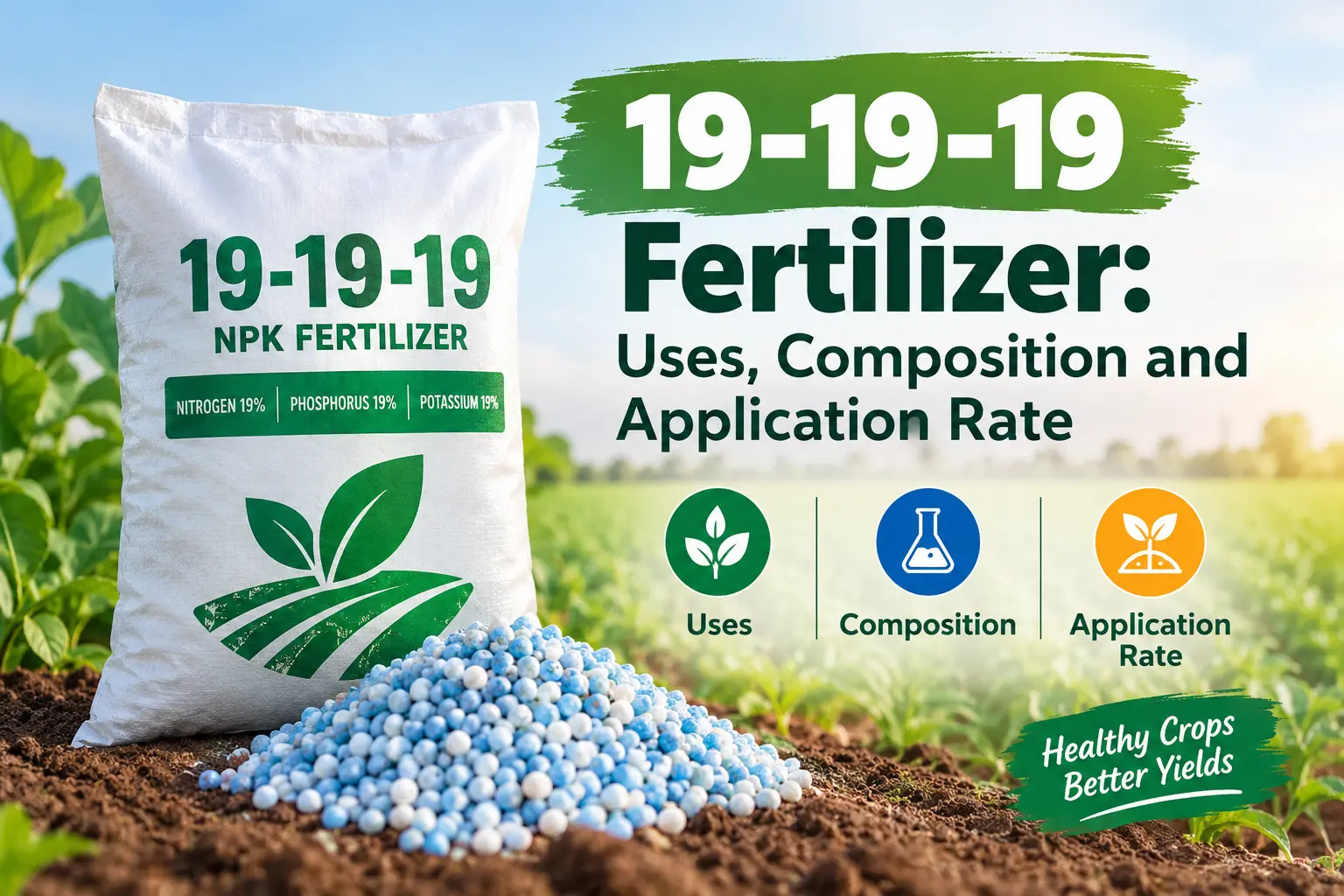
19-19-19 fertilizer contains 19% nitrogen, 19% phosphate as P₂O₅, and 19% potash as K₂O by weight. It is an equal-analysis NPK fertilizer that supplies the three primary labelled nutrients in a 1:1:1 ratio.
That does not mean it is automatically the right fertilizer for every crop or soil.
19-19-19 is most useful when nitrogen, phosphate, and potash are all required in reasonably similar proportions. If a soil already contains plenty of phosphorus, or a crop needs much more potassium than nitrogen, another fertilizer grade may be a better fit.
This guide explains what 19-19-19 fertilizer contains, what it is used for, how to calculate an application rate, and how to decide whether its nutrient ratio suits your crop.
What Does 19-19-19 Fertilizer Mean?
The three numbers on a fertilizer label describe its guaranteed N-P-K analysis.
They are written in this order:
Nitrogen – Phosphate – Potash
For 19-19-19 fertilizer:
| Label value | Guaranteed analysis | Represents |
|---|---|---|
| N | 19% | Nitrogen |
| P₂O₅ | 19% | Phosphate |
| K₂O | 19% | Potash |
The University of Minnesota Extension explains that fertilizer labels conventionally report nitrogen as N, phosphorus fertilizer as P₂O₅, and potassium fertilizer as K₂O.
This means a 100 kg quantity of 19-19-19 contains:
- 19 kg nitrogen
- 19 kg P₂O₅
- 19 kg K₂O
A 50 kg bag contains:
- 9.5 kg nitrogen
- 9.5 kg P₂O₅
- 9.5 kg K₂O
A 25 kg bag contains:
- 4.75 kg nitrogen
- 4.75 kg P₂O₅
- 4.75 kg K₂O
The second number does not mean 19% elemental phosphorus, and the third does not mean 19% elemental potassium. P₂O₅ and K₂O are the conventional fertilizer-label expressions for phosphorus and potassium fertilizers. Penn State Extension also notes this distinction when explaining fertilizer analysis.
Agricultural Insight
A fertilizer can be “balanced” in the bag without being balanced for your field. The 1:1:1 ratio simply means equal labelled percentages of N, P₂O₅, and K₂O. Your crop may need a completely different nutrient ratio.
What Does Each Nutrient Do?
Nitrogen
Nitrogen supports chlorophyll formation, proteins, enzymes, and vegetative plant growth.
Plants with inadequate nitrogen often develop pale or yellow-green leaves and reduced growth. However, applying more nitrogen than the crop can use may produce excessive vegetative growth and increase the risk of nutrient losses.
Phosphorus
Phosphorus fertilizer is represented on the label as P₂O₅.
Plants use phosphorus in energy transfer, cell division, root development, and reproductive growth.
A crop may require nitrogen even when the soil already has adequate phosphorus. In that situation, continually applying a complete 19-19-19 fertilizer may supply phosphate that is not needed.
Potassium
Potassium fertilizer is expressed as K₂O, or potash.
Potassium plays important roles in water regulation, stomatal activity, enzyme function, crop quality, and plant responses to stress.
Some high-yielding fruit, vegetable, tuber, and field crops can require considerably more potassium than phosphorus during certain growth stages. A fixed 1:1:1 fertilizer cannot independently increase potassium without also increasing nitrogen and phosphate.
What Is 19-19-19 Fertilizer Used For?
19-19-19 fertilizer is generally used where all three major fertilizer nutrients need to be supplied together.
Depending on the product formulation and label, it may be used for:
- Field crops
- Vegetables
- Fruit crops
- Greenhouse crops
- Nursery plants
- Ornamentals
- Turf and lawns
- Soil fertilization
- Fertigation
- Foliar feeding
Water-soluble triple-19 products are commonly marketed for fertigation and foliar use, while other formulations may be designed primarily for soil application.
Do not assume every product carrying a 19-19-19 analysis can be used in the same way.
Products with the same NPK numbers may differ in:
- Nitrogen forms
- Solubility
- Micronutrients
- Secondary nutrients
- Additives
- Recommended crops
- Approved application methods
Always check the guaranteed analysis and directions for the actual product you intend to use.
When Is 19-19-19 a Good Fertilizer Choice?
19-19-19 has a nutrient ratio of:
1:1:1
That makes it most logical where the required amounts of N, P₂O₅, and K₂O are relatively similar.
Use this table as a decision guide.
| Situation | Is 19-19-19 a good fit? | Why |
|---|---|---|
| N, P₂O₅, and K₂O are needed at similar rates | Often | Its 1:1:1 ratio resembles the requirement |
| Soil phosphorus is already high | Usually not | Every application adds more phosphate |
| Crop mainly needs nitrogen | Usually not | P₂O₅ and K₂O are supplied whether needed or not |
| Crop needs much more potassium than phosphorus | Usually not by itself | Enough product for K may over-supply N and P₂O₅ |
| A balanced soluble fertilizer is specified in a fertigation plan | Possibly | Check crop stage, product label, and nutrient plan |
| No soil test or recommendation is available | Uncertain | The actual nutrient need has not been established |
University of Minnesota Extension recommends selecting fertilizer sources according to the relative amounts of nutrients actually needed. For example, if more nitrogen is required but little phosphorus or potassium is needed, a fertilizer source with relatively more N and less P and K is more appropriate.
Field Tip
Write the recommended N, P₂O₅, and K₂O rates next to one another. If the three numbers are very different, 19-19-19 is unlikely to match the entire recommendation efficiently by itself
.
How Much Nutrient Does 19-19-19 Supply?
Because all three nutrient guarantees are 19%, the calculation is straightforward.
Nutrient supplied = fertilizer amount × 0.19
Example: 25 kg of 19-19-19
25 × 0.19 = 4.75 kg
Therefore, 25 kg of product supplies:
- 4.75 kg N
- 4.75 kg P₂O₅
- 4.75 kg K₂O
Example: 100 kg of 19-19-19
100 × 0.19 = 19 kg
Therefore, 100 kg supplies:
- 19 kg N
- 19 kg P₂O₅
- 19 kg K₂O
Example: 100 lb of 19-19-19
100 × 0.19 = 19 lb
Therefore, 100 lb supplies:
- 19 lb N
- 19 lb P₂O₅
- 19 lb K₂O
This calculation is useful when comparing fertilizer bag sizes, application rates, and costs.
How to Calculate the 19-19-19 Fertilizer Application Rate
There is no single 19-19-19 fertilizer application rate that is correct for every crop.
The more reliable approach is to begin with the nutrient requirement.
Use:
Fertilizer required = nutrient requirement ÷ nutrient concentration
For 19-19-19:
19% = 0.19
Therefore:
Fertilizer required = nutrient requirement ÷ 0.19
This is the same basic method used in Extension fertilizer calculations: divide the amount of nutrient required by the nutrient fraction in the fertilizer product.
You can perform this conversion with the BlogAgri Fertilizer Dosage Calculator.
Example: 30 kg N per hectare
Suppose your nutrient recommendation requires:
30 kg N/ha
Calculate:
30 ÷ 0.19 = 157.9 kg of 19-19-19 per hectare
Because triple-19 contains equal percentages of all three nutrients, that application also supplies approximately:
- 30 kg N/ha
- 30 kg P₂O₅/ha
- 30 kg K₂O/ha
If the nutrient recommendation is approximately 30-30-30, 19-19-19 is a close mathematical fit.
If the soil needs 30 kg nitrogen but little or no phosphate, it is not.
Example: 20 kg N per hectare
20 ÷ 0.19 = 105.3 kg/ha of 19-19-19
That also supplies approximately:
- 20 kg N/ha
- 20 kg P₂O₅/ha
- 20 kg K₂O/ha
Why a Balanced Fertilizer Can Still Over-Supply Nutrients
Consider a more realistic unequal recommendation.
Suppose the field needs:
- 40 kg N/ha
- 20 kg P₂O₅/ha
- 60 kg K₂O/ha
Calculate the amount of 19-19-19 needed to satisfy each nutrient individually:
| Nutrient | Required | 19-19-19 needed |
|---|---|---|
| N | 40 kg/ha | 210.5 kg/ha |
| P₂O₅ | 20 kg/ha | 105.3 kg/ha |
| K₂O | 60 kg/ha | 315.8 kg/ha |
To supply all 60 kg/ha of K₂O using only 19-19-19, you would apply about 315.8 kg/ha.
But that rate also supplies approximately:
- 60 kg N/ha
- 60 kg P₂O₅/ha
- 60 kg K₂O/ha
The potassium target is met, but nitrogen exceeds the stated requirement by 20 kg/ha and phosphate exceeds it by 40 kg/ha.
In this case, a different fertilizer or combination of fertilizers would likely match the nutrient requirement more closely.
The BlogAgri NPK Fertilizer Calculator is designed for this exact comparison: enter the N, P₂O₅, and K₂O targets and the fertilizer grade to see which nutrient controls the product rate and which nutrients may be over-supplied.
Common Mistake
Do not calculate the rate from the nutrient with the highest requirement without checking how much of the other nutrients that rate will supply. Compound fertilizers always deliver their nutrients in the fixed ratio printed on the label.
How Much 19-19-19 Fertilizer per Acre?
The same calculation works in pounds per acre.
Suppose the field requires:
20 lb N/acre
Calculate:
20 ÷ 0.19 = 105.3 lb of 19-19-19 per acre
That rate also supplies approximately:
- 20 lb N/acre
- 20 lb P₂O₅/acre
- 20 lb K₂O/acre
Before applying that amount, confirm that the soil and crop actually need all three nutrients at approximately those rates.
The better question is therefore not simply:
How much 19-19-19 should I use per acre?
It is:
How much nitrogen, phosphate, and potash does this crop and field require?
Soil Application of 19-19-19 Fertilizer
Granular or soil-applied 19-19-19 should be used according to the crop recommendation and product directions.
Depending on the production system, it may be:
- Broadcast
- Incorporated before planting
- Banded
- Side-dressed
- Applied through suitable fertilizer equipment
Placement matters.
Concentrated fertilizer placed too close to seed or sensitive roots can cause salt injury. Uniform application also matters because uneven spreading can leave one part of a field over-fertilized and another part deficient.
Common Mistake
Do not calculate fertilizer as “bags per field” without first measuring the actual field area. Calculate a rate per hectare, acre, or other known unit first, then determine the total product required.
After calculating the product rate, the BlogAgri Fertilizer Cost Calculator can estimate total fertilizer quantity, bags, cost per hectare, and whole-field product cost.
Using Water-Soluble 19-19-19 Through Fertigation
Only use a 19-19-19 fertilizer through an irrigation system if the product is sufficiently soluble and intended for fertigation.
A fertigation program should consider:
- Fertilizer solubility
- Irrigation-water quality
- Crop nutrient demand
- Injection rate
- Irrigation volume
- System calibration
- Compatibility with other fertilizers
- Risk of precipitation
- Emitter and filter performance
Mississippi State University Extension notes that fertigation fertilizer sources need to be highly soluble. Undissolved fertilizer can settle in tanks and contribute to clogged irrigation tubing or emitters, while incompatible materials can form precipitates.
Agricultural Insight
The main advantage of fertigation is not simply that fertilizer can be applied through irrigation. It allows nutrients to be divided into smaller applications and timed more closely with crop demand.
Do not mix concentrated fertilizers simply because each dissolves successfully on its own. Compatibility must also be considered.
Can 19-19-19 Be Used as a Foliar Fertilizer?
Some water-soluble 19-19-19 formulations are labelled for foliar application.
The exact concentration should come from the specific product label, not from a universal internet dosage.
For example, IFFCO’s official directions for its own 19-19-19 water-soluble product specify a 0.5–1.0% foliar concentration for that formulation. That is useful as a product-specific example, but it should not be treated as the correct rate for every triple-19 fertilizer.
Products can differ in:
- Nutrient sources
- Purity
- Salt concentration
- Added micronutrients
- Formulation additives
- Recommended crops
- Permitted application methods
Safety Note
Follow the directions on the exact 19-19-19 product being used for foliar application. Do not increase the concentration beyond the label simply because the crop appears deficient. Excess soluble fertilizer can damage leaf tissue.
When Should You Apply 19-19-19 Fertilizer?
Application timing should follow crop nutrient demand rather than a universal calendar.
Ask four questions before applying:
- What growth stage is the crop in?
- Which nutrients are required at that stage?
- What nutrients have already been supplied?
- Does a 1:1:1 fertilizer match the remaining requirement?
Crop nutrient requirements can change substantially through the growing season.
A balanced fertilizer that fits an early stage may become less appropriate during flowering, fruit filling, tuber development, grain filling, or crop maturation.
19-19-19 vs 10-10-10 vs 20-20-20
All three fertilizers have the same basic NPK ratio:
1:1:1
The main difference is concentration.
| Fertilizer | N | P₂O₅ | K₂O | Total labelled NPK |
|---|---|---|---|---|
| 10-10-10 | 10% | 10% | 10% | 30% |
| 19-19-19 | 19% | 19% | 19% | 57% |
| 20-20-20 | 20% | 20% | 20% | 60% |
A higher analysis does not automatically make a fertilizer better.
It means less product is required to supply the same quantity of nutrient.
To supply 10 kg of nitrogen with 10-10-10
10 ÷ 0.10 = 100 kg fertilizer
With 19-19-19
10 ÷ 0.19 = 52.6 kg fertilizer
With 20-20-20
10 ÷ 0.20 = 50 kg fertilizer
The appropriate product depends on:
- Nutrient requirement
- Product formulation
- Price per unit of nutrient
- Availability
- Application equipment
- Solubility
- Application method
A fertilizer with a higher analysis may reduce the amount of material that needs to be transported and handled, but the nutrient ratio still needs to fit the crop.
What Crops Can Use NPK 19-19-19?
19-19-19 can be used within nutrient programs for many crops where its nutrient ratio fits the requirement.
Depending on the formulation, possible applications include:
- Cereals
- Vegetables
- Fruit crops
- Field crops
- Ornamentals
- Greenhouse crops
- Nursery plants
- Turf
However, crop name alone is not enough to decide whether triple-19 is appropriate.
Two farms growing the same crop can require very different fertilizer programs because of differences in:
- Soil-test fertility
- Yield goal
- Previous crop
- Manure history
- Irrigation
- Soil texture
- Climate
- Residual fertility
- Previous fertilizer applications
A soil test and locally calibrated crop recommendation are more useful than a generic list of crops that “like” 19-19-19.
Is 19-19-19 Good for Vegetables?
It can be useful when vegetables need nitrogen, phosphate, and potash at reasonably similar rates.
It should not automatically be used as the standard fertilizer for every vegetable crop.
Gardens and vegetable fields that receive manure or compost repeatedly can sometimes accumulate phosphorus. In those situations, continuing to apply an equal-analysis NPK fertilizer may add more phosphate than the crop requires.
A soil test helps determine whether additional phosphorus or potassium is actually needed. University of Minnesota Extension emphasizes using soil-test results and crop requirements when selecting fertilizer sources.
Is 19-19-19 Good for Fruit and Flowering Crops?
It may fit some growth stages, but flowering or fruiting does not automatically mean the crop needs equal N, P₂O₅, and K₂O.
Nutrient demand changes with:
- Crop species
- Growth stage
- Yield target
- Soil fertility
- Root conditions
- Irrigation
- Production system
In some crops, potassium demand can become much greater than phosphorus demand as fruit or storage organs develop.
When the required nutrient ratio changes, the fertilizer program may need to change with it.
Is 19-19-19 Good for Lawns?
It can supply nitrogen to turf, but it also supplies equal labelled quantities of phosphate and potash.
If soil phosphorus is already sufficient, applying 19-19-19 simply to provide nitrogen adds phosphorus that may not be necessary.
Select turf fertilizer according to soil-test results, local fertilizer recommendations, and any regional restrictions on phosphorus application.
Soil pH Also Matters
Nutrient availability is influenced by soil conditions, including pH.
However, do not assume that fertilizer alone will correct a soil pH problem.
If soil pH is outside the appropriate range for the crop, use a soil test and locally calibrated recommendation to determine whether lime or another amendment is needed.
The BlogAgri Soil pH Adjustment Estimator can help apply an existing locally appropriate lime factor across a known field area, but it is not a substitute for a laboratory lime recommendation.
When 19-19-19 May Be the Wrong Fertilizer
Consider a different fertilizer source when:
- Soil phosphorus is already high
- Only nitrogen is required
- Potassium need is much higher than phosphorus need
- The crop requires a stage-specific nutrient ratio
- Previous fertilizer has already supplied one nutrient
- Manure or compost contributes substantial nutrients
- The product is unsuitable for the intended irrigation system
- The product label does not permit the intended application method
Choosing another fertilizer does not mean there is anything inherently wrong with 19-19-19.
It means the fertilizer should fit the crop and field rather than the other way around.
If one product cannot supply the desired ratio, use the BlogAgri Fertilizer Blend Calculator to calculate the final N-P-K grade produced by combining two fertilizer materials.
Common 19-19-19 Fertilizer Mistakes
Applying Fertilizer Without Measuring the Area
A recommendation expressed per hectare or acre cannot be applied accurately if the treated area is unknown.
Measure the actual crop area before calculating total fertilizer quantity.
Assuming Every Triple-19 Product Is Identical
The three headline numbers can be identical while other parts of the formulation differ.
Compare the actual labels for:
- Nutrient sources
- Solubility
- Micronutrients
- Application methods
- Mixing directions
- Crop-specific instructions
Meeting One Nutrient Requirement Without Checking the Others
Applying enough 19-19-19 to satisfy potassium also supplies nitrogen and phosphate.
Always calculate all three.
Ignoring Previous Nutrient Applications
Manure, compost, previous fertilizer, crop residues, irrigation water, and previous crops can all affect the nutrient plan.
Do not calculate a new application in isolation if these sources have already been accounted for.
Using Visible Symptoms as the Only Diagnosis
Poor growth or yellow leaves can be associated with nutrient deficiency, but similar symptoms can also result from:
- Waterlogging
- Drought
- Root disease
- Salinity
- Incorrect pH
- Root damage
- Poor soil structure
Applying 19-19-19 will not correct every problem that looks like a nutrient deficiency.
Increasing Foliar Concentration to Get a Faster Response
A stronger solution is not necessarily more effective.
Excessive fertilizer concentration can increase the risk of leaf injury.
Climate Consideration
Under hot, dry conditions, fertilizer salts can become more concentrated around plant roots as soil moisture declines. Application timing and irrigation management therefore deserve extra attention during drought and in dry climates.
Practical Checklist Before Applying 19-19-19
Check these points before fertilizing:
- Measure the area. Know the actual hectares, acres, or square metres being treated.
- Determine the nutrient need. Use a soil test, crop recommendation, or nutrient-management plan.
- Compare the ratio. Check whether N, P₂O₅, and K₂O are required in similar proportions.
- Read the formulation. Determine whether the product is granular, water soluble, fertigation-grade, or labelled for foliar use.
- Calculate product rate. Convert the nutrient requirement into actual fertilizer quantity.
- Check all three nutrients. Make sure meeting one requirement does not excessively over-supply another.
- Account for previous inputs. Consider manure, compost, fertilizer, and other nutrient sources where relevant.
- Follow the label. Use only approved rates and application methods.
- Check crop condition. Avoid assuming fertilizer will solve drought, disease, root, or drainage problems.
- Record the application. Keeping field records makes future nutrient planning more accurate.
Frequently Asked Questions
What does 19-19-19 mean in fertilizer?
19-19-19 means the fertilizer contains 19% nitrogen, 19% phosphate expressed as P₂O₅, and 19% potash expressed as K₂O by weight. The equal numbers produce a 1:1:1 fertilizer ratio. They do not mean the fertilizer contains 19% elemental phosphorus and 19% elemental potassium.
What is 19-19-19 fertilizer used for?
19-19-19 fertilizer is used where nitrogen, phosphate, and potash need to be supplied together in roughly similar proportions. Depending on the formulation, it may be used for soil fertilization, fertigation, or foliar feeding. The crop requirement, soil fertility, application method, and product label should determine whether it is appropriate.
How much 19-19-19 fertilizer should I apply per acre?
There is no universal per-acre rate. Start with the actual nutrient recommendation. If a field requires 20 lb N/acre, dividing 20 by 0.19 gives about 105 lb of 19-19-19 per acre. That rate also supplies approximately 20 lb each of P₂O₅ and K₂O, so those requirements must also be checked.
How much nitrogen is in a 50 kg bag of 19-19-19?
A 50 kg bag contains 9.5 kg of nitrogen because 50 × 0.19 equals 9.5. It also supplies 9.5 kg of P₂O₅ and 9.5 kg of K₂O. Whether all three nutrients are required in equal amounts depends on the soil, crop, and growth stage.
Is 19-19-19 fertilizer good for all plants?
No single fertilizer ratio is ideal for every plant or soil. 19-19-19 works best when nitrogen, phosphate, and potash are needed in roughly equal proportions. If phosphorus is already high or the crop requires much more potassium than nitrogen, another fertilizer grade may fit the requirement better.
Can 19-19-19 fertilizer be used for foliar spraying?
Some water-soluble 19-19-19 products are labelled for foliar use, but the correct concentration depends on the individual formulation. Always follow the rate on the exact product label. Do not assume a foliar concentration published for one 19-19-19 fertilizer is appropriate for another product.
Can 19-19-19 be applied through drip irrigation?
A suitably water-soluble 19-19-19 fertilizer labelled for fertigation can be used through compatible irrigation systems. Check solubility, water quality, injector calibration, fertilizer compatibility, and label directions. Undissolved or incompatible fertilizer materials can form precipitates or contribute to clogged filters and emitters.
Is 19-19-19 better than 10-10-10?
Neither is automatically better. Both have the same 1:1:1 nutrient ratio, but 19-19-19 is more concentrated. Less 19-19-19 is required to supply the same amount of each nutrient. The better choice depends on crop nutrient requirements, formulation, cost, availability, and the planned application method.
Should You Use 19-19-19 Fertilizer?
19-19-19 fertilizer is a concentrated source of nitrogen, phosphate, and potash that works best when the field requires those nutrients in approximately equal proportions.
Its strength is also its limitation.
Every unit of nitrogen comes with an equal labelled quantity of P₂O₅ and K₂O. If the soil mainly needs one nutrient, an equal-analysis fertilizer may supply more of the others than necessary.
Start with the crop requirement, soil conditions, field area, previous nutrient inputs, and product label rather than copying a universal fertilizer dosage.
Before applying, use the BlogAgri NPK Fertilizer Calculator to compare the field’s N, P₂O₅, and K₂O requirements with the fixed 19-19-19 nutrient ratio.
Sources and Further Reading
For fertilizer-label interpretation and calculating product rates from nutrient requirements, see University of Minnesota Extension: Interpreting Soil Tests for Fruit and Vegetable Crops.
For the conventional P₂O₅ and K₂O fertilizer expressions, see Penn State Extension: How Much Phosphorus and Potassium Are Really in Your Fertilizer?.
For fertilizer solubility, injection, precipitation, and drip-system considerations, see Mississippi State University Extension: Fertigation—The Basics of Injecting Fertilizer.
For an example of product-specific 19-19-19 foliar and drip directions, see IFFCO NPK 19-19-19 product guidance.
