Email: blogagri2@gmail.com

Mushroom Farming for Beginners: From Hobby to Profit

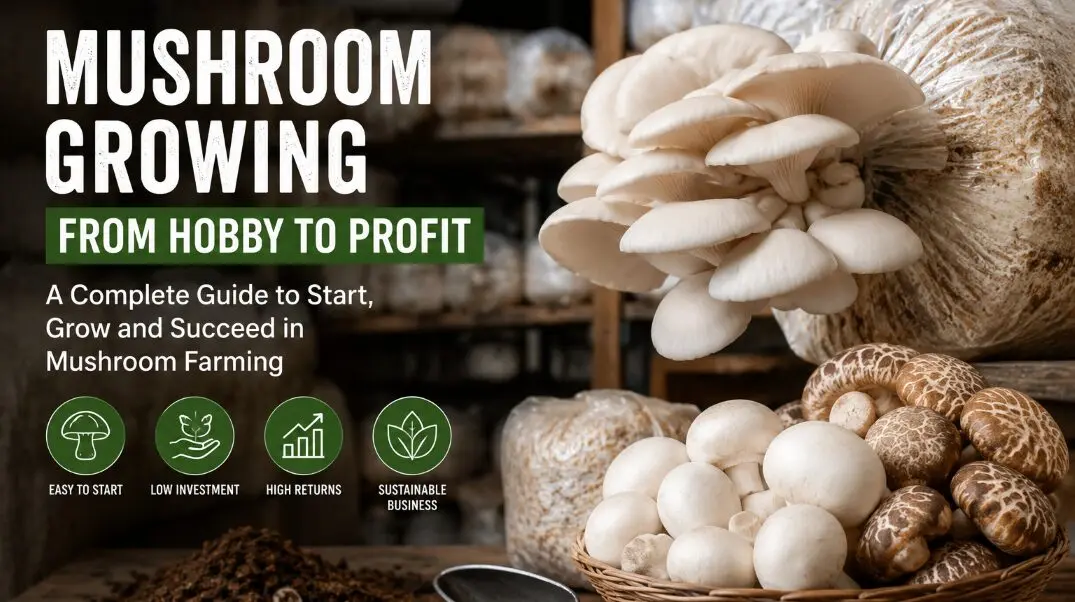
Mushroom farming involves cultivating known edible fungi on prepared organic materials under controlled conditions. A hobby can become a small business only after the grower can produce clean, consistent crops, maintain safe harvesting and storage practices, calculate the full cost of production, and confirm reliable customers before expanding.
Mushrooms can produce valuable food in a relatively small area, but they are not a guaranteed source of quick income.
Successful mushroom production requires much more than placing spawn in straw and waiting for mushrooms to appear. The grower must manage cleanliness, substrate preparation, temperature, humidity, fresh air, lighting, pests, harvesting, refrigeration, packaging, sales, and waste.
A beginner should first learn how to produce one mushroom species consistently. Expanding too soon can turn a manageable hobby into an expensive contamination and marketing problem.
What Is Mushroom Farming?
Mushroom farming is the controlled cultivation of edible fungi using a suitable substrate and a known mushroom culture or spawn.
Mushrooms are not green plants. They do not produce food through photosynthesis. The fungus grows through organic material as a network of fine threads called mycelium.
The visible mushroom is the fruiting body produced by that mycelium under suitable environmental conditions.
Cornell Small Farms explains that a mushroom is only one stage of the larger fungal life cycle. A grower must first establish healthy mycelium and then create the conditions that encourage fruiting. Read Cornell’s Mycology 101 guide.
Basic mushroom-growing terms
| Term | Meaning |
|---|---|
| Culture | Living mushroom mycelium maintained under controlled conditions |
| Spawn | Grain, sawdust, plugs, or another carrier colonised by mushroom mycelium |
| Substrate | Organic material on which the mushroom mycelium grows |
| Inoculation | Adding spawn to prepared substrate |
| Incubation | Period during which mycelium colonises the substrate |
| Fruiting | Stage in which environmental conditions encourage mushrooms to form |
| Pinning | Development of very small young mushrooms |
| Flush | A group of mushrooms maturing around the same time |
| Contamination | Growth of unwanted moulds, bacteria, insects, or other organisms |
| Spent substrate | Material remaining after useful mushroom production declines |
Understanding these terms makes it easier to follow supplier instructions and identify where a crop has failed.
Is Mushroom Farming Suitable for You?
Mushroom farming may suit someone who enjoys close observation, routine cleaning, environmental control, recordkeeping, and selling highly perishable produce.
Use the following readiness table before investing.
| Question | Ready to begin | Warning sign |
|---|---|---|
| Can you check the crop daily? | Daily inspection is practical | Growing room may be unattended |
| Is clean water available? | Reliable water source is available | Water quality is unknown |
| Can temperature and humidity be managed? | Conditions can be measured and adjusted | Room conditions change sharply |
| Can fresh air be supplied? | Ventilation is controllable | Room is sealed or poorly ventilated |
| Is refrigeration available? | Mushrooms can be cooled promptly | Harvest may remain warm for hours |
| Is there a market? | Buyers and preferred species are known | Production will begin before market research |
| Can contaminated material be isolated? | Separate disposal and cleaning plan exists | All batches share one uncontrolled room |
| Can costs be recorded? | Labour, energy, materials, and losses will be tracked | Only spawn and substrate costs are considered |
A home grow kit is a good learning project. It does not prove that a commercial operation will be profitable.
Important: Produce several successful crops and sell a small test quantity before purchasing a large steriliser, humidifier, shelving system, or commercial growing room.
Best Mushrooms for Beginners
Not every edible mushroom is equally easy to cultivate.
The best species depends on the available substrate, climate, market, equipment, and grower experience.
| Mushroom | Common production method | Beginner suitability | Main challenge |
|---|---|---|---|
| Oyster mushroom | Pasteurised straw or supplemented sawdust blocks | High | Fresh-air management and short shelf life |
| Shiitake | Hardwood logs or sawdust blocks | Moderate | Long incubation and strain-specific conditions |
| Lion’s mane | Supplemented hardwood sawdust blocks | Moderate | Sensitive fruit quality and environmental control |
| Wine cap | Outdoor woodchip beds | Moderate | Seasonal and less predictable production |
| Button or portobello | Prepared compost plus casing layer | Low for beginners | Complex composting and environmental management |
| Enoki | Controlled indoor production | Advanced | Tight environmental and food-safety control |
Oyster Mushrooms
Oyster mushrooms are often the most practical starting species because they can grow on straw or sawdust-based substrates and may fruit relatively quickly.
They are still sensitive to:
- Poor air exchange
- Excessive heat
- Low humidity
- Contaminated substrate
- Delayed harvest
- Weak refrigeration
Different oyster strains are adapted to different temperature ranges. Buy spawn suitable for the season and intended growing room rather than choosing only by cap colour.
Shiitake Mushrooms
Shiitake can be grown outdoors on hardwood logs or indoors on prepared sawdust blocks.
Log production requires less environmental equipment but involves a longer establishment period and seasonal harvests. Indoor blocks can provide more controlled production but require greater sanitation and climate management.
Cornell identifies shiitake as a reliable option for outdoor log production and notes that specialty species differ in their preferred wood and cultivation method. See Cornell’s outdoor mushroom production guide.
Lion’s Mane
Lion’s mane is valued in specialty markets but may be less forgiving than oyster mushrooms.
Poor fresh-air management can produce misshapen fruiting bodies. Excess moisture may encourage yellowing or contamination, while delayed harvesting can reduce quality.
Button Mushrooms
Button, cremini, and portobello mushrooms are forms of Agaricus bisporus.
Commercial production normally requires carefully prepared compost, pasteurisation, spawning, casing, pinning, and cropping. Penn State describes the commercial process as complex and notes that a full crop cycle can involve several controlled production stages. Explore Penn State’s mushroom production resources.
Button mushrooms are therefore not usually the simplest first commercial species.
Common Mistake: Choosing a mushroom because it has a high retail price. A high price does not help when the species performs poorly in your facility or customers do not buy it regularly.
Choose a Mushroom Production Method
There are several ways to enter mushroom growing.
Ready-to-Fruit Kit
A kit contains a block already colonised by mushroom mycelium.
It teaches:
- Humidity management
- Fresh-air control
- Pin development
- Harvest timing
- Basic crop observation
It does not teach spawn production, substrate treatment, inoculation, or commercial contamination control.
Purchased Colonised Blocks
A grower buys ready-to-fruit blocks from a specialist producer and focuses on fruiting, harvesting, packaging, and sales.
Advantages include:
- Lower laboratory investment
- Faster start
- Reduced substrate-preparation work
- Easier production testing
Limitations include:
- Higher block cost
- Dependence on a supplier
- Shipping risk
- Less control over block quality
- Lower margin than efficient in-house production
This can be a sensible transition between a hobby kit and a full production operation.
Indoor Bag or Block Production
The grower prepares substrate, inoculates it with spawn, incubates the bags, and fruits them in a controlled room.
This gives more production control but requires:
- Clean work areas
- Reliable spawn
- Substrate-treatment equipment
- Environmental controls
- Contamination management
- Greater technical skill
Outdoor Log Production
Hardwood logs can support species such as shiitake and, in some systems, oyster or lion’s mane.
Outdoor production has lower energy and infrastructure needs, but fruiting is more seasonal and less controllable. Cornell notes that indoor production allows a wider range of species and more reliable year-round scheduling, while outdoor systems have lower infrastructure costs but greater seasonal limits.
Outdoor Woodchip Beds
Species such as wine cap can be grown in prepared woodchip beds.
This method can fit gardens and diversified farms, but harvest timing depends heavily on weather and moisture.
Start With the Market
Do not design the farm before speaking to buyers.
Potential customers include:
- Restaurants
- Farmers’ markets
- Grocery shops
- Specialty food stores
- Farm shops
- Community-supported agriculture programs
- Caterers
- Hotels
- Food processors
- Direct household customers
Ask buyers:
- Which mushroom species do they purchase?
- How many pounds or kilograms do they need weekly?
- Which package size do they prefer?
- Which delivery days work best?
- Do they need certified or inspected suppliers?
- What defects cause rejection?
- Do they prefer clusters or separated mushrooms?
- What price do they currently pay?
- How quickly do they pay suppliers?
- Does demand change by season?
Cornell warns that new growers often focus heavily on production and only later discover that they have no reliable way to sell the crop. Strong production and strong market relationships must develop together.
Field Tip: Take a small sample box to potential buyers before expanding. Ask them to score appearance, size, cleanliness, packaging, flavour, and shelf life.
Designing a Small Mushroom Farm
A small indoor mushroom operation should separate clean and dirty activities.
Possible work zones include:
- Raw substrate storage
- Substrate preparation
- Heat treatment
- Cooling
- Clean inoculation
- Incubation
- Fruiting
- Harvesting
- Packing
- Refrigerated storage
- Contaminated-material isolation
- Equipment cleaning
The production flow should move from raw material toward finished mushrooms without repeatedly carrying dirty materials through clean areas.
Growing-room requirements
A fruiting room may need:
- Washable surfaces
- Shelving
- Humidity control
- Fresh-air exchange
- Temperature monitoring
- Air circulation
- Suitable lighting
- Floor drainage
- Insect screens
- Safe electricity
- Easy access for cleaning
- Separation from living areas
Avoid using a damp room simply because mushrooms like humidity. Uncontrolled dampness, stagnant air, mould, building damage, and electrical hazards do not create a safe mushroom farm.
BlogAgri’s aquaponics guide for beginners explains similar principles of controlled-environment production, including daily monitoring, water management, electricity, and backup planning.
Substrate Selection
The substrate is the food source and physical environment for mushroom mycelium.
Different species prefer different materials.
| Mushroom | Common substrate examples |
|---|---|
| Oyster | Straw, hardwood sawdust, cottonseed hull blends, other suitable agricultural residues |
| Shiitake | Hardwood logs or supplemented hardwood sawdust |
| Lion’s mane | Supplemented hardwood sawdust |
| Wine cap | Hardwood chips and outdoor organic beds |
| Button mushroom | Specially prepared compost with a casing layer |
Penn State explains that mushroom substrates are prepared from organic plant materials and must be managed carefully to provide suitable nutrition and microbial conditions.
Do not assume that every cheap agricultural waste will support reliable production. The material may contain:
- Pesticide residues
- Excess salt
- Contaminating mould
- Unsuitable wood species
- Chemical treatments
- Too much moisture
- Too little structure
- Inconsistent particle size
Test a small batch before purchasing tonnes of material.
Pasteurisation and Sterilisation Are Different
These terms should not be used interchangeably.
Pasteurisation
Pasteurisation reduces competing organisms without necessarily eliminating every living microorganism.
It is commonly used for suitable low-nutrient substrates such as straw in some oyster mushroom systems.
Sterilisation
Sterilisation aims to eliminate living organisms from the substrate.
Highly supplemented sawdust blocks usually require more complete treatment because added nutrients also support contaminants.
Once sterilised substrate cools, it becomes highly vulnerable to contamination. It must be inoculated using an appropriate clean process.
Safety Note: Steam vessels, pressure sterilisers, burners, hot water, and pressurised equipment can cause severe burns or mechanical injury. Use equipment designed for the process and follow manufacturer, fire-safety, and workplace requirements.
Mushroom Farming Step by Step
1. Select One Species and Strain
Choose according to:
- Local climate
- Available substrate
- Buyer demand
- Fruiting temperature
- Shelf life
- Production method
- Spawn supplier support
Do not begin with five species at once.
2. Buy Reliable Spawn
Purchase spawn from a reputable laboratory or supplier.
Ask for:
- Species and strain
- Production date
- Recommended storage
- Suitable substrate
- Recommended spawning rate
- Incubation conditions
- Fruiting conditions
- Contamination policy
Spawn should appear healthy and match the supplier’s description. Unusual colours, unpleasant odours, slime, or uncolonised wet areas may indicate a problem.
3. Prepare the Substrate
Measure:
- Dry substrate weight
- Water added
- Supplements
- Final moisture
- Treatment time
- Treatment temperature
- Batch number
Avoid estimating everything by eye once the project moves beyond a few hobby bags.
4. Heat-Treat the Substrate
Use the method appropriate for the species and substrate.
Do not copy a straw pasteurisation method for a heavily supplemented sawdust block.
5. Cool the Substrate
Do not add spawn to hot substrate.
Cool it in a clean, protected area and prevent contact with dirty floors, insects, untreated air, and contaminated tools.
6. Inoculate Cleanly
Clean:
- Hands
- Work surface
- Containers
- Cutting tools
- Bag openings
- Reusable equipment
Limit unnecessary talking, movement, open doors, and dirty materials around the inoculation area.
Inoculation does not always require an expensive laboratory for basic low-tech production, but the cleaner the process, the lower the contamination opportunity.
7. Incubate the Bags or Logs
During incubation, mycelium spreads through the substrate.
Monitor:
- Temperature
- Moisture
- Colonisation pattern
- Bag damage
- Unusual colour
- Odour
- Insects
- Excess heat
Mycelium produces heat as it grows. The temperature inside a tightly packed group of bags may be higher than the room temperature.
Do not place all bags against one another without considering heat buildup and air movement.
8. Introduce Fruiting Conditions
The change from incubation to fruiting may involve:
- Lower or different temperature
- Higher humidity
- Fresh-air exchange
- Light
- Opening or cutting the bag
- Soaking logs
- Changing carbon dioxide levels
Exact requirements differ by species and strain. Follow supplier instructions and adjust through crop records rather than using one universal setting.
9. Monitor Pinning and Growth
Check the crop at least daily.
Record:
- Pinning date
- Room temperature
- Relative humidity
- Ventilation changes
- Watering
- Stem shape
- Cap development
- Contamination
- Harvest date
Long stems and small caps in oyster mushrooms often indicate inadequate fresh air, although strain and light can also affect form.
Cracked or dry edges may suggest low humidity or excessive airflow. Wet, slimy surfaces may indicate over-misting, poor ventilation, or disease.
10. Harvest at the Correct Stage
Harvest before the mushrooms become overmature, damaged, or heavily spore-producing.
For oyster mushrooms, many growers harvest a cluster while the caps are still fresh and before the edges turn strongly upward. The exact stage depends on the buyer.
Use a clean knife or twist the cluster carefully according to the species and production system.
Remove damaged substrate and trim the base during packing rather than leaving dirty material attached.
11. Cool the Crop Promptly
Fresh mushrooms are highly perishable.
The FDA advises storing mushrooms and other perishable fresh produce in a clean refrigerator at 40°F or below. It also recommends clean hands, clean equipment, separation from raw animal products, and removal of rotten produce. Read the FDA produce-safety guidance.
Do not wash mushrooms before storage unless the production and packaging process specifically requires it. Surface moisture may shorten shelf life.
Environmental Control
Exact requirements depend on mushroom species and strain.
Use this table as a management framework rather than a universal set of target numbers.
| Factor | Too low | Too high |
|---|---|---|
| Temperature | Slow growth or delayed fruiting | Heat stress, contamination, poor fruit quality |
| Humidity | Dry pins, cracking, low yield | Wet surfaces, bacterial problems, mould |
| Fresh air | Long stems, weak caps, high carbon dioxide | Drying and unstable humidity |
| Light | Weak orientation or abnormal form in some species | Heat or drying if light is intense |
| Substrate moisture | Small crop and stalled growth | Poor aeration and contamination |
| Air movement | Stagnant pockets | Direct drying of mushrooms |
Use calibrated instruments where possible. A cheap sensor should be checked against another reliable instrument before it controls an expensive crop.
Agricultural Insight: High humidity does not mean continuously spraying mushrooms. The goal is humid air with clean, appropriately dry fruiting surfaces—not standing water on caps and floors.
Contamination Management
Contamination is a normal risk in mushroom production, but it should not be accepted as unavoidable waste.
Common warning signs include:
- Green mould
- Black mould
- Pink or orange growth
- Sour odour
- Rotten smell
- Slime
- Unusual heat
- Slow patchy colonisation
- Insect larvae
- Bags that swell unexpectedly
What to do with a contaminated bag
- Do not open it in the clean production area.
- Isolate it from healthy blocks.
- Seal it where appropriate.
- Record the batch number.
- Remove it using a route that avoids clean rooms.
- Dispose of or treat it according to local waste rules.
- Clean the affected area.
- Investigate the likely source.
Do not scrape mould from a contaminated block and sell mushrooms growing beside it.
Track contamination by batch
Record:
- Spawn lot
- Substrate source
- Preparation date
- Treatment method
- Inoculation date
- Worker
- Room
- Contamination type
- Number of failed bags
- Suspected cause
A repeated pattern may identify a weak spawn lot, inadequate treatment, dirty equipment, poor cooling, or a contaminated room.
Worker Health and Safety
Mushroom farms can expose workers to humidity, lifting, hot equipment, cleaning chemicals, organic dust, mould, and mushroom spores.
NIOSH investigations have linked high airborne mushroom and mould-spore exposure with respiratory symptoms and hypersensitivity illness in some mushroom workers. Ventilation, dust reduction, worker training, suitable protective equipment, and medical attention for persistent respiratory symptoms are important.
Practical precautions include:
- Ventilate fruiting and packing areas
- Harvest before heavy spore release where appropriate
- Clean without creating airborne dust
- Use suitable respiratory protection when required
- Train workers in chemical handling
- Provide gloves where tasks require them
- Use safe lifting methods
- Guard hot and pressurised equipment
- Keep floors dry and non-slip
- Investigate coughing, wheezing, chest tightness, or persistent irritation
A commercial farm should follow local workplace safety regulations rather than relying on informal home-growing methods.
Food Safety and Mushroom Sales
Fresh mushrooms are food and should be produced in a clean, traceable system.
USDA’s Mushroom Good Agricultural Practices program provides a commodity-specific audit framework for mushroom production facilities and supply chains. Review the USDA Mushroom GAP program.
Food-safety controls may include:
- Safe water
- Worker hygiene
- Clean harvest tools
- Clean containers
- Pest control
- Equipment sanitation
- Temperature control
- Traceability
- Separate waste handling
- Clean vehicles
- Documented corrective action
FDA has highlighted food-safety risks in mushroom growing, harvesting, holding, and packing, including concerns connected to Listeria and Salmonella in parts of the specialty mushroom supply chain.
Before selling, confirm:
- Business registration
- Farm or food permits
- Produce-safety requirements
- Labelling rules
- Packaging rules
- Farmers’ market requirements
- Tax requirements
- Insurance
- Processing licenses
- Rules for dried or powdered products
Regulations vary by country and region.
Safety Note: Do not sell wild-collected mushrooms under a cultivated-mushroom label. Wild species can be difficult to identify, and cooking does not reliably make poisonous species safe.
Packaging and Storage
Packaging should protect the mushrooms without trapping excessive condensation.
Possible packaging includes:
- Breathable punnets
- Vented containers
- Paper bags for some direct sales
- Food-safe boxes with liners
- Buyer-approved bulk packaging
FDA recommends keeping fresh mushrooms refrigerated at 40°F or below. For certain wild-type mushrooms, it also advises breathable packaging because unsuitable sealed storage can increase food-safety risks.
Label commercial packages according to local requirements.
Useful information may include:
- Mushroom species
- Farm name
- Net weight
- Harvest or packing date
- Storage instructions
- Batch code
- Contact details
- Required regulatory statements
Measuring Mushroom Yield
Do not record only the final sales value.
Track production by batch.
Useful measurements include:
- Dry substrate weight
- Wet substrate weight
- Spawn used
- Number of bags
- Number contaminated
- First harvest date
- Weight per flush
- Total harvested weight
- Marketable weight
- Rejected weight
- Sale price
- Labour hours
- Electricity
- Packaging
Biological efficiency
Commercial growers often use biological efficiency to compare how efficiently dry substrate is converted into fresh mushrooms.
Biological efficiency = fresh mushroom weight ÷ dry substrate weight × 100
Cornell uses biological efficiency as a central production variable in indoor mushroom enterprise planning.
For example, if 10 pounds of dry substrate produce 8 pounds of fresh mushrooms:
8 ÷ 10 × 100 = 80% biological efficiency
This measurement helps compare strains, substrate formulas, workers, rooms, and seasons.
It does not measure profit by itself.
Can Mushroom Farming Be Profitable?
Mushroom farming may be profitable when the grower has:
- Consistent yields
- Low contamination
- Efficient labour
- Reliable customers
- Suitable prices
- Refrigeration
- Planned delivery
- Controlled energy costs
- Good-quality spawn
- Accurate records
Cornell advises growers to complete an enterprise assessment before committing to a mushroom business. The assessment should examine markets, resources, expenses, alternative enterprises, and realistic expected revenue.
Historical Cornell studies have reported attractive returns for some specialty mushroom systems, but those figures were based on particular regions, years, scales, markets, labour assumptions, and production methods. They should not be presented as universal income promises.
Mushroom production cost worksheet
| Cost item | Estimated amount |
|---|---|
| Spawn | $_____ |
| Substrate | $_____ |
| Supplements | $_____ |
| Bags or containers | $_____ |
| Fuel or steam | $_____ |
| Electricity | $_____ |
| Water | $_____ |
| Humidification | $_____ |
| Ventilation | $_____ |
| Labour | $_____ |
| Cleaning supplies | $_____ |
| Pest management | $_____ |
| Refrigeration | $_____ |
| Packaging | $_____ |
| Transport | $_____ |
| Market fees | $_____ |
| Rent or building cost | $_____ |
| Equipment depreciation | $_____ |
| Contaminated batches | $_____ |
| Unsold mushrooms | $_____ |
| Total cost | $_____ |
Revenue worksheet
| Revenue item | Estimated amount |
|---|---|
| Marketable fresh mushrooms | _____ lb or kg |
| Average selling price | $_____ |
| Fresh mushroom revenue | $_____ |
| Approved value-added sales | $_____ |
| Total revenue | $_____ |
| Estimated profit | $_____ |
Use:
Estimated profit = total revenue − total production and marketing costs
Prepare three scenarios:
- Lower yield with higher contamination
- Expected yield and normal sales
- Strong yield with low losses
If the enterprise is profitable only in the third scenario, the business carries significant risk.
BlogAgri’s small farm income ideas guide can help compare mushroom production with other farm enterprises.
Important: Include your own labour. A project that produces positive cash flow but pays nothing for hundreds of working hours is not automatically a profitable business.
Scaling From Hobby to Business
Use stages instead of making one large jump.
Stage 1: Grow Kit
Learn fruiting, harvesting, humidity, and fresh-air management.
Stage 2: Purchased Blocks
Fruit several blocks on a schedule and test local sales.
Stage 3: Small Substrate Batches
Prepare a limited number of bags and measure contamination.
Stage 4: Repeated Production
Complete several crop cycles using the same documented process.
Stage 5: Test Market
Supply a small number of customers consistently.
Stage 6: Business Planning
Calculate full production, marketing, and infrastructure costs.
Stage 7: Controlled Expansion
Increase capacity only after the existing system is reliable.
A grower should not add more bags when the current production room already has unresolved contamination, ventilation, labour, or sales problems.
Selling Value-Added Mushroom Products
Possible products include:
- Dried mushrooms
- Mushroom powder
- Seasoning blends
- Soup mixes
- Ready-to-cook packs
- Grow kits
- Colonised blocks
- Spawn
- Workshops
Each product may introduce additional requirements for:
- Processing licenses
- Dehydration controls
- Food-safety plans
- Labelling
- Shelf-life testing
- Allergen or ingredient statements
- Packaging
- Claims
- Tax
- Shipping
Cornell notes that processed products require additional attention to identity, safety, regulatory compliance, and validated production methods.
Do not describe a mushroom food as treating cancer, strengthening immunity, curing disease, or replacing medicine without lawful and reliable evidence.
Using Spent Mushroom Substrate
Spent substrate may still contain organic matter and nutrients, but its suitability depends on the original ingredients, salts, contamination, and treatment history.
Possible uses include:
- Composting
- Soil amendment
- Mulch
- Worm-composting feedstock
- Landscape use
- Further research trials
Penn State notes that spent mushroom substrate can improve soil structure, but fresh material may contain salts that affect sensitive crops. Weathering and testing may be needed before garden use. Read Penn State’s spent mushroom substrate guide.
Do not spread substrate containing unknown contamination through a food garden without assessing the risk.
Common Mushroom Farming Mistakes
Starting With Too Many Species
Each species adds another environmental schedule and contamination risk.
Buying Cheap or Unknown Spawn
Poor spawn can waste every other input.
Treating a Damp Basement as a Growing Room
Uncontrolled moisture can damage the building and encourage unwanted mould.
Confusing Pasteurisation With Sterilisation
The wrong treatment can cause repeated contamination.
Ignoring Fresh Air
High humidity alone does not create well-shaped mushrooms.
Misting Mushroom Caps Continuously
Wet surfaces can reduce quality and encourage disease.
Expanding Before Finding Buyers
Mushrooms may be unsold before the market is developed.
Ignoring Refrigeration
A good crop can lose value quickly after harvest.
Failing to Record Labour
The enterprise may appear profitable only because the owner’s time is treated as free.
Opening Contaminated Bags Indoors
This can spread spores through the production area.
Using Wild Mushrooms as Spawn
Wild material may be misidentified or carry competing organisms.
Selling Dried Powder Without Checking Regulations
Processing may require additional licensing, testing, and labelling.
When You Should Not Expand the Mushroom Farm
Delay expansion when:
- Contamination remains high
- The species is not producing consistent quality
- Refrigeration is inadequate
- The growing room cannot be cleaned
- Ventilation is unreliable
- Customers have not been tested
- Workers experience respiratory symptoms
- Labour requirements are unknown
- Electricity is unreliable
- Permits have not been confirmed
- Price assumptions are unrealistic
- Waste disposal is unresolved
- Current records are incomplete
Correcting a small system is easier than correcting a warehouse full of contaminated substrate.
Frequently Asked Questions
Which mushroom is best for beginners?
Oyster mushrooms are often the most practical beginner choice because they can grow on several prepared substrates and may fruit relatively quickly. Growers still need to control contamination, humidity, temperature, fresh air, harvesting, and refrigeration. Choose a strain suited to the intended season and production room.
Can mushroom farming be profitable?
Mushroom farming can be profitable when marketable yield, selling price, customer demand, and production efficiency cover spawn, substrate, energy, labour, refrigeration, packaging, transport, contamination, and unsold produce. Profit should be tested through repeated production records rather than estimated from retail prices alone.
How much space is needed for mushroom farming?
A small trial can begin on one shelving unit or in a compact controlled room. Commercial space depends on the number of blocks, aisle access, ventilation, humidification, incubation, packing, storage, and cleaning needs. Production capacity should be calculated from usable shelf area rather than total floor area.
Do mushrooms need sunlight?
Mushrooms do not use sunlight for photosynthesis, but many cultivated species benefit from some light during fruiting because it supports normal orientation and development. Bright direct sun can overheat or dry a fruiting room. Lighting requirements vary by species and strain.
What is the best substrate for oyster mushrooms?
Oyster mushrooms can grow on suitable pasteurised straw or prepared sawdust-based substrates. The best material depends on strain, local availability, cleanliness, particle size, moisture, treatment method, and production system. Test a small batch before adopting a new agricultural residue commercially.
What is the difference between spawn and spores?
Spawn is a carrier such as grain or sawdust already colonised by mushroom mycelium and is commonly used to inoculate substrate. Spores are microscopic reproductive cells. Beginners normally achieve more predictable cultivation by purchasing known, healthy spawn rather than attempting to grow commercial crops directly from spores.
How long does it take to grow mushrooms?
The production period varies by species, strain, substrate, spawn rate, temperature, and method. Oyster mushrooms on prepared blocks may fruit relatively quickly, while shiitake logs may require many months before the first crop. Supplier instructions and batch records provide the most useful schedule.
Why are my mushroom bags turning green?
Green growth commonly indicates an unwanted mould. Isolate the bag without opening it in the clean growing area, record the batch, and remove it safely. Investigate spawn quality, substrate treatment, cooling, inoculation hygiene, bag damage, and room sanitation before preparing another batch.
How should fresh mushrooms be stored?
Cool mushrooms promptly after harvest and store them in a clean refrigerator at 40°F or below. Use suitable breathable or vented food-grade packaging, avoid crushing, and separate them from raw animal products. Storage life depends on species, freshness, handling, temperature, and packaging.
Can I grow mushrooms in a basement?
A basement may be converted into a growing area only when temperature, humidity, ventilation, drainage, cleanliness, electrical safety, and building moisture can be managed. Simply making a basement damp can encourage structural mould and unhealthy air rather than safe mushroom production.
Can contaminated mushroom substrate be saved?
A visibly contaminated commercial block should normally be isolated rather than opened or scraped in the production room. Attempting to save it can spread spores and threaten healthy batches. The safest action depends on the organism, crop stage, facility, and local disposal requirements.
Do mushroom farms need food-safety certification?
Requirements vary by country, buyer, business size, product, and sales channel. Even when a voluntary certification is not required, growers need clean water, worker hygiene, sanitation, refrigeration, traceability, pest control, and safe packing. Confirm the exact requirements with local food and agriculture authorities.
Prove the System Before Expanding It
Turning mushroom growing from a hobby into a profitable enterprise requires technical skill and business discipline.
Begin with one species, one production method, and a small number of batches. Record contamination, yield, labour, energy, packaging, shelf life, rejected mushrooms, customer feedback, and actual selling prices.
Expand only when you can answer five questions clearly:
- Can the farm produce consistent mushrooms?
- Can contamination be controlled?
- Can the crop be cooled and handled safely?
- Are customers willing to buy every week?
- Does the selling price cover all costs, including labour?
For a broader comparison of farm-enterprise options, read BlogAgri’s small farm income ideas and cash crops for small farms. You can also explore BlogAgri’s newer modern mushroom farming guide to avoid publishing two pages that compete for the same search intent.