Email: blogagri2@gmail.com

Plants Mosquitoes Hate: What Actually Helps

Mosquitoes have a special talent for spoiling a peaceful evening outdoors.
You sit down with a cup of tea, start enjoying the garden, and before long you are waving mosquitoes away from your arms and ankles. Naturally, that sends many gardeners searching for plants mosquitoes hate, hoping a few well-placed pots will solve the problem.
There is some sense behind the idea. Lemongrass, basil, mint, rosemary, lavender, marigolds, and lemon balm all have noticeable fragrances, and some contain aromatic compounds associated with mosquito-repelling products.
But there is an important difference between a fragrant living plant and a tested mosquito repellent.
A lavender plant beside your chair does not create an invisible protective barrier. A pot of basil cannot make up for buckets, blocked gutters, birdbaths, or plant saucers holding stagnant water nearby.
I still like growing fragrant herbs and flowers around patios. They smell good, look attractive, and many of them are useful in the kitchen. I simply do not expect them to do a job they were never designed to do.
Garden Reality Check: Grow fragrant plants because they improve your garden. Treat any effect they have on mosquito activity nearby as a possible bonus, not reliable protection from bites.
For reducing mosquitoes around the home, dealing with standing water is much more important.
Do Plants Mosquitoes Hate Really Work?
They may influence a very small area around the plant, especially when aromatic leaves are touched or crushed, but they should not be expected to work like an approved mosquito repellent.
Many plants commonly described as mosquito-repelling contain aromatic oils in their leaves and stems.
You notice this immediately with mint.
Walk past a healthy mint plant and rub a leaf between your fingers. The smell becomes much stronger. Rosemary, basil, lemon balm, and lemongrass behave in a similar way.
That does not mean planting them around your patio creates reliable protection.
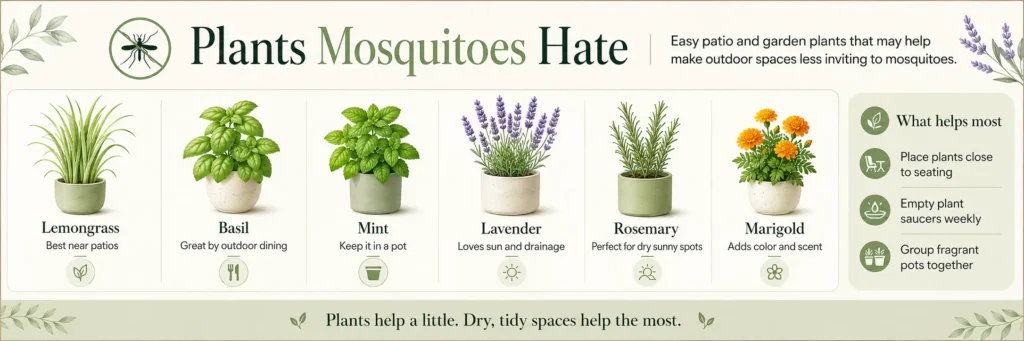
Wind, distance, plant health, temperature, and the number of mosquitoes nearby can all affect how noticeable the fragrance is.
Imagine a balcony with basil, mint, and lemongrass around a small table. It can smell wonderfully fresh and make the space much more enjoyable.
But if the saucers underneath those containers hold water for days, you have a bigger problem than plant fragrance can solve.
The CDC recommends checking your property at least weekly for containers that collect water, including flowerpot saucers, buckets, toys, birdbaths, and other outdoor items.
The Simple Rule: Fragrant plants can improve the patio. Removing mosquito breeding sites improves mosquito control.
Why Mosquitoes Dislike Some Plant Smells
Mosquitoes locate people using several cues, including carbon dioxide, body odors, heat, and moisture.
Aromatic herbs release compounds with strong scents. Lemongrass, mint, rosemary, basil, sage, and lemon balm are obvious examples.
Some plant-derived compounds are also used in formulated insect-repellent products.
The important word here is formulated.
Growing a plant containing an aromatic compound is not the same as applying a product that contains a tested concentration of an active ingredient.
For example, the EPA lists several active ingredients used in registered skin-applied repellents. That should not be confused with simply placing the source plant beside a garden chair.
I would still happily plant rosemary, basil, lavender, or mint beside a patio.
Just grow them for the right reasons: fragrance, food, flowers, texture, and garden enjoyment.
Good to Know: A plant can contain an interesting aromatic compound without the whole living plant functioning as an effective personal mosquito repellent.
Read Also: Low Maintenance Outdoor Plants that Grow in Full Shade
7 Best Plants Mosquitoes Hate for a Fragrant Garden
If you want to experiment with aromatic plants around a patio, balcony, or garden, start with plants that are useful even without mosquito claims.
| Plant | Best Place to Grow | Care Level | Extra Benefit | Quick Note |
|---|---|---|---|---|
| Lemongrass | Large pots, patios, warm gardens | Easy to medium | Fresh lemon fragrance | Loves warmth |
| Basil | Pots, kitchen gardens, sunny patios | Easy | Excellent cooking herb | Water regularly |
| Mint | Pots, balconies, patio corners | Easy | Tea and drinks | Keep it contained |
| Rosemary | Sunny dry spots, pots, borders | Easy | Cooking herb | Avoid soggy soil |
| Lavender | Sunny borders, pots, paths | Medium | Flowers and fragrance | Needs good drainage |
| Marigold | Garden edges, vegetable beds, pots | Easy | Long-lasting color | Beginner friendly |
| Lemon balm | Containers, herb gardens | Easy | Fragrant tea herb | Can spread quickly |
1. Lemongrass: A Strong Fragrance for Warm Gardens
Lemongrass is usually one of the first plants gardeners mention when mosquitoes enter the conversation.
I can understand why.
Rub one of those long leaves carefully between your fingers and the fresh citrus scent is immediately noticeable.
The plant also looks good.
Its long grassy leaves form generous clumps that work well beside patios, paths, garden borders, and outdoor seating areas.
In warm climates, lemongrass can become surprisingly large. In cooler regions, I prefer growing it in a roomy pot. That makes it much easier to move when temperatures begin dropping.
If you are adding it to a patio, put the plant somewhere you will actually enjoy it.
A large pot beside an outdoor chair makes more sense than hiding the plant behind a shed simply because someone called it a “mosquito plant.”
Give lemongrass plenty of sunlight, warmth, and regular moisture.
When the plant becomes badly root-bound or repeatedly dries out, you will often see brown tips and tired-looking growth.
Whether you notice any difference in mosquito activity or not, healthy lemongrass still earns its place by giving the garden height, movement, fragrance, and a tropical appearance.
Gardener’s Tip: Lemongrass can become a large clump. Start with a container that gives its roots room rather than moving it into a new pot every few weeks.
From BlogAgri’s Agri-Tech section: How to Use Drones for Crop Spraying: Beginner’s Guide
2. Basil: Fragrant, Useful, and Worth the Space
Basil is one of my favorite plants to recommend because it earns every inch of growing space.
Even if you forget mosquitoes completely, you still have fresh leaves for pasta, salads, sauces, soups, sandwiches, and pizza.
The plant also releases a strong, familiar scent when you harvest or pinch the growing tips.
Sweet basil is the easiest variety to find, although lemon basil and Thai basil are worth growing if you enjoy experimenting in the kitchen.
A pot beside the kitchen door works beautifully.
You can grab a handful while cooking and enjoy the plant whenever you sit outside.
Basil does need attention.
It prefers warmth, good light, and fairly steady moisture. I do not keep the soil soaking wet, but I also try not to let container-grown basil wilt repeatedly.
If I am growing it mainly for leaves, I pinch away flower buds so the plant continues producing fresh leafy growth.
Kitchen Garden Tip: If a plant gives you fresh food every week, it has already justified its place in the garden. You do not need to depend on mosquito claims to make basil worthwhile.
If you enjoy growing herbs in small spaces, BlogAgri’s guide to Hydroponic Farming: Setup, Costs, Benefits & Systems also discusses basil and other leafy herbs as practical beginner crops.
3. Mint: Strong Scent, Big Personality
Mint does not know how to be subtle.
Brush against the leaves and the scent immediately follows you.
Peppermint and spearmint are especially useful around patios, balconies, steps, and kitchen gardens.
They are also plants most households can actually use.
Fresh mint works well in tea, lemonade, chutney, sauces, salads, and cold summer drinks.
But mint comes with one warning every new gardener deserves to hear:
Keep it under control.
Mint spreads through vigorous underground stems and can travel farther through a garden bed than you expect.
A tiny plant that looks harmless in spring can become a much bigger gardening project later.
That is why I usually keep mint in a container.
Put the pot somewhere you can reach it easily, such as near an outdoor table or kitchen door.
If you want to start your own plant, read BlogAgri’s complete guide on how to grow mint at home.
Gardener’s Warning: Mint is one of those plants people love during the first season and sometimes fight during the second. A pot keeps the relationship much friendlier.
Again, grow mint because it is useful and wonderfully fragrant.
Do not rely on a mint pot as personal mosquito protection.
4. Rosemary: Perfect for Sunny, Dry Corners
If you have a sunny part of the garden where softer herbs struggle with heat and dry soil, rosemary may feel right at home.
Its needle-like leaves carry a strong woody fragrance that becomes much more noticeable when touched.
Rosemary generally prefers drier conditions than basil or mint.
One of the easiest ways to make rosemary unhappy is leaving its roots sitting in heavy, constantly wet soil.
Use a free-draining potting mix in containers and give the plant as much sunlight as you reasonably can.
A mature rosemary plant looks excellent beside steps, near a patio wall, or along a path.
Every time you brush against the foliage, you release some of that familiar herbal scent.
Then there is the kitchen.
Rosemary works beautifully with roasted vegetables, potatoes, bread, soups, marinades, and many savory dishes.
For a hot, relatively dry garden, rosemary is often easier to live with than thirsty herbs requiring constant watering.
Plant Pairing Idea: Rosemary, lavender, sage, and thyme enjoy similar sunny, well-drained conditions. They can make an attractive low-water herb corner when your climate suits them.
5. Lavender: Beautiful, Fragrant, but Not a Miracle
Lavender has probably suffered from more exaggerated mosquito claims than almost any other garden plant.
It certainly smells wonderful.
A healthy lavender plant in flower can transform a sunny border, path, or patio container.
The silvery foliage and purple flowers give you something attractive even when mosquitoes are the last thing on your mind.
But one small lavender plant will not turn your backyard into a mosquito-free zone.
That is simply asking too much from a plant.
Lavender prefers sunlight and excellent drainage.
Heavy, wet soil causes far more problems than relatively dry conditions.
If your garden remains damp after rain, try a raised area or a container with good drainage rather than forcing lavender into unsuitable soil.
I plant lavender for its flowers, fragrance, shape, and garden character.
That is already plenty.
Reality Check: “Mosquito-repelling plant” is often a nursery marketing phrase. Judge a plant by what it genuinely brings to your garden, not by the strongest claim printed on the label.
6. Marigolds: Easy Color With a Distinctive Smell
Marigolds are cheerful plants.
Their yellow, orange, and reddish flowers quickly brighten vegetable beds, containers, walkways, and sunny borders.
They also have a distinctive smell, which is one reason they frequently appear in lists of plants mosquitoes supposedly dislike.
Do marigolds form a protective mosquito barrier around a garden?
No.
Are they still worth growing?
Absolutely.
They are excellent beginner flowers.
Give them plenty of sunshine, reasonable soil, and regular water while they establish. Many varieties flower for months without needing much fuss.
I especially like planting them around vegetable beds and patio edges because they add instant color.
Beginner Pick: If your garden looks a little dull, marigolds may provide more obvious value through their flowers than through any possible effect on mosquitoes.
7. Lemon Balm: Fresh Lemon Scent in a Pot
Lemon balm has a gentle citrus fragrance that becomes much stronger when you touch its leaves.
It belongs to the mint family, and that tells experienced gardeners something immediately:
It likes to grow.
Sometimes a little too enthusiastically.
If you have a small garden, I recommend growing lemon balm in a container rather than giving it unrestricted access to an open bed.
Keep the pot near a seating area, balcony, or herb garden where you can enjoy the leaves and their scent.
The leaves are also commonly grown for herbal tea.
Lemon balm is easygoing when contained.
Plant it without boundaries, though, and you may eventually find seedlings or spreading growth appearing where you did not invite them.
Container Tip: Vigorous herbs are often much easier to enjoy when the pot decides their boundaries instead of the gardener having to enforce them later.
What About Scented Geranium, Sage, and Thyme?
These plants are worth mentioning, but I would not add them as another three “best mosquito-repellent plants” when the article is specifically about seven.
Scented geranium is particularly misunderstood.
You may see it sold as a “citronella plant” or “mosquito plant.” Some varieties have pleasant citrus-scented foliage, but keeping one beside your chair is not equivalent to using a formulated citronella or mosquito-repellent product.
Grow it because you enjoy its foliage and fragrance.
Sage and thyme are even easier to recommend because both are useful kitchen herbs.
They also fit nicely beside rosemary and lavender because they generally appreciate sunny, well-drained conditions.
If you enjoy growing culinary herbs, explore more guides in BlogAgri’s Herbs section.
Edible Fragrant Plants Are a Smart Starting Point
For beginners, edible herbs make the most sense.
Basil, mint, rosemary, thyme, sage, lemongrass, lemon balm, garlic, and chives can all earn their space in the kitchen as well as the garden.
That keeps your expectations realistic.
If you purchase a plant only because a label promises mosquito-repelling benefits, you may be disappointed.
If you grow the same plant because you enjoy its fragrance, flavor, flowers, or appearance, you still receive something worthwhile.
A small balcony might hold basil, mint, thyme, and rosemary.
A sunny yard could include lemongrass, lavender, marigolds, sage, and chives.
Choose plants that suit your actual growing conditions first.
Everything else comes second.
Smart Gardening Principle: Choose multipurpose plants. A herb that gives you food, fragrance, and attractive foliage is valuable even if its mosquito effect turns out to be negligible.
Growing herbs can even become more than a hobby. BlogAgri’s guide to small farm income ideas explains how fresh herbs can fit into a small-scale farming or garden business.
Best Plants Mosquitoes Hate by Garden Space
Your available space matters.
A tiny apartment balcony needs a different setup from a large backyard.
| Garden Space | Good Plant Choices | Practical Tip |
|---|---|---|
| Small balcony | Basil, mint, rosemary | Use containers and leave space for airflow |
| Patio seating area | Lemongrass, basil, lavender | Grow plants you enjoy seeing and smelling |
| Outdoor dining table | Basil, rosemary, mint | Choose herbs you will actually use |
| Sunny garden border | Lavender, rosemary, marigold | Match plants with similar sun needs |
| Kitchen garden | Basil, mint, chives, thyme | Prioritize edible herbs |
| Doorway area | Rosemary, basil, scented geranium | Keep containers tidy and drained |
| Warm humid garden | Lemongrass, basil, mint, marigold | Watch vigorous growth |
| Dry climate garden | Rosemary, lavender, sage, thyme | Excellent drainage matters |
If your outdoor area receives very little sunlight, do not force sun-loving rosemary and lavender into it. Instead, see BlogAgri’s guide to low-maintenance outdoor plants that grow in full shade.
Plants to Use Carefully Around Pets and Children
“Natural” does not automatically mean harmless.
That is worth remembering whenever you introduce unfamiliar plants, essential oils, or homemade remedies into a garden shared with pets or young children.
Some plants spread aggressively.
Some may irritate skin.
Others should not be eaten.
Essential oils deserve particular care because they are much more concentrated than the living plants they come from.
| Plant or Product | Main Concern | Practical Approach |
|---|---|---|
| Mint | Spreads aggressively | Grow it in a pot |
| Lemon balm | Can spread through beds | Use containers |
| Wormwood | Not suitable for every household | Research safety before planting |
| Ageratum / floss flower | Not intended as an edible plant | Use care around pets and young children |
| Essential oils | Concentrated and may cause irritation or other problems | Follow product-specific guidance |
| Scented geranium | Often marketed with exaggerated mosquito claims | Grow primarily for fragrance |
Safety Note: Never assume that because a product or oil comes from a plant, it is automatically safe to put on skin, give to a pet, or use around children.
When reliable protection against mosquito bites is necessary, the CDC recommends proven protective measures rather than relying on garden plants.
Where Should You Place Fragrant Plants?
Placement matters, although not because these plants create an invisible protective bubble.
It matters because fragrant plants are most useful and enjoyable when they are close enough to smell, touch, harvest, and care for.
Put basil near an outdoor dining table.
Grow mint close enough to pick for drinks.
Place rosemary along a sunny path.
Use lemongrass as a larger architectural plant near a patio.
Good locations include:
- Outdoor dining areas
- Porch steps
- Window boxes
- Balcony corners
- Garden benches
- Kitchen doors
- Walkways
- Patio containers
I prefer using small groups of useful plants rather than one lonely “mosquito plant.”
For example, you could use one large lemongrass pot near the sitting area, basil beside the table, mint in its own container, and rosemary in the sunniest corner.
That gives you different shapes, fragrances, textures, and herbs to harvest.
Just remember to look underneath the pots.
A saucer holding stagnant water works against the whole idea.
Five-Second Check: Every time you water patio pots, look underneath them. If water is sitting in a saucer, empty it rather than leaving it there for days.
What to Do Besides Growing Mosquito Plants
If mosquitoes are becoming a genuine nuisance around your home, look for water before buying more plants.
Mosquitoes require water during their immature stages, and small outdoor containers can become breeding habitat.
The CDC advises homeowners to empty, scrub, turn over, cover, or discard water-holding items weekly as part of household mosquito control.
You can read the full guidance in the CDC’s Mosquito Control at Home guide.
| Weekly Garden Task | Why It Matters |
|---|---|
| Empty plant saucers | Removes small pools of standing water |
| Clean and refresh birdbaths | Prevents water remaining stagnant |
| Turn buckets upside down | Stops rain collecting |
| Check gutters | Finds hidden standing water |
| Cover rain barrels | Limits mosquito access |
| Remove unused containers | Eliminates unnecessary water-holding spots |
| Check children’s outdoor toys | Many toys collect rain unnoticed |
| Inspect tarps and covers | Folded areas can trap water |
| Use a fan around seating areas | Moving air can make landing more difficult |
A fan is one of those simple patio tools people often overlook.
Steady moving air can make an outdoor sitting area less comfortable for mosquitoes while also making warm evenings more pleasant for you.
Door and window screens provide another useful layer.
Weekly Garden Callout: Pick one day each week as your “water check.” Walk around the property after watering or rain and empty anything that should not be holding water. This habit matters more than adding another scented plant.
When Plants Are Not Enough
There is an important difference between trying to make a patio more pleasant and needing protection from mosquito bites.
When mosquito-borne illness is a concern, do not depend on lavender, basil, mint, or any other garden plant.
The CDC provides guidance on preventing mosquito bites, including the use of appropriate repellents and protective clothing.
For readers in the United States, the EPA’s repellent finder can help compare registered products based on factors such as the pest and expected protection time.
That is the right place for mosquito protection.
Your herb garden has a different job.
Important: Garden plants can be part of a pleasant outdoor space. They should not replace recommended mosquito-bite prevention where protection is actually needed.
A Simple Fragrant Patio Setup for Beginners
You do not need twenty plants or an expensive garden redesign.
Start with four or five plants you genuinely want to grow.
Place a large pot of lemongrass somewhere warm near the patio.
Grow basil close to the outdoor table or kitchen door.
Keep mint in its own container.
Put rosemary in the driest sunny corner.
Add marigolds around the edge for color.
You now have fragrance, edible herbs, flowers, height, and texture.
Then do the less glamorous but more important job.
Walk around your outdoor space and check for water.
Look at:
- Plant saucers
- Forgotten buckets
- Watering cans
- Children’s outdoor toys
- Gutters
- Birdbaths
- Tarps
- Empty containers
- Blocked drains
- Wheelbarrows
- Garden furniture covers
That combination is much more sensible than purchasing a plant simply because “mosquito repellent” is printed on the nursery tag.
Beginner Setup: Start with basil + mint + rosemary + lemongrass. They give you four very different scents and several kitchen uses without making your first patio garden complicated.
Common Mistakes With So-Called Mosquito-Repellent Plants
Expecting One Plant to Solve Everything
This is the biggest mistake.
A little pot labeled “mosquito plant” cannot compensate for standing water throughout the garden.
Planting Fragrant Herbs Where Nobody Goes
A lavender plant forty feet away may look beautiful, but you are not going to enjoy much fragrance from it while sitting on the patio.
Place useful herbs where you can reach them.
Letting Mint and Lemon Balm Escape
Both can become vigorous.
Containers save a lot of future work.
Confusing Scented Geranium With Repellent Products
A citrus-scented geranium is still a plant.
It should not be treated as equivalent to a tested citronella-containing or other mosquito-repellent product.
Neglecting the Plants
A wilted basil plant, waterlogged rosemary, or badly root-bound lemongrass will not give you the healthy, fragrant garden you imagined.
Choose plants for the conditions you actually have.
Forgetting the Pot Saucers
This one always makes me smile a little.
People sometimes arrange five “mosquito-repelling” plants around a table and leave water standing underneath every one of them.
Keep your fragrant plants.
Just empty the water.
Gardener’s Takeaway: Healthy plants + sensible placement + no unnecessary standing water is a much better plan than chasing a miracle mosquito plant.
What Makes This Approach More Realistic?
Garden advice becomes unhelpful when it promises too much.
“Plant this and mosquitoes disappear” sounds wonderful.
Real gardens do not work that way.
A more sensible approach combines a few simple habits:
- Grow fragrant plants because you enjoy them.
- Remove unnecessary standing water.
- Keep gutters and containers tidy.
- Use screens where practical.
- Use outdoor fans around sitting areas when useful.
- Follow recommended mosquito-bite prevention when personal protection is needed.
The best part is that the plants still give something back.
Basil gives you dinner.
Mint goes into tea and summer drinks.
Rosemary goes on roasted potatoes.
Lavender gives you flowers and fragrance.
Marigolds add bright color.
Lemongrass adds height and a tropical feel.
Lemon balm gives you fresh citrus-scented leaves.
That is why I still think these plants deserve a place around the garden.
FAQs About Plants Mosquitoes Hate
Which plants do mosquitoes hate the most?
Lemongrass, basil, mint, rosemary, lavender, marigolds, and lemon balm are commonly included in lists of plants mosquitoes dislike because they produce noticeable fragrances or aromatic compounds.
However, growing these plants should not be considered reliable mosquito-bite protection.
Choose them mainly for their fragrance, culinary value, flowers, and usefulness in the garden.
What plants repel mosquitoes fast?
No ordinary garden plant should be expected to work instantly like a formulated mosquito repellent.
Mint, basil, lemongrass, rosemary, and lemon balm produce noticeable aromas when their foliage is handled, but any effect from simply having the living plants nearby is limited and variable.
What flower repels mosquitoes?
Lavender and marigolds are often promoted as mosquito-repelling flowers.
Both are attractive garden plants with distinctive fragrances, but neither should be relied upon as a substitute for mosquito-control or bite-prevention measures.
What smell do mosquitoes absolutely hate?
There is no single garden-plant smell that guarantees mosquitoes will stay away.
Citronella, lemongrass, mint, basil, lavender, and rosemary are commonly associated with mosquito-repelling compounds or products, but the scent produced naturally by a growing plant is different from a formulated repellent.
Does lavender keep mosquitoes away?
Lavender has strongly scented foliage and flowers, but a lavender plant should not be expected to protect an entire patio or garden from mosquitoes.
Grow lavender for its beauty, scent, and garden value rather than depending on it for bite prevention.
Is mint good to grow around a patio?
Yes, mint can be a useful patio herb because it grows well in containers, smells fresh, and can be harvested for drinks and cooking.
Keeping it in a pot also prevents it from spreading aggressively through garden beds. For growing instructions, see BlogAgri’s guide on how to grow mint at home.
What is the best natural way to reduce mosquitoes around a home?
Removing unnecessary standing water is one of the most important household steps.
Regularly inspect flowerpot saucers, buckets, gutters, birdbaths, toys, containers, and other places where rainwater can collect.
The CDC provides detailed household mosquito-control guidance here.
Do mosquito plants prevent mosquito bites?
Do not rely on garden plants to prevent mosquito bites.
If personal protection is needed, use appropriate prevention measures recommended by public-health authorities. The CDC’s mosquito-bite prevention guidance explains available options.
Final Thoughts
Plants mosquitoes hate are better understood as fragrant garden companions, not miracle mosquito solutions.
If I were starting a patio garden today, I would happily choose lemongrass, basil, mint, rosemary, lavender, marigolds, and lemon balm.
But I would choose them because they make the space better.
Some give you herbs to harvest.
Some give you flowers.
Some smell wonderful when you brush past them.
Some simply make a plain patio feel more like a garden.
Keep mint and lemon balm contained.
Give rosemary and lavender good drainage.
Keep basil watered.
Give lemongrass warmth.
Enjoy the marigolds while they flower.
And while you are caring for those plants, keep checking the garden for standing water.
That is the realistic way to combine beautiful planting with sensible mosquito management.
Final Gardener’s Note: Do not ask one little pot to protect an entire backyard. Grow plants for what they genuinely do well, keep the garden tidy, remove standing water, and use proper mosquito protection when you actually need protection from bites.
Keep Exploring BlogAgri
If you are building a garden around easy, useful plants, continue with these guides:
