Email: blogagri2@gmail.com
21 Practical Agriculture Business Ideas You Can Start Small
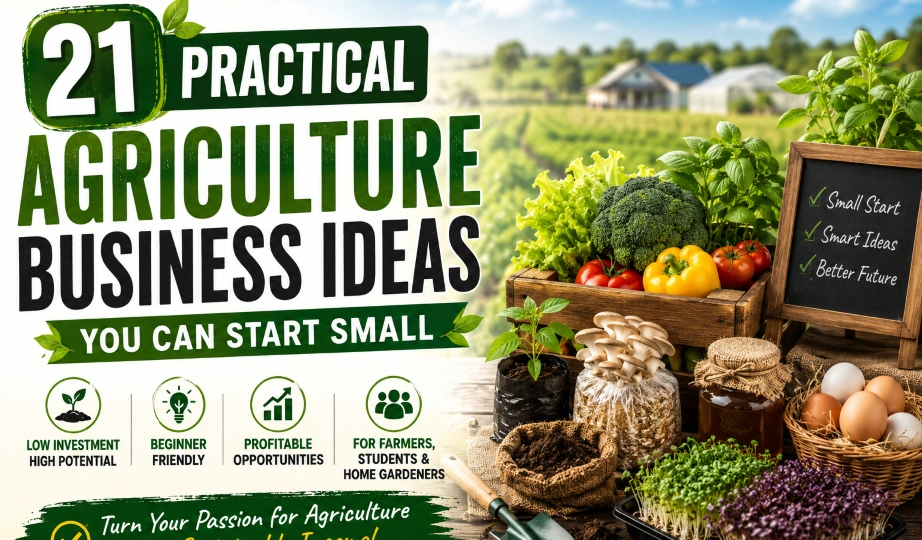
The best agriculture business ideas solve a clear local problem and match the entrepreneur’s available space, skills, climate and budget. Beginners can consider plant nurseries, mushrooms, microgreens, compost, eggs, specialty crops, produce delivery or farm-support services. The safest approach is to validate customer demand with a small pilot before investing heavily.
Agriculture is not limited to owning a large farm. A business can operate at almost any stage between producing an agricultural input and delivering a finished product to a customer.
You might grow seedlings, package herbs, repair irrigation lines, collect produce from small farms or manage digital records for growers. FAO describes agrifood value chains as systems that include production, harvesting, processing, packaging, transport, distribution, trade and waste management. ew creates opportunities for beginners, farmers, home gardeners and agriculture students.
What Makes an Agriculture Business Worth Starting?
A promising agriculture business needs more than an interesting crop or animal. It must combine customer demand with reliable production and workable financial numbers.
A practical opportunity normally has five qualities:
- People already buy the product or service
- Production is possible under local conditions
- The selling price covers direct costs
- The business can start at a testable scale
- The owner can manage the main risks
Demand should be checked first. A crop may grow perfectly but still lose money when buyers are too far away, the market is already oversupplied or transport damages the product.
Production reliability matters just as much. Water shortages, unsuitable temperatures, poor-quality seed, disease pressure and weak storage can turn an attractive idea into an unstable business.
Agricultural Insight: Profit often comes from solving a value-chain problem rather than producing the largest harvest. Cleaning, grading, packaging, storage and reliable delivery may add more customer value than increasing production alone.
Small and medium agrifood enterprises play an important role in food systems, particularly in processing, distribution and other post-production activities. arison of Agriculture Business Ideas
The timeframes below are general planning ranges rather than guaranteed results. Crop variety, animal breed, temperature, market access and legal requirements can change them substantially.
| Business idea | Space needed | Investment level | First possible sale | Main risk | Best suited to |
|---|---|---|---|---|---|
| Microgreens | Very small | Low | 2–4 weeks | Weak repeat demand | Urban beginners |
| Oyster mushrooms | Small indoor area | Low to moderate | 6–10 weeks | Contamination | Careful growers |
| Seedling nursery | Small to medium | Low | 6–12 weeks | Seasonal demand | Gardeners |
| Potted herbs | Small | Low | 6–12 weeks | Poor presentation | Home growers |
| Vermicompost | Small shaded area | Low | 2–4 months | Heat or excess moisture | Gardeners and farmers |
| Specialty vegetables | Medium | Low to moderate | 1–4 months | Market oversupply | Small farmers |
| Cut flowers | Medium | Moderate | 3–6 months | Short shelf life | Growers near towns |
| Beekeeping | Limited land | Moderate | 6–12 months | Colony loss | Rural growers |
| Egg production | Medium | Moderate | Several months | Feed cost and disease | Daily operators |
| Fish farming | Medium to large | Moderate to high | 6–12 months | Water quality | Experienced beginners |
| Dried herbs | Small | Low to moderate | 1–3 months | Food-safety compliance | Herb growers |
| Produce delivery | Very small | Low | 1–4 weeks | Low delivery density | Students and traders |
| Farm content services | None | Low | 1–4 weeks | Finding clients | Students |
| Irrigation services | None | Moderate | 2–8 weeks | Installation errors | Technically skilled people |
| Equipment rental | Storage required | Moderate to high | 2–8 weeks | Breakage and maintenance | Farming communities |
Use the table to create a shortlist, not to make a final decision. Two people starting the same enterprise can face completely different costs and outcomes.
Read Also: Small Farm Income Ideas: Ways to Make Money from a Small Farm
Small Agriculture Business Ideas With Limited Space
1. Microgreens
Microgreens are young edible plants harvested shortly after the first true leaves begin developing. They can be grown on shelving, benches or other protected surfaces.
Their short crop cycle makes them useful for testing a market without waiting through a full growing season. However, they are highly perishable and usually depend on restaurants, health-conscious households or specialty retailers.
Start with a few commonly requested varieties. Offer samples and ask potential buyers how much they could use each week before increasing production.
Common Mistake: Do not fill an entire room with trays before finding regular customers. Fast crop growth does not guarantee fast sales.
2. Oyster Mushroom Production
Oyster mushrooms can be produced in a relatively small protected area using suitable substrate, spawn and controlled humidity.

The main challenge is sanitation. Poor preparation or handling can allow competing molds and microorganisms to take over the growing material.
Commercial mushroom production involves several distinct stages and requires careful technical management. Penn State Extension advises potential commercial growers to build production experience before establishing a private enterprise. limited batch. Record contamination rate, harvest weight, labor time and the percentage sold within the usable period.
3. Seedling Nursery
A seedling nursery supplies vegetable, herb, flower or tree transplants to home gardeners and farmers.
This is one of the most practical small agriculture business ideas because customers may pay for healthy plants that save them several weeks of propagation work.
Good seedlings should have:
- Strong stems
- Healthy root systems
- Correct plant labels
- No visible pests
- No severe stretching
- Suitable hardening before transplanting
Match production to the local planting calendar. Seedlings produced too early may become root-bound before buyers are ready.
4. Potted Culinary Herbs
Basil, mint, coriander, parsley, rosemary and other culinary herbs may be sold as live plants.
Presentation strongly affects value. Clean containers, healthy foliage and clear care instructions can separate a marketable product from an ordinary garden plant.
Choose herbs that suit local temperatures. Cool-season herbs may struggle in tropical heat while moisture-sensitive Mediterranean herbs may fail in poorly drained soil.
5. Vermicompost and Earthworm Production
Vermicomposting uses selected earthworms to process suitable organic material into a soil amendment.
The business may sell:
- Finished vermicompost
- Worm populations
- Starter systems
- Training
- Composting support
Earthworm production can suit small landowners, but temperature, moisture, feedstock quality and protection from predators require regular management. contaminated waste, meat, excessive oil or materials treated with unsuitable chemicals.
Climate Consideration: Worm beds can overheat in hot climates and become waterlogged during heavy rain. Shade, drainage and moisture monitoring are basic production controls.
Agriculture Business Ideas for Students
The best agriculture business ideas for students usually have flexible hours, low fixed costs and a strong learning component.
6. Weekend Plant Nursery
Students can propagate a limited range of herbs, vegetables or ornamental plants and sell them through local groups, campus networks or weekend markets.
A small nursery teaches plant health, inventory control, pricing and customer service without requiring a large farm.
7. Farm Photography and Content Support
Many small farms need better product photos, short videos, social media posts and online product descriptions.
A student with a smartphone and basic editing skills can help a farm show:
- Harvest availability
- Farm practices
- Product preparation
- Market schedules
- Customer testimonials
- Seasonal updates
Never make certification, pesticide-free or organic claims unless the farm can verify them.
8. Produce Collection and Delivery
A student may collect pre-ordered vegetables, eggs, fruit or herbs from nearby producers and deliver consolidated orders to households.
The business earns through a delivery charge, handling margin or agreed commission.
Start with a small delivery zone. Closely spaced customers usually create better delivery economics than scattered orders.
9. Agricultural Tutoring
Agriculture students can tutor school learners, assist with basic farm-record templates or teach beginner gardening classes.
The service should remain within the student’s competence. Technical pesticide, veterinary or commercial recommendations may require qualified professionals.
10. Digital Farm Record Setup
Small farmers often record purchases, harvests and sales inconsistently. A student can create simple spreadsheets or mobile-friendly systems for:
- Input purchases
- Planting dates
- Harvest quantities
- Customer orders
- Feed use
- Mortality
- Equipment maintenance
- Cash received
Better records do not automatically create profit, but they make waste and weak margins easier to identify.
Land-Based Farming Opportunities
11. Specialty Vegetable Production
Instead of growing a widely available crop, a small farm may target specific varieties requested by restaurants or local communities.
Possible products include:
- Colored tomatoes
- Baby vegetables
- Hot peppers
- Asian greens
- Salad mixes
- Traditional regional vegetables
The specialty crop should be chosen after speaking with buyers. Avoid assuming that an unusual product will automatically earn a premium.
12. Cut Flowers
Cut flowers can generate good value from a limited area when growers have nearby florists, event planners or direct customers.
Success depends on harvest timing, stem quality, variety selection and careful post-harvest handling. Flowers can lose value quickly when they are harvested late or exposed to heat.
Begin with varieties suited to the local climate and test small mixed bunches before producing large single-variety blocks.
13. Beekeeping
Beekeeping may generate honey, beeswax, propolis or pollination income where local rules and environmental conditions allow.
New beekeepers need practical training, protective equipment and a plan for colony health. Nearby pesticide applications, forage availability, weather and pests can affect results.
Place hives only where they will not create unnecessary risks for neighbors, workers or livestock.
14. Egg Production
Egg businesses can serve households, shops, bakeries or restaurants.
Feed is usually a major recurring expense, so beginners should calculate feed use and expected saleable eggs rather than focusing only on the number of birds.
Biosecurity, clean water, ventilation, disease prevention, predator control and manure management must be planned before birds arrive.
15. Culinary and Medicinal Herb Production
Herbs may be sold fresh, dried or as planting material.
Culinary herbs are usually easier to market because buyers understand their use. Medicinal plants require extra caution. A grower should not advertise unverified disease-treatment claims or present traditional use as clinical proof.
16. Small-Scale Fish Farming
Fish farming may be suitable where water quantity, water quality, climate, feed supply and market demand align.
It is not automatically a low-risk business. Overstocking, low oxygen, disease, poor-quality fingerlings and high feed costs can cause serious losses.
A beginner should obtain species-specific guidance from a local aquaculture or fisheries authority before building ponds or tanks.
Value-Added Agriculture Businesses
Value addition means changing a raw product in a way that makes it more useful, convenient or marketable.
Examples include drying herbs, grading fruit, cleaning vegetables or turning produce into a permitted processed food. USDA describes value-added support as helping producers develop higher-value products and expand markets. Herbs and Spice Mixes
Drying can extend the marketable period of suitable herbs, but moisture control, cleanliness, packaging and labeling are critical.
The product must be dried consistently enough to reduce spoilage risk. Use food-safe surfaces and follow local processing regulations.
18. Sauces, Pickles and Preserves
Processed foods may generate more value from surplus or cosmetically imperfect produce.
However, acidity, heat processing, hygiene, shelf stability and allergen labeling require proper controls. Do not create a commercial recipe by guessing preservation times.
Consult the relevant food-safety authority or a qualified processing specialist.
19. Cleaned and Packaged Produce
Customers may pay more for vegetables that are sorted, trimmed, washed where appropriate, weighed and packed consistently.
Before washing produce, confirm that clean water, drainage, drying and cold storage can be managed safely. Poor washing practices may spread contamination rather than remove it.
20. Compost and Potting Mixes
A farm or garden business may turn clean organic material into compost or formulate growing mixes for local gardeners.
Consistency matters. Customers need a product that drains, holds moisture and supports roots in a predictable way.
Do not add unverified nutrient claims to the label. Laboratory testing may be necessary when making specific fertility or safety claims.
Safety Note: Agricultural chemicals, treated plant material, manure and unknown industrial waste should not be mixed casually into products intended for food-growing gardens.
Agricultural Service and Technology Businesses
21. Irrigation Installation and Maintenance
A technically skilled person can install small drip systems, repair leaks, clean filters and help growers improve water distribution.
The service must be based on actual crop needs, water pressure and field layout. Poor design can leave some plants dry while overwatering others.
Additional service opportunities include:
- Soil-sample collection support
- Farm mapping
- Equipment rental
- Greenhouse maintenance
- Produce aggregation
- Farm bookkeeping
- Online order management
- Crop scouting under qualified supervision
USDA urban agriculture resources similarly identify business planning, market development and operational support as important parts of establishing an urban farm. ose the Right Startup Agriculture Business
A successful startup agriculture business begins with selection, not construction.
Step 1: Identify a Paying Customer
Choose a specific buyer group:
- Local households
- Restaurants
- Retail shops
- Farmers
- Nurseries
- Schools
- Processors
- Online buyers
Speak with at least 10 potential customers. Ask what they currently buy, how often they buy it, what problems they face and what would make them change suppliers.
Do not ask only, “Would you buy this?” People may answer positively without placing an order. Ask about quantity, price range, preferred delivery day and current supplier.
Step 2: Audit Your Resources
List what is already available:
- Land
- Covered space
- Clean water
- Electricity
- Transport
- Labor
- Storage
- Tools
- Technical knowledge
- Customer relationships
An idea that uses existing resources may be safer than one requiring several new systems at once.
Step 3: Check Climate and Production Fit
Evaluate:
- Seasonal temperatures
- Rainfall pattern
- Humidity
- Water reliability
- Soil drainage
- Pest pressure
- Storm or frost risk
- Product shelf life
Protected production can reduce some climate risks, but it adds equipment, energy and management costs.
Step 4: Calculate Unit Economics
Determine:
- Selling price per unit
- Direct cost per unit
- Expected losses
- Packaging cost
- Delivery cost
- Labor requirement
- Fixed startup expense
Use conservative assumptions. Calculate with a lower selling price and slightly higher production cost to see whether the business remains workable.
Step 5: Run a Limited Pilot
A pilot should be large enough to reveal real problems but small enough that failure is affordable.
Examples include:
- 20 microgreen trays
- 100 seedlings
- 10 weekly produce boxes
- One mushroom production batch
- One delivery route
- One small flower bed
- Three trial customers for a farm service
Field Tip: Set the maximum amount you can afford to lose before beginning the pilot. This prevents a small experiment from quietly turning into an uncontrolled investment.
Simple Agriculture Business Profit Calculation
Start with contribution margin:
Contribution per unit = Selling price per unit − Direct cost per unit
Suppose one product sells for 100 units of local currency. Seeds, substrate, packaging, transaction fees and delivery cost 55.
The contribution is:
100 − 55 = 45
If fixed startup expenses are 900:
Break-even units = 900 ÷ 45 = 20 units
This simplified example does not include tax, owner salary, equipment replacement, spoilage or unexpected losses. Add those items before deciding that a business is profitable.
Keep separate records for:
- Sales
- Unsold products
- Production losses
- Free samples
- Personal withdrawals
- Equipment
- Recurring inputs
- Transport
- Paid labor
- Unpaid owner labor
A business can generate cash while still underpaying the owner or wearing out equipment without saving for replacement.
A 30-Day Agriculture Business Validation Plan
Days 1–7: Understand the Market
- Select three possible ideas
- Identify likely customers
- Interview at least 10 buyers
- Visit local markets
- Record current prices
- Note quality and packaging expectations
- Check local rules
Days 8–14: Compare the Options
Score each idea from one to five for:
- Demand
- Startup cost
- Skill fit
- Climate fit
- Time to sale
- Production risk
- Legal complexity
- Access to customers
Remove any idea that depends on unavailable water, unsuitable temperatures or an unverified market.
Days 15–21: Prepare the Pilot
- Select one idea
- Calculate pilot costs
- Find suppliers
- Define production steps
- Set a loss limit
- Arrange potential buyers
- Create a record sheet
Do not purchase commercial-scale equipment during this stage unless the pilot genuinely requires it.
Days 22–30: Launch and Measure
Track:
- Units produced
- Units sold
- Production loss
- Customer feedback
- Labor hours
- Direct cost
- Delivery time
- Repeat-order interest
At the end of the month, decide whether to stop, modify or continue.
Common Mistakes New Agricultural Entrepreneurs Make
Producing Before Finding Customers
A full harvest is not proof of a business. Confirm realistic buying interest before expanding production.
Ignoring Seasonality
Demand, price, pests and yields may change by season. One profitable month does not prove year-round viability.
Starting Too Many Products
Every additional crop or product creates more purchasing, production, packaging and record-keeping work. Begin with one clear offer.
Expanding After One Good Sale
A large first order may be temporary. Look for repeat demand before investing in permanent infrastructure.
Depending on One Buyer
One restaurant, shop or trader can change suppliers without warning. Develop several customer relationships.
Ignoring Regulations
Business registration, zoning, animal welfare, food handling, water use, labeling and pesticide rules vary by location.
When pesticides are used, follow the registered label and local law. EPA guidance emphasizes that labels provide legally enforceable directions and safety precautions in the United States; entrepreneurs elsewhere should consult their own national regulator. eak Records
Memory is not a reliable accounting system. Record each batch, sale, loss and expense.
Important: Never describe projected revenue as guaranteed profit. Agricultural output and market prices can change because of weather, disease, input shortages and buyer behavior.
What Early Success Looks Like
A pilot is showing promise when several of these conditions appear:
- Customers place repeat orders
- The product meets quality expectations
- Production losses remain manageable
- The contribution margin is positive
- Delivery can be completed reliably
- Labor hours are realistic
- Inputs are consistently available
- Customers recommend the product
- The owner can explain the numbers clearly
- Expansion does not require uncontrolled debt
A weak pilot does not always mean the idea should be abandoned. The product, customer group, package size, production method or delivery schedule may need adjustment.
Stop and reassess when:
- Customers like the idea but will not pay
- Production fails repeatedly
- Legal requirements cannot be met
- Water or energy costs are unsustainable
- Spoilage remains high
- One customer controls nearly all sales
- The owner cannot recover labor and direct costs
Final Thoughts on Agriculture Business Ideas
The most suitable agriculture business ideas are not always the largest, newest or most technical. They are the ones that match a real customer need and can be produced reliably with available resources.
A beginner may start with seedlings, herbs, mushrooms, compost, delivery or a farm-support service. A farmer may add value through packaging, processing or direct marketing. A student may begin with records, content, tutoring or a weekend nursery.
Choose one idea, test it at limited scale and record the results. A controlled pilot will usually teach more than a long list of projected earnings.
5. Frequently Asked Questions
What are the best agriculture business ideas for beginners?
Seedling nurseries, potted herbs, vermicompost, microgreens, produce delivery and farm record services can suit beginners because they are testable at a limited scale. The best choice still depends on local customers, climate, available space, technical ability and production costs.
What agriculture business can I start without land?
Landless options include farm photography, agricultural content services, produce delivery, online order management, bookkeeping, equipment rental and irrigation maintenance. Indoor mushroom or microgreen production may also be possible when suitable protected space, water and sanitation are available.
Which agriculture business ideas are suitable for students?
Students can consider a weekend plant nursery, produce delivery, farm photography, agricultural tutoring, digital record setup or social media support for farms. These options can be started around study schedules and may require less capital than crop or livestock production.
What are the best small agriculture business ideas?
Practical small agriculture business ideas include seedlings, potted herbs, mushrooms, microgreens, compost, dried herbs and specialty vegetables. Start with the idea that has verified local demand and fits your available space, climate, water supply and working hours.
How much money is needed to start an agriculture business?
Startup cost varies widely by country and enterprise. A service business may use existing tools while fish farming, poultry or protected cultivation may require substantial infrastructure. Calculate pilot inputs, equipment, permits, packaging, labor, transport and expected production losses before investing.
Can an agriculture business be started from home?
Some businesses can operate from home where zoning and food-safety rules permit. Possibilities include seedlings, potted herbs, compost, small mushroom batches, record services and agricultural content work. Confirm local regulations before keeping livestock or selling processed food from a residence.
How can I test an agriculture business idea?
Interview potential customers, compare existing suppliers and run a small paid pilot. Track production cost, labor, losses, selling price and repeat orders. Avoid depending only on verbal interest because a positive comment is not the same as a completed purchase.
Which agriculture business becomes profitable fastest?
Service businesses and short-cycle crops may reach the first sale quickly, but fast sales do not guarantee profit. Produce delivery, farm content services and microgreens can have short testing periods. Profitability depends on customer retention, direct costs, spoilage and labor efficiency.
Is mushroom farming suitable for beginners?
Mushroom farming is possible at small scale but requires careful sanitation, suitable growing material, temperature and humidity management. Beginners should learn the production process and run a small batch before purchasing commercial equipment because contamination can cause complete crop loss.
What is the biggest mistake in a startup agriculture business?
A common mistake is investing in production before confirming demand. Beginners may buy equipment, plant a large area or raise animals without knowing who will purchase the output. Customer interviews, pre-orders and a controlled pilot reduce this risk.
