Email: blogagri2@gmail.com
Hydroponic Farming: Setup, Costs, Benefits & Systems
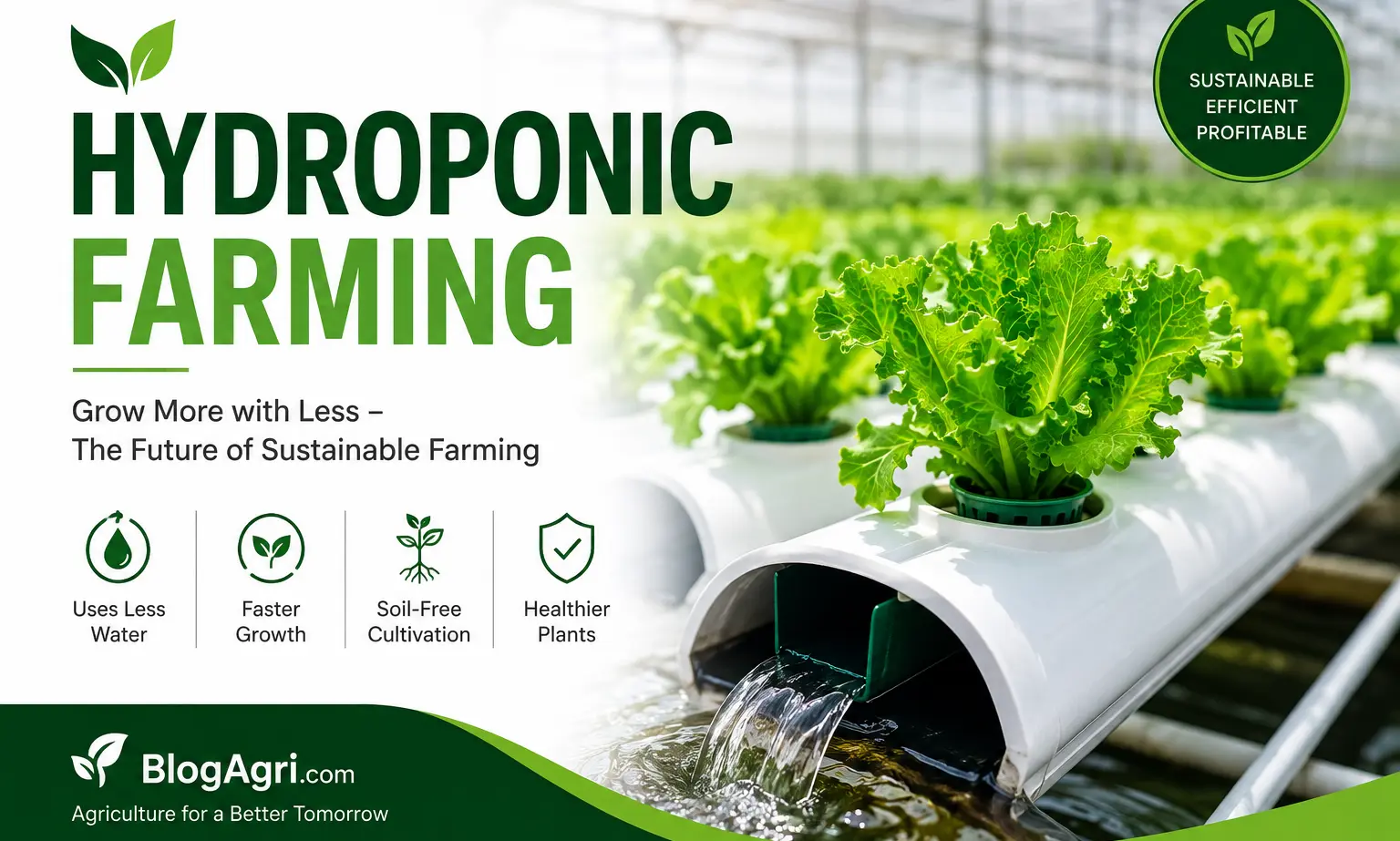
Hydroponic farming is the practice of growing plants without conventional soil by supplying their roots with water containing dissolved nutrients. Plants may grow directly in nutrient solution or in supporting materials such as coconut coir, perlite, rockwool, or expanded clay.
Hydroponics gives growers greater control over water and plant nutrition, but that control brings responsibility. Water quality, nutrients, pH, root oxygen, temperature, equipment, and crop selection must all be managed correctly.
A small lettuce system can be relatively simple. A commercial tomato or vertical hydroponic farm can require pumps, fertigation equipment, climate control, sensors, backup electricity, crop support, and skilled management.
That difference is why hydroponics should be chosen according to the crop and production goal, not simply because it appears more modern.
What Is Hydroponic Farming?
Hydroponic farming means growing plants without relying on agricultural soil as the primary source of water and nutrients.
Instead, essential plant nutrients are dissolved in irrigation water and delivered directly to the root zone.
USDA describes hydroponics as growing plants using a water-based nutrient solution instead of soil. Hydroponic systems may also use materials such as coconut coir, vermiculite, or perlite to support the roots.
This means hydroponics does not always involve roots floating freely in water.
A tomato plant growing in a bag of coconut coir and receiving a carefully controlled nutrient solution through drip irrigation is also being grown hydroponically.
Read Also: Controlled Environment Farming: How It Works, Systems, Benefits, and Risks
What Plants Still Need Without Soil
Removing soil does not remove the biological needs of a plant.
A successful hydroponic system must still provide:
- Water
- Mineral nutrients
- Light
- Carbon dioxide
- Oxygen around the roots
- Suitable temperature
- Appropriate humidity
- Physical support where required
University of New Hampshire Extension identifies water, nutrients, light, carbon dioxide, and oxygen as essential requirements for successful home hydroponics.
Agricultural Insight
Soil normally stores water, nutrients, air, and microorganisms while buffering changes around plant roots. Hydroponics removes much of that natural buffer. The grower must therefore provide and monitor those conditions more deliberately.
How Does Hydroponic Farming Work?
Hydroponics works by delivering nutrients in forms that plant roots can absorb from water.
A basic system follows this process:
- Water is placed in a reservoir or growing container.
- Hydroponic fertilizer is dissolved into the water.
- The nutrient solution reaches plant roots.
- Roots absorb water and dissolved mineral nutrients.
- Oxygen reaches the root zone through air spaces, aeration, flowing solution, or substrate.
- Excess nutrient solution may be collected and reused in recirculating systems.
- The grower monitors water level, pH, nutrient concentration, plant condition, and equipment.
The exact process changes with system design.
In deep water culture, roots remain in aerated nutrient solution.
In Nutrient Film Technique, a shallow stream moves past the roots.
In a drip system, nutrient solution is delivered to individual plants growing in containers or slabs.
The purpose remains the same: give roots consistent access to water, nutrients, and oxygen without using field soil.
Read Also: Future of Aeroponic Farming Systems
Main Types of Hydroponic Farming Systems
The best hydroponic system depends on crop size, budget, management ability, available electricity, and production scale.
The following table helps compare common options.
| System | How It Works | Best Suited To | Complexity |
|---|---|---|---|
| Kratky | Roots access a non-circulating nutrient reservoir | Lettuce, herbs | Low |
| Deep Water Culture | Roots remain in aerated nutrient solution | Lettuce, leafy greens, herbs | Low to moderate |
| NFT | Thin nutrient film flows through channels | Lettuce, herbs, small leafy crops | Moderate |
| Drip system | Nutrient solution is delivered to each plant | Tomatoes, peppers, cucumber, strawberries | Moderate to high |
| Ebb and flow | Growing bed periodically floods and drains | Herbs, ornamentals, mixed crops | Moderate |
| Wick system | Nutrients move through a wick into root media | Small plants and beginner demonstrations | Low |
The simplest system is not necessarily inferior. A beginner often learns more from a reliable small system than from a complicated automated farm that is difficult to troubleshoot.
Kratky Method
The Kratky method is a passive hydroponic technique that uses a reservoir of nutrient solution without continuously circulating the water.
As the plant consumes water, an air gap develops between the solution and the plant base. Part of the root system remains exposed to humid air while the lower roots continue accessing nutrients and water.
Because pumps may not be necessary, Kratky systems can be useful for learning hydroponics with fewer mechanical failure points.
University of California Agriculture and Natural Resources has demonstrated non-circulating Kratky production for leafy greens.
Deep Water Culture
Deep Water Culture, often shortened to DWC, keeps plant roots in a nutrient reservoir.
An air pump and air stone are commonly used to increase oxygen in the water.
DWC can be practical for:
- Lettuce
- Basil
- Pak choi
- Other leafy greens
Large fruiting crops can also grow in similar systems, but their water, nutrient, root-space, and physical-support requirements are greater.
Nutrient Film Technique
Nutrient Film Technique, or NFT, sends a shallow flow of nutrient solution through slightly sloping channels.
Plant roots develop inside the channel while nutrient solution continuously passes over part of the root system.
NFT is widely associated with commercial lettuce and herb production.
Its weakness is mechanical dependence.
If the pump stops or water flow becomes blocked, plants have relatively little stored moisture around their roots.
Common Mistake
Do not build a large NFT system without thinking about power failure and blocked flow. A soil-grown crop usually has moisture stored around its roots. NFT plants may lose that protection quickly when circulation stops.
Drip Hydroponics
Drip systems deliver nutrient solution through tubing and emitters directly to individual plants.
They are particularly useful for larger fruiting crops such as:
- Tomatoes
- Cucumbers
- Peppers
- Strawberries
- Eggplants
Plants are often supported by coconut coir, perlite, rockwool, or another soilless medium.
A drip system may be recirculating or drain-to-waste depending on design and management.
Ebb and Flow
Ebb-and-flow systems periodically flood the growing area with nutrient solution before allowing it to drain back into a reservoir.
The wet-dry cycle provides plants with moisture while allowing air to return to the root zone after drainage.
Timers, pumps, drainage, and correct bed design are important.
Wick Systems
A wick system moves nutrient solution from a reservoir toward the root zone using capillary action.
It contains few mechanical parts and is inexpensive to demonstrate.
Its nutrient and water delivery rate may be inadequate for large or fast-growing plants, so it is more suitable for small-scale applications.
Hydroponic Farming vs Traditional Soil Farming
Neither method is universally better.
Soil and hydroponics solve different production problems.
| Factor | Hydroponic Farming | Traditional Soil Farming |
| Root medium | Water or soilless substrate | Agricultural soil |
| Nutrient control | High | Moderate |
| Water recirculation | Possible | Usually limited |
| Startup cost | Often higher | Often lower |
| Technical monitoring | Higher | Generally lower |
| Soil-borne weeds | Greatly reduced | Common |
| Root-zone buffering | Low | Higher |
| Power dependence | Can be high | Usually lower |
| Space efficiency | Can be very high | Depends on field system |
| Outdoor suitability | Possible | Excellent where climate and soil suit crop |
| Year-round production | Possible with controlled environment | Climate dependent |
| Failure speed | Some problems develop quickly | Soil may provide more buffering |
Soil can store nutrients and moisture and resist sudden changes. Oklahoma State University Extension notes that this buffering effect is absent from soilless culture, making active pH and EC management more important.
Hydroponics is therefore more controllable but often less forgiving.
A farmer with fertile land, affordable irrigation, suitable climate, and low-value field crops may gain little from replacing soil.
A grower producing lettuce near an urban market, where land and water are costly, may see a much stronger reason to consider hydroponics.
Main Benefits of Hydroponic Farming
Efficient Water Management
Recirculating hydroponic systems can capture nutrient solution and reuse it instead of allowing every irrigation event to leave the production area.
This can substantially reduce water use compared with some conventional irrigation systems.
Extension sources report large savings, sometimes approaching 90 percent under particular comparisons, but the exact reduction depends on crop, climate, system design, and the conventional method used as the baseline.
The correct claim is therefore not that every hydroponic farm uses a fixed percentage less water.
It is that well-designed recirculating systems can use water more efficiently because losses can be controlled and reused.
Precise Nutrient Management
The grower can measure and adjust nutrient concentration rather than depending entirely on nutrient movement through soil.
This is especially valuable in protected cultivation.
Production Where Soil Is Poor or Unavailable
Hydroponics can be used in:
- Urban areas
- Rooftops
- Greenhouses
- Warehouses
- Areas with degraded soil
- Locations with salinity or soil-disease problems
- Home environments without garden space
High Production per Unit of Area
Plants may be placed close together when crop architecture permits.
Vertical systems can further increase production area by adding growing levels.
Year-Round Growing
Hydroponics combined with greenhouse or indoor climate control can extend the growing season or support year-round production.
Reduced Weed Pressure
Because agricultural soil is absent, weed management is usually much simpler.
Easier Root-Zone Observation
Roots, reservoirs, irrigation lines, and nutrient conditions can often be inspected directly.
This can make some problems easier to detect.
Limitations and Risks of Hydroponics
The benefits of hydroponic farming do not remove its risks.
Higher Technical Responsibility
Plants depend on the grower to maintain their root environment.
Poor pH, excessive salts, failed pumps, high water temperature, nutrient imbalance, or root disease may affect crops quickly.
Electricity Dependence
Pumps, aerators, grow lights, cooling equipment, heaters, sensors, and fertigation systems may require electricity.
Power reliability becomes especially important in NFT, aeroponics, indoor farms, and heavily automated commercial systems.
Initial Investment
Reservoirs, channels, plumbing, growing media, meters, pumps, structures, lights, climate control, and backup equipment can make hydroponics more expensive to establish than basic soil production.
Water Quality Matters
The starting water may already contain dissolved salts and alkalinity that influence hydroponic nutrient management.
Oklahoma State University recommends checking source-water pH, EC, alkalinity, and relevant dissolved minerals when evaluating hydroponic water quality.
Root Diseases Can Spread
A recirculating system connects many plants through the same nutrient solution.
That efficiency can also allow some root pathogens to move through the system.
Not Every Crop Is Economically Suitable
A crop can grow hydroponically and still be a poor commercial choice.
Wheat, maize, rice, or other low-value staple crops may require too much area, lighting, infrastructure, or energy to justify fully controlled hydroponic production.
Important
Ask two different questions before investing:
“Can this crop grow hydroponically?”
and
“Can this crop be grown hydroponically at a cost my market can support?”
The answers are not always the same.
Which Crops Are Best for Hydroponic Farming?
Hydroponics is particularly well suited to crops that have relatively high value, manageable plant size, short production cycles, and strong demand for fresh produce.
Common choices include:
- Lettuce
- Basil
- Spinach
- Pak choi
- Kale
- Mint
- Parsley
- Tomatoes
- Peppers
- Cucumbers
- Strawberries
USDA reports that tomatoes, lettuce, and cucumbers accounted for a large share of U.S. controlled-environment production, with hydroponics being the most common cultivation method in the data discussed.
Leafy greens are particularly attractive for beginners because they:
- Mature relatively quickly
- Have compact root systems
- Need less structural support
- Work well in several simple hydroponic systems
- Allow beginners to repeat crop cycles quickly
Large fruiting crops generally require more attention to:
- Plant support
- Lighting
- Pollination
- Potassium and calcium management
- Root volume
- Irrigation
- Climate
- Crop duration
Hydroponic Farming Setup: What You Need
A basic hydroponic farming setup requires more than a container of water.
The exact equipment depends on system type.
Basic Components
Most systems require some combination of:
- Growing reservoir
- Water supply
- Hydroponic nutrients
- Plants or seedlings
- Net pots or crop containers
- Growing medium if required
- Pump
- Air pump or aeration where required
- Irrigation tubing
- Return lines
- pH measurement
- EC measurement
- Lighting if natural sunlight is insufficient
- Support structures for fruiting crops
- Cleaning and sanitation equipment
For home systems, Illinois Extension demonstrates simple setups using containers, net pots, rockwool, nutrient solution, aquarium aeration, lighting, and pH/EC monitoring equipment.
Choose the System Before Buying Equipment
Avoid buying random hydroponic components before deciding:
- What crop you will grow
- How many plants you need
- Where the system will operate
- Whether sunlight is available
- Whether water will recirculate
- How often you can inspect the crop
- What happens during a power failure
These decisions determine the correct equipment.
How to Start Hydroponic Farming Step by Step
1. Choose One Crop
Start with a crop that matches your experience and system.
For a first project, lettuce or basil is usually easier than tomatoes or cucumbers.
2. Select the Growing Location
Check:
- Natural light
- Electricity
- Water
- Drainage
- Temperature
- Ventilation
- Working space
- Protection from pests
- Access for cleaning
An indoor system will need artificial lighting if natural light is insufficient.
3. Test Your Water
Do not assume clear drinking water is automatically ideal for hydroponics.
Water chemistry can affect nutrient availability.
Check pH and EC at minimum. Commercial growers should consider a more complete water analysis.
4. Choose a System
A beginner may choose:
- Kratky for simplicity
- DWC for leafy greens
- NFT for a more active recirculating system
Larger fruiting plants may be better suited to drip-irrigated substrate systems.
5. Start Seedlings Separately
Seeds are commonly germinated in plugs or cubes before being transferred to the production system.
Keep the seedling medium moist but well aerated.
Do not drown young roots.
6. Prepare the Nutrient Solution
Use a complete fertilizer designed for hydroponic production.
Follow crop-appropriate guidance rather than mixing ordinary garden fertilizers randomly.
Hydroponic plants need macronutrients and micronutrients in suitable proportions.
7. Set EC First
EC, or electrical conductivity, gives an estimate of dissolved salt concentration.
Bring the nutrient solution into an appropriate EC range for the crop.
8. Adjust pH
After nutrient concentration is correct, check and adjust pH.
9. Transfer Seedlings
Move seedlings when they have a healthy root system and can physically fit the production unit.
Avoid burying the crown of lettuce or similar crops too deeply.
10. Monitor the System
Check:
- Water level
- Flow
- Pumps
- Root condition
- pH
- EC
- Temperature
- Pest activity
- Plant color
- Growth rate
11. Keep Records
Record planting date, readings, adjustments, problems, harvest date, and saleable yield.
Commercial decisions should be made from records rather than memory.
Understanding pH and EC
Two measurements appear repeatedly in hydroponics: pH and EC.
They measure different things.
What Is pH?
pH describes how acidic or alkaline the nutrient solution is.
It influences the chemical availability of mineral nutrients.
A nutrient can be present in the reservoir but difficult for the plant to absorb if pH moves outside a suitable range.
What Is EC?
Electrical conductivity estimates the concentration of dissolved salts in the nutrient solution.
In practical terms:
- Very low EC may indicate weak nutrient concentration.
- Very high EC may create excessive salt stress.
- Correct EC depends on crop and growth stage.
Penn State notes that nutrient availability and plant nutrition cannot be managed properly without considering pH. It gives a broad range of roughly pH 5.0–7.0 for many hydroponically grown vegetables, while exact crop targets vary.
Field Tip
Do not diagnose plant nutrition using EC alone. EC tells you how concentrated the dissolved salts are. It does not tell you whether every individual nutrient is present in the correct proportion.
A Practical Crop Guide for pH and EC
The following ranges illustrate why one nutrient solution should not automatically be used for every crop.
| Crop | Approximate EC, mS/cm | Approximate pH |
| Basil | 1.0–1.6 | 5.5–6.0 |
| Lettuce | 1.2–1.8 | 6.0–7.0 |
| Cucumber | 1.7–2.0 | 5.0–5.5 |
| Spinach | 1.8–2.3 | 6.0–7.0 |
| Strawberry | 1.8–2.2 | Around 6.0 |
| Tomato | 2.0–4.0 | 6.0–6.5 |
These ranges are based on Oklahoma State University Extension guidance and should be treated as crop-management references rather than universal recipes. Water chemistry, cultivar, climate, growth stage, fertilizer program, and production method can change the appropriate target.
The main lesson is simple: tomatoes generally tolerate and require a stronger nutrient solution than lettuce.
Hydroponic Farming at Home
Hydroponic farming at home does not need to begin with a large vertical tower.
A small system can provide the same basic learning experience.
Good Beginner Crops
Start with:
- Lettuce
- Basil
- Mint
- Pak choi
- Leafy herbs
These crops are easier to manage in a compact space than large fruiting plants.
A Simple Home Learning Setup
A beginner can start with:
- Opaque reservoir
- Net pots
- Seedling plugs
- Hydroponic nutrient solution
- Lettuce seedlings
- pH test equipment
- EC meter where available
- Air pump and stone for DWC
- Suitable light
University Extension resources specifically recommend simple home systems because they allow growers to learn nutrient management before investing heavily.
Why the Reservoir Should Block Light
Light entering nutrient-rich water encourages algae.
An opaque reservoir and covered growing channels reduce this problem.
Indoor Lighting
If sunlight cannot supply enough light, plants need artificial lighting.
Lighting requirements vary dramatically by crop.
Lettuce and herbs are easier to support indoors than crops producing large quantities of fruit.
Gardener’s Note
For a first home project, measure success by producing one healthy crop consistently. Do not judge the system by how many pumps, sensors, towers, or lights it contains.
Hydroponic Farming Cost: What Actually Determines It?
There is no useful universal answer to “How much does hydroponic farming cost?”
A passive home system and a climate-controlled commercial vertical farm are both hydroponic, but their investment requirements are completely different.
Major cost drivers include:
| Cost Area | Low-Cost System | Commercial System |
| Structure | Existing room/outdoor shade | Greenhouse or controlled building |
| Growing system | DIY reservoir | Commercial channels, benches, tanks |
| Pumps | None or small pump | Multiple production pumps |
| Lighting | Natural light | Supplemental or full LED lighting |
| Climate control | Room conditions | Heating, cooling, dehumidification |
| Monitoring | Manual meters | Sensors and automation |
| Fertigation | Hand mixing | Automated dosing |
| Backup systems | Limited | Generator, alarms, spare pumps |
| Labor | Owner managed | Trained staff |
| Water treatment | Basic | Filtration or reverse osmosis where needed |
This is why hydroponic farming cost should be calculated from the production design, not from a generic price per plant or square metre.
Low-Cost Hydroponics
Passive systems can reduce:
- Pump costs
- Plumbing
- Electricity use
- Automation
They are useful for learning and some small-scale production.
Commercial Hydroponics
Commercial costs may include:
- Greenhouse construction
- Cooling
- Heating
- Nutrient injectors
- Water storage
- Filtration
- Pumps
- Sensors
- Lighting
- Crop-support systems
- Packing space
- Refrigeration
- Labor
- Food-safety systems
- Backup power
Oklahoma State University notes that automated pH and EC monitoring equipment alone can represent a significant equipment cost, illustrating why automation should be justified by system scale and labor savings.
Calculate Cost per Saleable Crop
A commercial grower should record:
Total production cost ÷ saleable units harvested
Include:
- Seed
- Growing media
- Fertilizer
- Electricity
- Water
- Labor
- Packaging
- Equipment depreciation
- Plant losses
- Transport
- Repairs
Do not calculate profitability using yield alone.
Daily and Weekly Hydroponic Maintenance
Hydroponic crops should not be treated as “set and forget” systems unless the specific system has been designed for that purpose.
University of Minnesota Extension notes that hydroponic production can require regular or daily maintenance, including checking pumps, plumbing, plant health, nutrient solution, water source, and sanitation.
Daily Checks
Look at:
- Pump operation
- Water flow
- Reservoir level
- Plant wilting
- Leaf color
- Root appearance
- Leaks
- Unusual odors
- Water temperature
- Pest activity
For intensively managed systems, pH and EC may also need daily checks.
Oklahoma State University recommends regular pH and EC monitoring and notes that these values should ideally be checked consistently at the same time of day.
Weekly Checks
Review:
- Water quality
- Tubing
- Filters
- Emitters
- Roots
- Pest traps
- Sensor calibration
- Crop uniformity
- Nutrient use
- Water consumption
Clean plant debris before it becomes a sanitation problem.
Common Hydroponic Problems and What to Check
Use symptoms as clues rather than immediately adding fertilizer.
| Problem | Possible Cause | First Things to Check |
| Plants suddenly wilt | Pump or irrigation failure | Pump, reservoir, blocked lines |
| Leaves yellow | Nutrient issue or unsuitable pH | pH, EC, crop age, roots |
| Leaf tips burn | High salts or environmental stress | EC, humidity, airflow |
| Brown roots | Heat, low oxygen, root disease | Water temperature, aeration, sanitation |
| Algae | Light entering nutrient water | Reservoir cover, channels, leaks |
| Uneven growth | Uneven flow or light | Emitters, channel slope, lighting |
| EC rises | Water being removed faster than nutrients | Reservoir level, temperature |
| EC falls | Nutrient uptake or excess dilution | Fertilizer strength, water additions |
| pH changes rapidly | Water alkalinity or biological activity | Source water, reservoir condition |
| Plants grow weak and stretched | Insufficient light | Light intensity and duration |
Brown Roots
Healthy hydroponic roots are often white to cream-colored, although nutrient products and crops can stain roots.
Brown roots combined with poor growth, odor, or slime require investigation.
Check:
- Root-zone oxygen
- Water temperature
- Sanitation
- Pathogen risk
- Dead root material
Nutrient Deficiency Symptoms
Do not assume yellow leaves automatically mean the nutrient solution is too weak.
A plant can show deficiency because:
- pH prevents nutrient uptake
- Roots are damaged
- Temperature is unsuitable
- Nutrient balance is incorrect
- EC is excessive
- Irrigation is failing
Common Mistake
Adding more fertilizer to every pale plant can make the problem worse. Check roots, pH, EC, water temperature, and irrigation before increasing nutrient strength.
When Hydroponic Farming Is Not a Good Choice
Hydroponics should solve a production problem.
It should not be adopted simply because it is modern.
Consider staying with soil or another production system when:
Electricity Is Unreliable
Pump-dependent systems can become risky without backup power.
The Crop Has Low Market Value
High infrastructure costs may not be justified for bulk field commodities.
Outdoor Conditions Are Already Excellent
Fertile soil, good climate, inexpensive land, and reliable irrigation may make soil production more economical.
Technical Management Is Unavailable
A large automated system still needs people who understand plants, nutrients, irrigation, and equipment.
Water Quality Is Difficult to Manage
Very saline or chemically unsuitable water may require expensive treatment.
There Is No Confirmed Market
High yield has little value if the crop cannot be sold quickly at a suitable price.
The Grower Has Never Run a Small System
A commercial farm should not be the first hydroponic experiment.
Agricultural Insight
Scaling hydroponics multiplies both efficiency and mistakes. A small irrigation problem affects a few plants. The same design fault repeated across thousands of plants becomes a commercial loss.
What Successful Hydroponic Farming Looks Like
Success is not defined by technology.
A healthy system should show:
- Uniform plant growth
- Appropriate root color and development
- Stable irrigation
- Predictable crop cycles
- Manageable pH and EC
- Low plant losses
- Low pest and disease pressure
- Reliable equipment
- Efficient water use
- Consistent saleable quality
A successful commercial operation should additionally achieve:
- Known production cost
- Reliable customers
- Predictable harvest volume
- Acceptable labor requirements
- Manageable energy costs
- Positive margin after all operating costs
The best hydroponic system is therefore not the system producing the tallest plant.
It is the one producing consistent, saleable crops with manageable risk and cost.
Final Thoughts on Hydroponic Farming
Hydroponic farming gives growers precise control over water, nutrition, root conditions, and production space.
That control can support efficient water use, year-round production, high-density growing, and crop production where suitable agricultural soil is unavailable.
The trade-off is greater management responsibility.
Hydroponic crops may depend on pumps, nutrient chemistry, water quality, electricity, sensors, and regular observation more heavily than soil-grown crops.
For beginners, the most practical approach is to start with one simple system and one easy crop, complete several successful growing cycles, record the results, and expand only after the production process is reliable.
5. Frequently Asked Questions
What is hydroponic farming?
Hydroponic farming is a method of growing plants without conventional agricultural soil. Plant roots receive water containing dissolved mineral nutrients and may be supported by materials such as coconut coir, perlite, rockwool, or clay pellets. Systems range from simple home reservoirs to automated commercial greenhouse and indoor farms.
What are the main benefits of hydroponic farming?
The main benefits include precise nutrient management, efficient water reuse, reduced weed pressure, production where soil is poor or unavailable, high production density, and the possibility of year-round growing when hydroponics is combined with controlled-environment facilities. The actual benefit depends on crop, climate, system design, and operating cost.
Is hydroponic farming better than traditional soil farming?
Neither method is always better. Hydroponics offers greater root-zone control and can use water efficiently, but it often requires more equipment and technical monitoring. Soil farming may be more economical where fertile land, good climate, irrigation, and inexpensive growing space are already available. The correct choice depends on the crop and production goal.
Can I start hydroponic farming at home?
Yes. Home hydroponics can start with a small Kratky or deep-water-culture system growing lettuce or herbs. Beginners need a suitable container, hydroponic nutrients, seedlings, light, water, and basic monitoring. Starting small makes it easier to learn pH, nutrient management, root health, and sanitation before investing in larger equipment.
How much does hydroponic farming cost?
Hydroponic farming cost varies widely. A simple passive home system may require only basic containers, nutrients, seedlings, and testing supplies. Commercial systems may need greenhouses, pumps, fertigation, climate control, lighting, sensors, backup power, packing facilities, and labor. Costs should therefore be calculated for a specific crop, system, location, and production target.
Which crop is easiest for hydroponic farming?
Lettuce is one of the easiest crops for many beginners because it grows relatively quickly, remains compact, needs limited structural support, and performs well in simple DWC, NFT, and passive systems. Basil and other leafy herbs are also useful learning crops. Tomatoes and cucumbers are possible but require more space, support, nutrition, and management.
What pH is best for hydroponics?
Many hydroponic vegetables grow within a mildly acidic to near-neutral root-zone range, but the correct pH depends on crop. University Extension guidance places many commonly grown hydroponic crops roughly between pH 5 and 7. Growers should use a crop-specific target instead of assuming one pH is suitable for every plant.
Does hydroponic farming use less water?
Well-designed recirculating hydroponic systems can use substantially less water than some conventional irrigation systems because nutrient solution can be captured and reused. The exact saving varies by crop, climate, hydroponic design, and the soil-irrigation system used for comparison, so one universal water-saving percentage should not be applied to every farm.
Is hydroponic farming profitable?
Hydroponic farming can be profitable when crop value, market demand, yield, production cycles, energy costs, labor, infrastructure, and selling price work together. High yields alone do not guarantee profit. Commercial growers should calculate total cost per saleable crop and confirm reliable buyers before investing in a large hydroponic facility.
Next Step
Keep Learning About Smarter Farming
Explore another practical BlogAgri guide to compare farming methods, improve your growing system, and make better decisions for your farm, garden, or production setup.
