Email: blogagri2@gmail.com
Controlled Environment Farming: Benefits, and Risks
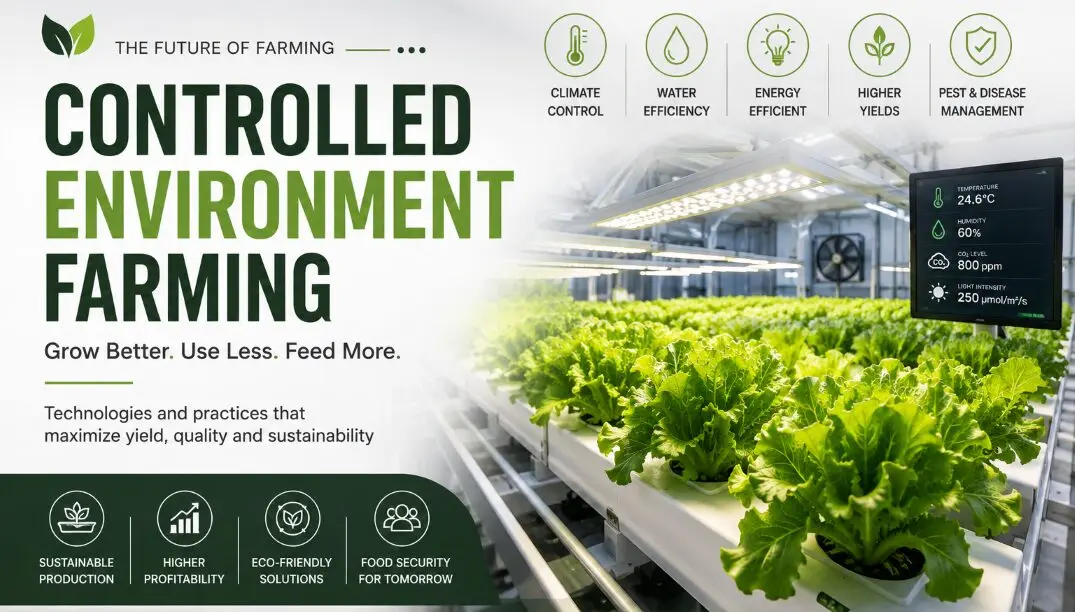
Controlled environment farming is a method of growing crops where farmers partially or fully manage conditions such as temperature, humidity, light, water, nutrients, airflow, and sometimes carbon dioxide. It includes technologies ranging from greenhouses and protected structures to hydroponic systems and fully enclosed vertical farms.
The main advantage is consistency. Instead of allowing weather alone to determine growing conditions, growers create an environment suited to the crop.
However, more control also means more equipment, monitoring, energy use, and technical responsibility.
Controlled environment agriculture has expanded substantially. USDA data show that U.S. CEA operations increased from 1,476 in 2009 to 2,994 in 2019, while production increased by 56 percent during the same period. Tomatoes, lettuce, and cucumbers represented much of that production.
What Is Controlled Environment Farming?
Controlled environment farming, commonly called controlled environment agriculture or CEA, is agriculture carried out inside a structure where one or more environmental factors affecting plant growth can be managed.
The amount of control varies considerably.
A basic high tunnel may only protect plants from rain, wind, frost, or excessive sunlight. A modern greenhouse can regulate ventilation, irrigation, heating, humidity, and supplemental lighting.
At the other extreme, an indoor vertical farm may control almost every important growing variable using sensors, LED lighting, nutrient dosing systems, air conditioning, dehumidification, and automation.
UC Davis describes CEA as a spectrum that can extend from relatively simple protected structures to automated, closed-loop indoor production.
This distinction matters because controlled environment farming does not automatically mean vertical farming, hydroponics, or complete indoor production.
Agricultural Insight
Think of CEA as a scale of control. The more tightly the environment is controlled, the less the crop depends on outdoor weather. At the same time, capital costs, energy requirements, maintenance needs, and technical complexity generally increase.
Read Also: Mushroom Farming for Beginners: From Hobby to Profit
How Does Controlled Environment Farming Work?
Plants still require the same basic resources they need outdoors. Controlled farming simply gives growers more ability to manage those resources.
Important variables include:
| Growing factor | Why growers control it | Problems if poorly managed |
|---|---|---|
| Temperature | Controls plant growth and development | Slow growth, heat stress, poor flowering |
| Humidity | Affects transpiration and disease conditions | Fungal disease or excessive water loss |
| Light | Powers photosynthesis | Weak growth or wasted electricity |
| Water | Maintains plant cells and transports nutrients | Wilting, root disease, nutrient problems |
| Nutrients | Supply essential minerals | Deficiency, toxicity, poor growth |
| Root-zone oxygen | Supports healthy roots | Root decline and disease |
| Airflow | Moves heat and moisture around leaves | Uneven climate and disease risk |
| CO2 | Required for photosynthesis | Growth may become limited in sealed systems |
| pH | Controls nutrient availability | Nutrient lockout or toxicity |
| EC | Indicates nutrient-solution concentration | Underfeeding or excessive salts |
Missouri Extension identifies support, light, temperature, humidity, carbon dioxide, water, and nutrients among the main environmental components managed in CEA.
The important point is that these variables interact.
Increasing temperature, for example, can change plant water demand. Increasing light may increase photosynthesis but can also increase cooling needs. High humidity can reduce water loss while simultaneously creating conditions favorable to some diseases.
That is why successful CEA depends on managing the whole growing environment, not simply installing grow lights and irrigation.
Read Also: Crop Yield Estimator: Calculate Farm Yield Online
Is Controlled Environment Farming the Same as Vertical Farming?
No.
Controlled environment agriculture describes environmental management. Vertical farming describes the physical arrangement of crops.
Vertical farming normally places crops on stacked levels, racks, towers, or shelves. Many vertical farms operate inside controlled environments because stacked plants require carefully managed lighting, temperature, airflow, irrigation, and humidity.
However, crops can also be grown vertically inside greenhouses.
Likewise, a greenhouse growing tomatoes in a single horizontal production area can be controlled environment farming without being a vertical farm.
Virginia Tech makes this distinction between the growing method and the facility in which it operates.
Main Types of Controlled Environment Farming
Different CEA systems provide different levels of environmental control.
Greenhouse Farming
Greenhouses use transparent materials to capture natural sunlight while protecting crops from outside conditions.
Depending on the design, growers can add:
- Heating
- Cooling
- Shade screens
- Ventilation
- Circulation fans
- Supplemental lighting
- Automated irrigation
- Humidity control
- CO2 management
- Fertigation systems
Greenhouses can be considerably less dependent on artificial lighting than fully enclosed vertical farms because sunlight supplies much of the crop’s light requirement.
They are widely used for tomatoes, cucumbers, peppers, lettuce, herbs, ornamentals, strawberries, seedlings, and many other high-value crops.
Hydroponic Farming Systems
Hydroponics involves growing plants using a water-based nutrient solution instead of relying on agricultural soil.
Plants may grow directly in nutrient solution or use supporting materials such as coconut coir, perlite, rockwool, or expanded clay.
USDA describes hydroponics as growing plants using water-based nutrient solutions rather than soil, sometimes with an aggregate growing medium.
Common hydroponic farming systems include:
- Nutrient Film Technique (NFT): A thin layer of nutrient solution flows through channels containing plant roots.
- Deep Water Culture (DWC): Roots remain suspended in an oxygenated nutrient solution.
- Drip systems: Nutrient solution is delivered directly to each plant or growing container.
- Ebb and flow: The root zone is periodically flooded before the nutrient solution drains away.
- Wicking systems: Water and nutrients move toward the root zone through capillary action.
Virginia Tech notes that NFT is particularly suited to many leafy greens and herbs while drip systems are commonly used for fruiting crops such as tomatoes, cucumbers, peppers, and strawberries.
Aeroponic Farming
Aeroponic farming suspends plant roots in air rather than keeping them continuously submerged in nutrient solution.
A nutrient-rich mist is sprayed around the roots at controlled intervals.
The exposed root zone can receive high amounts of oxygen, but reliable pumps, nozzles, timers, and water quality become especially important.
A blocked nozzle or failed pump can affect aeroponic plants more quickly than crops growing in a large soil or substrate volume.
Common Mistake
Do not choose aeroponics simply because it sounds more advanced. A technically simpler hydroponic system may be more appropriate for a first CEA project because plants generally have a larger moisture buffer if equipment fails.
Aquaponics
Aquaponics combines aquaculture with hydroponic plant production.
Fish or other aquatic organisms generate wastes that microorganisms convert into nutrients plants can use. Plants then help remove nutrients from the circulating water.
USDA defines aquaponics as the combination of aquaculture and hydroponics within one production system.
Aquaponics can recycle water and produce both plants and aquatic products, but growers must manage two biological systems instead of one.
Indoor Vertical Farming
Indoor vertical farming commonly uses stacked production layers inside warehouses, purpose-built facilities, containers, or other enclosed structures.
Artificial lighting and climate-control equipment allow production with little or no dependence on natural sunlight.
This creates excellent environmental control but can make electricity one of the operation’s most important inputs.
Controlled Farming Systems Compared
| System | Environmental control | Technical difficulty | Lighting requirement | Common crops |
| High tunnel | Low to moderate | Low | Mostly sunlight | Vegetables, berries |
| Greenhouse | Moderate to high | Moderate | Sunlight plus optional lights | Tomatoes, cucumber, peppers, herbs |
| Hydroponic greenhouse | High | Moderate to high | Natural plus supplemental | Lettuce, tomatoes, herbs, strawberries |
| Indoor hydroponics | Very high | High | Mostly artificial | Leafy greens, herbs |
| Aeroponics | Very high | High | Depends on facility | Leafy greens, herbs, propagation crops |
| Indoor vertical farm | Very high | Very high | Heavy artificial-light dependence | Lettuce, herbs, microgreens |
There is no universally best option.
A commercial tomato grower may benefit from a greenhouse with drip-fed substrate production. A small lettuce operation may find NFT more suitable. A beginner testing hydroponics at home may get better results from a simple deep-water or non-circulating system.
Which Crops Grow Best in Controlled Environments?
Technically, many plants can grow in controlled environments.
Economically, the list is much narrower.
CEA works particularly well for crops that have:
- High market value
- Relatively short production cycles
- Predictable plant size
- High value per square metre
- Strong demand for fresh produce
- Benefits from year-round production
- Manageable lighting and climate requirements
Leafy greens such as lettuce are especially common.
USDA reported that tomatoes, lettuce, and cucumbers accounted for roughly 60 to 70 percent of U.S. CEA production in both 2009 and 2019.
Other suitable crops include basil and culinary herbs, peppers, strawberries, microgreens, seedlings, and propagation material.
Large staple crops such as wheat, rice, and maize can technically be grown under controlled conditions. However, their relatively low value per unit of biomass and large light requirements usually make fully enclosed production difficult to justify economically.
Field Tip
Before selecting a crop, calculate how much saleable produce can be harvested from each square metre each year. Crop value, cycle length, plant density, energy use, and local selling price are often more important than maximum biological yield alone.
How to Start Controlled Environment Farming
Beginners should avoid designing the most technologically advanced farm first.
Start with the crop and work backward.
Step 1: Choose the Crop
Decide what you want to grow before purchasing equipment.
For a first hydroponic project, lettuce and many herbs are easier to manage than large fruiting crops.
Step 2: Define the Production Goal
Determine whether the system is intended for:
- Home production
- Research
- Nursery propagation
- Local market sales
- Restaurant supply
- Commercial wholesale production
A commercial facility requires very different reliability, food-safety, labor, and financial planning than a home hydroponic unit.
Step 3: Study Local Climate
A greenhouse in a cold climate may require substantial winter heating.
The same structure in a hot, humid climate may require strong ventilation, shading, evaporative cooling, or dehumidification.
A fully enclosed farm avoids many outdoor climate problems but replaces them with mechanical cooling and lighting requirements.
Climate Consideration
Do not copy environmental-control equipment directly from a farm in another climate. Heating, cooling, humidity removal, light availability, and water quality can change dramatically between tropical, dry, temperate, and cold regions.
Step 4: Choose the Growing System
Select a system according to crop type and management ability.
Leafy greens may suit NFT or DWC.
Tomatoes, cucumbers, peppers, and strawberries often need stronger plant support and may perform better in substrate-based drip systems.
Step 5: Test the Water
Water quality influences nutrient management.
Check at minimum:
- pH
- Electrical conductivity
- Alkalinity where possible
- Hardness
- Sodium where water quality is questionable
Hydroponic systems have less buffering than soil, so poor water chemistry can quickly affect nutrient availability.
Step 6: Install Environmental Monitoring
A basic system should monitor variables appropriate to the crop and facility.
These may include:
- Air temperature
- Relative humidity
- Water temperature
- pH
- Electrical conductivity
- Light
- Reservoir level
- Dissolved oxygen in applicable systems
Cornell’s CEA guidance describes temperature, nutrient-solution temperature, relative humidity, CO2, light, pH, dissolved oxygen, and electrical conductivity among the variables commonly monitored in hydroponic production.
Step 7: Start Small and Record Results
Grow one or two crop cycles before expanding.
Record:
- Germination dates
- Transplant dates
- Daily temperature
- pH and EC readings
- Water additions
- Nutrient adjustments
- Pest observations
- Plant losses
- Harvest dates
- Saleable yield
These records reveal whether the system is actually becoming more efficient.
A Practical Lettuce Example
Lettuce provides a useful example because it is widely used in beginner and commercial hydroponic systems.
University of Florida guidance lists approximately 1.2–1.8 mS/cm EC and pH 6.0–7.0 as suitable ranges for hydroponic lettuce, although exact targets depend on cultivar, water, nutrient program, and production stage.
The same UF guidance recommends monitoring nutrient-solution temperature and maintaining good oxygenation.
These numbers should not simply be copied for every crop.
For example, Oklahoma State University provides different EC and pH recommendations for basil, cucumber, pepper, tomato, strawberry, spinach, and other hydroponic crops.
Important
pH and EC are not interchangeable measurements. pH indicates acidity or alkalinity while EC estimates the concentration of dissolved salts. A nutrient solution can have acceptable EC but an unsuitable pH.
Daily CEA Monitoring Checklist
A simple daily routine can prevent small problems from becoming crop losses.
Morning
Check air temperature and humidity. Inspect irrigation flow, reservoir level, pumps, fans, lights, and visible plant condition.
Midday
Look for wilting, excessive leaf temperature, clogged emitters, uneven airflow, pest activity, or unusually high greenhouse temperatures.
End of Day
Check water use, pH, EC, environmental records, equipment alarms, and any changes in plant appearance.
For commercial systems, critical equipment should also have failure alarms and appropriate backup plans.
Common Controlled Environment Farming Problems
| Problem | Possible cause | First checks |
| Plants wilt despite available water | Root damage, heat, low oxygen | Root color, water temperature, pump operation |
| Leaf tips burn | Environmental or nutrient imbalance | Humidity, airflow, EC, crop-specific nutrition |
| Slow growth | Low light, temperature issue, nutrition | Light level, temperature, pH, EC |
| Algae develops | Nutrient solution exposed to light | Cover reservoirs and channels |
| Roots turn brown | Low oxygen, high temperature, disease | Dissolved oxygen, water temperature, sanitation |
| Plants vary greatly in size | Uneven irrigation or light | Flow rate, emitter function, light distribution |
| Humidity remains high | Weak ventilation or dehumidification | Air exchange, fans, crop density |
| EC rises rapidly | Water loss greater than nutrient uptake | Water use, temperature, reservoir management |
Common Mistake
Do not respond to every plant problem by adding more fertilizer. Poor root oxygen, excessive temperature, unsuitable pH, irrigation failure, disease, or excessive salts can produce symptoms that resemble nutrient deficiency.
Pest and Disease Management in Controlled Environments
An enclosed environment can reduce exposure to some pests, but it does not eliminate pest or disease risk.
Once a pest enters a protected system, stable temperature and abundant host plants may allow it to spread rapidly.
Likewise, recirculating water can potentially move some root pathogens between plants.
USDA-supported research notes that although CEA can help exclude pests and diseases, microbial and pathogen risks can still occur in indoor production.
Useful preventive practices include maintaining sanitation, inspecting incoming plants, removing diseased material, monitoring insects, cleaning tools, managing standing water, and following an integrated pest-management program.
Safety Note
Do not assume produce is automatically pathogen-free because it was grown indoors or hydroponically. Water quality, worker hygiene, equipment sanitation, handling, and food-safety procedures remain important.
Read Also: Free Crop Yield Calculator | Corn, Wheat & Rice Yield Predictor
Benefits of Controlled Environment Farming
CEA can offer several important advantages.
More Predictable Production
Temperature, water, light, and other conditions can be kept within a narrower range than open-field farming.
This reduces dependence on rainfall and some weather extremes.
Year-Round Growing
Heating, cooling, supplemental lighting, and indoor production can extend or remove normal seasonal restrictions.
Efficient Use of Space
Hydroponic systems can support dense production while vertical systems can use multiple growing layers.
Precise Water and Nutrient Management
Recirculating hydroponic farming systems can capture and reuse water and nutrient solution rather than allowing every irrigation event to drain away.
Protection From Extreme Weather
Protected crops are less exposed to heavy rain, hail, frost, wind, and some drought impacts.
Local Production
CEA facilities can be located near cities or other major markets where suitable agricultural land is limited.
Read Also: Hydroponic Farming: Setup, Costs, Benefits & Systems
Disadvantages of Controlled Environment Farming
CEA also creates risks that should not be ignored.
High Initial Investment
Structures, irrigation, sensors, pumps, lighting, environmental controls, and backup equipment can require substantial capital.
Energy Consumption
Heating, cooling, ventilation, pumping, dehumidification, and especially artificial lighting can consume significant energy.
Technical Complexity
Cornell notes that successful CEA can require knowledge spanning horticulture, chemistry, engineering, plant pathology, entomology, and computers.
Equipment Failure
A pump, fan, heater, cooling system, controller, or power supply can become directly responsible for crop survival.
Disease Can Spread Quickly
Dense planting and recirculating systems can allow some problems to spread rapidly if sanitation and monitoring are poor.
Not Every Crop Is Economically Suitable
CEA can produce many crops biologically but that does not guarantee profitable commercial production.
Which Type of Farming Is Most Eco-Friendly?
There is no single farming method that is always the most environmentally friendly.
The answer depends on the crop, climate, energy source, transport distance, water availability, land requirement, fertilizer use, structure, and production system.
Controlled environment farming can reduce land use, protect water resources, and improve some input efficiencies.
However, fully enclosed indoor farms can require substantial electricity for artificial lighting and climate control.
A 2025 life-cycle assessment of lettuce found that controlled-environment hydroponic production offered advantages in water efficiency and production per unit area and time but electricity-related greenhouse-gas emissions remained a major environmental challenge. The same study found that greenhouse production could perform favorably because it used fewer energy-intensive inputs.
Therefore, a solar-lit greenhouse in an appropriate climate may have a very different environmental footprint from a warehouse farm relying heavily on grid electricity.
Agricultural Insight
The environmentally responsible question is not simply “Is controlled environment farming sustainable?” A better question is “Which resources does this specific system save, and which additional resources does it consume?”
When Does Controlled Environment Farming Make Sense?
CEA is particularly useful when an uncontrolled production environment creates a serious limitation.
Examples include:
- Short outdoor growing seasons
- Extremely hot or cold climates
- Water scarcity
- High-value crops
- Urban markets with limited agricultural land
- Reliable year-round demand
- Nursery and propagation operations
- Crops requiring precise environmental conditions
- Research and breeding programs
It may be less attractive when land, sunlight, rainfall, and climate are already favorable for low-cost open-field production.
The correct system is therefore not always the most technologically advanced one.
It is the system that provides enough environmental control to improve crop reliability without adding unnecessary complexity and expense.
What Does Success Look Like in a CEA System?
Success should be measured using more than yield.
A healthy operation should achieve consistent crop quality while controlling resource use and production costs.
Useful indicators include:
- High percentage of saleable plants
- Uniform crop size
- Stable crop cycles
- Predictable harvest dates
- Low plant mortality
- Stable water use
- Controlled nutrient consumption
- Manageable electricity use
- Low pest and disease losses
- Reliable labor requirements
- Profitable production for commercial farms
Yield alone can be misleading.
A system producing exceptionally high yields but consuming excessive electricity, labor, water-treatment chemicals, or replacement equipment may still be economically weak.
Final Thoughts on Controlled Environment Farming
Controlled environment farming gives growers something conventional outdoor farming cannot always provide: greater control over the conditions surrounding a crop.
That control can support year-round production, efficient water and nutrient management, reliable quality, and farming in places where outside conditions are difficult.
However, CEA does not remove agricultural risk. It changes the type of risk.
Weather risk may decrease while energy costs, equipment reliability, disease management, nutrient control, and technical management become more important.
For beginners, the most sensible approach is usually to choose one suitable crop, use the simplest system capable of meeting its needs, measure results, and increase environmental control only when the additional control provides a clear benefit.
5. Frequently Asked Questions
What is the controlled environment in agriculture?
A controlled environment in agriculture is a growing space where farmers manage one or more conditions affecting crops, such as temperature, humidity, light, irrigation, nutrients, airflow, or carbon dioxide. Examples range from greenhouses with basic ventilation to automated indoor farms where nearly every important growing variable is regulated.
What is an example of a controlled environment?
A hydroponic greenhouse is a common example. Plants grow inside a protected structure while growers manage irrigation, nutrients, temperature, ventilation, humidity, and sometimes supplemental lighting. Indoor vertical farms and climate-controlled growing chambers are other examples of controlled agricultural environments.
What is controlled environment farming?
Controlled environment farming is the production of crops inside structures where growing conditions can be partially or fully managed. It includes greenhouse farming, hydroponics, some aquaponic and aeroponic systems, indoor farms, and vertical farms. The goal is to provide more consistent growing conditions than crops normally experience outdoors.
What is control farming?
“Control farming” is sometimes used informally to describe controlled farming or controlled environment agriculture. The more widely used term is controlled environment agriculture, or CEA. It refers to farming systems that intentionally manage environmental conditions instead of relying completely on outdoor weather and natural soil conditions.
Is hydroponics controlled environment farming?
Hydroponics can be part of controlled environment farming but the terms are not identical. Hydroponics describes how plant roots receive water and nutrients without conventional soil. CEA describes management of the growing environment. Hydroponics can therefore operate inside a greenhouse, indoor farm, or other protected facility.
What is the difference between hydroponics and aeroponic farming?
Hydroponics supplies plant roots with nutrient-rich water, either directly or through an inert substrate. Aeroponics suspends roots in air and applies nutrient solution as a mist. Aeroponics can provide excellent root oxygenation but normally requires reliable pumps and misting equipment because roots have less protection from irrigation failure.
Which type of farming is most eco-friendly?
No farming method is environmentally best in every situation. Controlled farming can reduce water and land requirements but fully enclosed systems may consume substantial electricity. Greenhouse, outdoor, organic, hydroponic, and other systems should be compared using local climate, energy source, crop requirements, water availability, transport, and total resource use.
What crops are best for controlled environment agriculture?
Lettuce, leafy greens, herbs, tomatoes, cucumbers, peppers, strawberries, microgreens, and propagation crops are common choices. The best crop depends on production cost and market value as well as biological suitability. Commercial growers should compare crop cycle length, energy requirements, plant density, selling price, and expected saleable yield.
Next Step
Keep Learning About Smarter Farming
Explore another practical BlogAgri guide to compare farming methods, improve your growing system, and make better decisions for your farm, garden, or production setup.
