Email: blogagri2@gmail.com
Modern Mushroom Farming Guide for Beginners
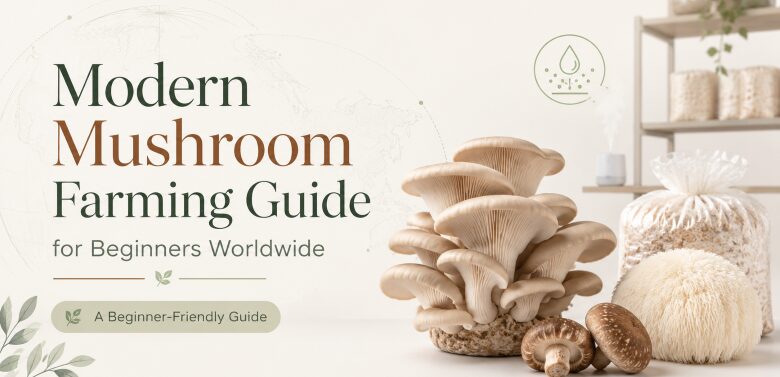
Modern mushroom farming is the process of growing edible mushrooms in a clean, controlled environment using quality spawn, prepared substrate, proper humidity, fresh air, and good hygiene.
You do not need a large farm to begin. Many beginners start in a small room, basement, garage, shed, greenhouse, or simple indoor growing space. With the right setup, mushrooms can be grown in many countries because they do not need open farmland like traditional crops.
This guide is written for beginners in any country. It covers the basic steps, equipment, growing methods, business planning, and mistakes to avoid before starting a mushroom farm.
What is modern mushroom farming?
Modern mushroom farming means growing mushrooms using improved techniques instead of relying only on natural outdoor conditions.
It usually includes:
- Indoor or protected growing spaces
- Clean substrate preparation
- Quality mushroom spawn
- Humidity and temperature control
- Fresh air exchange
- Proper lighting
- Hygiene and contamination control
- Planned harvesting and packaging
The goal is to grow healthy mushrooms consistently, whether you are producing for home use, local markets, restaurants, grocery shops, or a small farm business.
Why mushroom farming is becoming popular worldwide
Mushroom farming is growing in many countries because mushrooms are nutritious, space-saving, and useful in many types of cooking.
People use mushrooms in:
- Soups
- Stir-fries
- Pizza
- Pasta
- Rice dishes
- Vegan meals
- Meat substitutes
- Restaurant dishes
- Dried mushroom products
- Health-focused food products
Another reason mushroom farming is attractive is that it can be done in small spaces. Unlike many crops, mushrooms do not need direct sunlight or large fields. This makes mushroom farming suitable for cities, villages, cold regions, warm regions, and indoor agriculture projects.
Is mushroom farming good for beginners?
Yes, mushroom farming can be good for beginners if you start small.
The easiest way to begin is with ready-to-fruit mushroom blocks. These blocks are already prepared and colonized with mushroom mycelium. You only need to place them in the correct fruiting conditions.
This helps you learn:
- How mushrooms grow
- How humidity affects growth
- How fresh air affects shape
- When to harvest
- How to avoid drying or contamination
- How much yield you can expect
Beginners should avoid starting with a large commercial setup unless they already understand the growing process and have buyers ready.
Best mushroom varieties for beginners
Different mushrooms need different growing conditions. Some are easy, while others are better for experienced growers.
| Mushroom type | Difficulty | Best for beginners? | Notes |
|---|---|---|---|
| Oyster mushroom | Easy | Yes | Fast-growing, forgiving, good for many climates |
| Shiitake mushroom | Medium | Yes, after practice | Popular, good flavor, slower than oyster |
| Lion’s mane mushroom | Medium | Yes, with care | Premium mushroom, delicate handling needed |
| Button mushroom | Harder | Not ideal first choice | Needs compost-based system |
| Cremini mushroom | Harder | Not ideal first choice | Similar to button mushroom production |
| Portobello mushroom | Harder | Not ideal first choice | Needs more controlled production |
For most beginners, oyster mushroom farming is the best starting point. Oyster mushrooms grow quickly, can use simple substrates, and are easier to manage than many other varieties.
Choose your mushroom farming model
Before buying equipment, decide what type of mushroom farm you want to start.
| Farming model | Best for | Skill level | Cost level |
|---|---|---|---|
| Grow kit | Home learning | Very easy | Low |
| Ready-to-fruit blocks | Beginners testing market demand | Easy | Low to medium |
| Buying colonized blocks | Small business testing | Easy to medium | Medium |
| Making your own substrate blocks | Serious growers | Medium | Medium |
| Log-grown mushrooms | Outdoor growers | Medium | Low to medium |
| Full indoor farm | Commercial business | Advanced | High |
A smart beginner plan is to start with 10–20 ready-to-fruit blocks. Grow them, record the yield, test the quality, and see if people in your area want to buy them.
This reduces risk and helps you learn before investing more money.
How much space do you need?
You do not need a large farm to grow mushrooms. Mushrooms can grow vertically on shelves, which saves space.
You can start in:
- Spare room
- Basement
- Garage
- Store room
- Shed
- Small warehouse
- Greenhouse
- Shipping container
- Farm building
- Backyard structure
The space should be clean, protected from pests, and easy to control.
A good mushroom growing space needs:
- Clean floor and walls
- Fresh air exchange
- Humidity control
- Temperature control
- Drainage or easy cleaning system
- Shelving or racks
- Protection from direct sunlight and dust
Basic mushroom farm layout
A good layout makes mushroom farming easier and cleaner.
| Area | Purpose |
|---|---|
| Storage area | For bags, tools, packaging, and dry materials |
| Substrate preparation area | For mixing, soaking, pasteurizing, or sterilizing substrate |
| Inoculation area | For adding spawn to substrate |
| Incubation area | For mycelium growth before fruiting |
| Fruiting area | Where mushrooms grow and are harvested |
| Packing area | For cleaning, weighing, and packing mushrooms |
| Cold storage area | For keeping mushrooms fresh before sale |
| Waste area | For used blocks, rejected mushrooms, and cleaning waste |
Beginners using ready-to-fruit blocks do not need all these areas at first. But if you plan to scale, good layout becomes very important.
Essential equipment for modern mushroom farming
You do not need expensive equipment at the beginning. Start with basic tools and upgrade slowly.
| Equipment | Needed for beginners? | Purpose |
|---|---|---|
| Shelves or racks | Yes | Hold mushroom blocks |
| Thermometer | Yes | Monitor temperature |
| Hygrometer | Yes | Monitor humidity |
| Humidifier or fogger | Yes | Keep air moist |
| Small fan | Yes | Improve airflow |
| LED light | Yes | Support fruiting direction |
| Spray bottle | Yes, for small setups | Manual misting |
| Gloves and mask | Yes | Clean handling |
| Alcohol or sanitizer | Yes | Cleaning tools and surfaces |
| Grow bags or buckets | If making your own blocks | Hold substrate |
| Pressure cooker or sterilizer | Optional at first | Sterilize substrate |
| Cold storage/fridge | Needed for selling | Keep mushrooms fresh |
| Digital scale | Needed for selling | Weigh harvest and packs |
Do not buy everything at once. First, learn how mushrooms behave in your local environment.
Substrate basics
Mushrooms do not grow in normal soil. They grow on organic material called substrate.
Common substrates include:
- Wheat straw
- Rice straw
- Hardwood sawdust
- Wood pellets
- Corn cobs
- Sugarcane bagasse
- Cotton waste
- Soy hulls
- Logs
- Agricultural waste
The best substrate depends on your country and what materials are available locally.
For example:
- In rice-growing countries, rice straw may be affordable.
- In wheat-growing areas, wheat straw may be common.
- In forest regions, hardwood sawdust may be easier to find.
- In sugarcane areas, bagasse may be available.
The substrate should be clean, chemical-free, and properly treated before use.
Pasteurization vs sterilization
Before adding spawn, the substrate must be treated. This helps reduce mold, bacteria, and competing organisms.
| Method | Meaning | Common use |
|---|---|---|
| Pasteurization | Heating substrate enough to reduce harmful organisms | Straw-based oyster mushroom growing |
| Sterilization | Heating under high pressure to kill almost everything | Sawdust blocks and supplemented substrates |
A common beginner mistake is using untreated substrate. This often causes contamination and poor yield.
Clean substrate preparation is one of the most important parts of successful mushroom farming.
What is mushroom spawn?
Mushroom spawn is the living mycelium used to start mushroom growth. It works like the “seed” of mushroom farming, although mushrooms do not grow from seeds in the same way plants do.
Common spawn types include:
- Grain spawn
- Sawdust spawn
- Plug spawn
- Liquid culture
For beginners, buying spawn from a trusted supplier is better than trying to make your own.
Good spawn should:
- Look healthy and active
- Smell fresh, not sour or rotten
- Have no green, black, or orange contamination
- Come from a reliable source
- Be suitable for your mushroom variety
Poor spawn can ruin the whole batch.
Mushroom growth cycle explained simply
Mushrooms grow in stages. Understanding these stages helps you know what to expect.
| Stage | What happens | What you do |
|---|---|---|
| Inoculation | Spawn is mixed with substrate | Work cleanly |
| Incubation | Mycelium spreads through the substrate | Keep stable conditions |
| Colonization | Substrate becomes covered with mycelium | Watch for contamination |
| Pinning | Tiny mushrooms begin to form | Increase humidity and fresh air |
| Fruiting | Mushrooms grow larger | Monitor daily |
| Harvesting | Mushrooms are picked | Harvest at the right time |
| Second flush | More mushrooms may grow again | Keep block moist and clean |
Some mushrooms grow quickly, while others take longer. Oyster mushrooms are usually faster than shiitake and button mushrooms.
Climate control for mushroom farming
Mushrooms need the right environment. The main factors are humidity, temperature, fresh air, light, and cleanliness.
Humidity
Most mushrooms need high humidity during fruiting. If the air is too dry, mushrooms may crack, stop growing, or become small.
Temperature
Each mushroom variety has its own preferred temperature range. Choose a mushroom that suits your local climate if you want to reduce cooling or heating costs.
Fresh air
Mushrooms release carbon dioxide. If fresh air is too low, mushrooms may grow long stems and small caps.
Light
Mushrooms do not need strong sunlight. Many types only need soft indirect light or basic LED lighting.
Cleanliness
Cleanliness is critical. Dirty tools, dirty hands, poor substrate, and pests can all cause contamination.
Common beginner problems and solutions
| Problem | Possible cause | Solution |
|---|---|---|
| Green mold | Contamination | Improve cleaning and substrate treatment |
| Long stems | Not enough fresh air | Increase ventilation |
| Small caps | High CO₂ or weak conditions | Improve airflow and humidity |
| Dry mushrooms | Low humidity | Use humidifier or misting |
| Slimy mushrooms | Too much moisture and poor airflow | Reduce misting and improve ventilation |
| No mushrooms forming | Wrong conditions or block not ready | Check humidity, temperature, and maturity |
| Bad smell | Bacterial contamination | Remove infected material |
| Low yield | Poor spawn, substrate, or climate | Track and improve each batch |
Mushroom farming improves with observation. Check your growing area daily.
Harvesting mushrooms correctly
Harvest timing depends on the mushroom type.
For oyster mushrooms, harvest when the caps open but before they become too flat. For lion’s mane, harvest before it turns yellow. For shiitake, harvest when the caps are open but still firm.
Basic harvesting tips:
- Use clean hands or gloves
- Use a clean knife if needed
- Avoid crushing the mushrooms
- Remove damaged parts
- Cool mushrooms quickly after harvest
- Pack them gently
Fresh mushrooms are delicate. Good handling helps you sell better quality mushrooms.
How to sell mushrooms in any country
You can sell mushrooms through different channels depending on your location.
| Sales channel | Best for | Notes |
|---|---|---|
| Local markets | Beginners | Easy way to meet customers |
| Restaurants | Quality growers | Chefs may pay more for fresh mushrooms |
| Grocery stores | Regular producers | Need consistent supply |
| Farm shops | Rural areas | Good for local customers |
| Online orders | Urban areas | Good for direct selling |
| Home delivery | Small businesses | Useful in cities |
| Food processors | Larger farms | Need volume and consistency |
| Dried mushroom sales | Extra income | Longer shelf life |
Before selling, always check the food business rules in your country, province, state, or city.
Legal and food safety requirements
Rules are different in every country. This is why beginners should always check local requirements before selling mushrooms.
You may need:
- Business registration
- Food safety license
- Farm registration
- Market vendor permit
- Tax registration
- Product labeling approval
- Health department inspection
- Organic certification, if claiming organic
- Waste disposal approval
- Worker safety compliance
- Insurance
If you are only growing for home use, the rules may be simple. If you sell to the public, restaurants, stores, or online buyers, you may need official approval.
A safe rule is: before selling, ask your local agriculture department, food authority, municipality, or market manager.
Startup cost for mushroom farming
Startup cost depends on your country, space, equipment, labor, and mushroom type.
| Setup type | Cost level | Best for |
|---|---|---|
| Home grow kit | Low | Learning |
| Small room setup | Low to medium | Beginners |
| Side business setup | Medium | Local selling |
| Small commercial farm | Medium to high | Regular production |
| Large indoor farm | High | Serious business |
Common costs include:
- Growing space
- Shelving
- Humidifier
- Fans
- Lights
- Substrate
- Spawn
- Bags or containers
- Cleaning supplies
- Packaging
- Cold storage
- Transport
- Permits or licenses
Start small and reinvest profits. This is safer than building a large farm before understanding your local market.
Profitability basics
Mushroom farming can be profitable, but it is not automatic.
Profit depends on:
- Yield per block
- Cost of substrate
- Cost of spawn
- Labor time
- Electricity and water
- Packaging cost
- Selling price
- Spoilage rate
- Delivery cost
- Market demand
- Contamination rate
Track every batch. Write down how much you spent, how much you harvested, and how much you sold.
Without records, you are guessing. With records, you can improve.
How to scale a mushroom farm
Do not scale too quickly. First, prove that you can grow good mushrooms consistently.
Scale when:
- You have regular buyers
- Your contamination rate is low
- You know your production cost
- You can harvest on schedule
- You have enough cold storage
- You can deliver fresh mushrooms safely
- You understand your local regulations
Useful upgrades include:
- Better humidifier
- CO₂ monitor
- Temperature controller
- More shelves
- Dedicated incubation room
- Dedicated fruiting room
- Cold room or refrigerator
- Better packaging system
- Batch tracking software
Technology helps only after you understand the basics.
Sustainability in mushroom farming
Mushroom farming can be environmentally friendly when managed well.
Sustainable practices include:
- Using local agricultural waste
- Composting spent mushroom substrate
- Reducing water waste
- Selling locally
- Using reusable crates
- Avoiding unnecessary chemicals
- Reducing failed batches through better hygiene
- Reusing suitable equipment safely
Spent mushroom substrate can often be used as compost, soil conditioner, or animal bedding in some areas. Always check local rules before using or selling it.
30-day beginner action plan
Week 1: Learn and choose one mushroom
Choose one mushroom variety. Oyster mushroom is the best first option for most beginners.
Study your local climate, available substrate, and possible buyers.
Week 2: Buy a small test batch
Buy ready-to-fruit blocks or a small amount of spawn and substrate. Set up a simple growing area with shelves, humidity control, and fresh air.
Week 3: Grow and observe
Track humidity, temperature, growth speed, contamination, and mushroom shape. Take photos and notes.
Week 4: Harvest and test demand
Harvest your mushrooms. Share samples with family, neighbors, restaurants, or local customers. Ask for honest feedback.
Then decide whether to continue, improve, or scale.
Beginner checklist before starting
Before you start mushroom farming, make sure you know:
- Which mushroom you want to grow
- What substrate is available locally
- Where you will grow
- How you will control humidity
- How you will provide fresh air
- Where you will buy spawn
- How you will avoid contamination
- Whether you need a license to sell
- Who might buy your mushrooms
- How you will store mushrooms after harvest
This checklist can save you money and prevent common mistakes.
FAQs about modern mushroom farming
What is the easiest mushroom to grow?
Oyster mushroom is usually the easiest mushroom for beginners because it grows fast and can grow on simple substrates.
Can mushroom farming be done in any country?
Yes, edible mushrooms can be grown in many countries if you create the right growing conditions. The setup may change depending on local climate, available materials, and regulations.
Do mushrooms need sunlight?
No, mushrooms do not need direct sunlight. Most need only soft indirect light or simple LED lighting during fruiting.
How long does it take to grow mushrooms?
It depends on the mushroom type and method. Oyster mushrooms can grow quickly, while shiitake and button mushrooms usually take longer.
Is mushroom farming expensive?
It can be low-cost if you start small. A large commercial farm can be expensive because it needs climate control, equipment, labor, and storage.
Can I grow mushrooms at home?
Yes, you can grow mushrooms at home using grow kits or ready-to-fruit blocks. If you plan to sell them, check local laws first.
What is the best substrate for mushrooms?
The best substrate depends on the mushroom. Oyster mushrooms can grow on straw, sawdust, and many agricultural wastes. Shiitake usually grows well on hardwood logs or sawdust blocks.
Why do mushroom farms fail?
Common reasons include poor hygiene, contaminated substrate, weak spawn, wrong humidity, poor airflow, no market research, and scaling too fast.
Can I sell mushrooms online?
In some countries or regions, yes. But fresh food sales may require licenses, proper packaging, labeling, and delivery rules.
Are mushrooms profitable?
Mushrooms can be profitable if you control costs, produce consistent quality, reduce contamination, and sell to reliable buyers.
Do I need a license for mushroom farming?
For home use, usually not. For selling, many countries require some form of business registration, food safety approval, market permit, or labeling compliance.
Which mushroom is best for business?
Oyster, shiitake, lion’s mane, and button mushrooms are common business options. The best choice depends on local demand and your growing skills.
